Solar Charge Controller Amps Calculator
Size a PWM or MPPT solar charge controller from array watts, battery voltage, panel Voc and Isc, parallel strings, temperature, safety margin, and the battery charge-current limit.
Project Presets 8 solar scenarios
Array And Controller Inputs amps, volts, strings
Controller Sizing Result
Controller Spec Grid live
This is an electrical sizing estimate for controller selection. Final equipment must match the controller manual, conductor ampacity, overcurrent protection, battery limits, and local code.
Reference Tables controller selection checks
| Battery | 20 A | 40 A | 60 A |
|---|---|---|---|
| 12 V bank | 240 W useful | 480 W useful | 720 W useful |
| 24 V bank | 480 W useful | 960 W useful | 1440 W useful |
| 48 V bank | 960 W useful | 1920 W useful | 2880 W useful |
| Rule of thumb | Controller amps x battery volts is the approximate charging wattage before losses. | ||
| Type | Main amp check | Best use | Caution |
|---|---|---|---|
| PWM | Array Isc x safety | Small 12 V arrays | Extra panel voltage is mostly unused |
| MPPT | Watts / battery V | Higher voltage strings | PV input Voc must stay below limit |
| MPPT lithium | Watts / battery V | LFP banks | Confirm charge profile and BMS limit |
| Oversized PV | Controller output amps | Cloudy sites | Clipping occurs above controller rating |
| Panel temp | 0.25%/C | 0.30%/C | 0.35%/C |
|---|---|---|---|
| 10 deg C | 1.038x | 1.045x | 1.053x |
| 0 deg C | 1.063x | 1.075x | 1.088x |
| -10 deg C | 1.088x | 1.105x | 1.123x |
| -20 deg C | 1.113x | 1.135x | 1.158x |
| Project | Array | Battery | Likely rating |
|---|---|---|---|
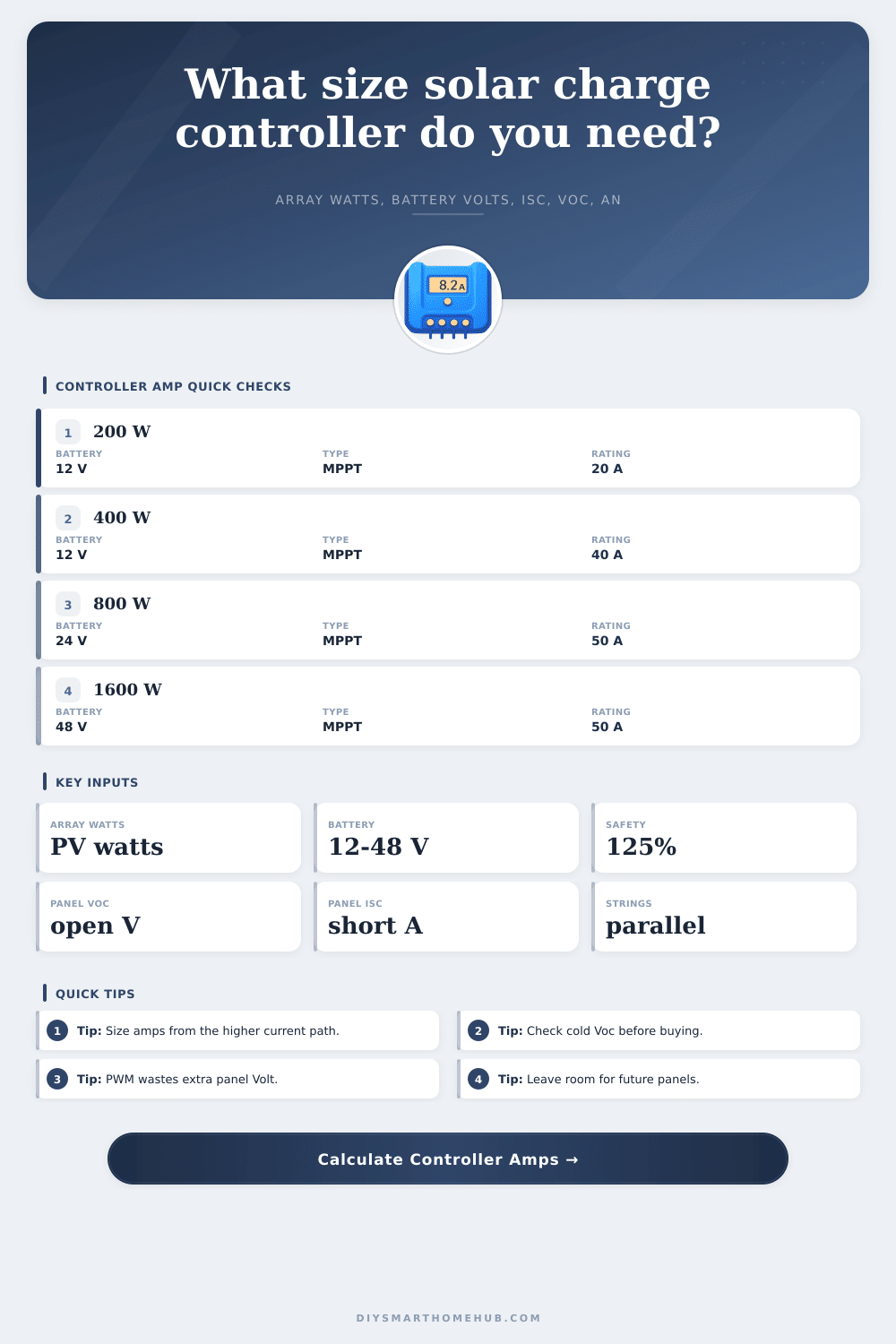
| Security and router | 200 W | 12 V | 20 A MPPT |
| Shed battery | 300 W | 12 V | 30 A PWM/MPPT |
| RV roof | 600 W | 12 V | 60 A MPPT |
| Cabin core loads | 1200 W | 24 V | 60 A MPPT |
| Garage battery | 1600 W | 48 V | 50 A MPPT |
Sizing Tips practical checks
The roof panels always come first. That’s where the magic happens. Measure it. Count the number of module that will fit. Feel the rush as the wattage numbers goes up toward your daily loads. And then you grab the charge controller, and all of a sudden it’s complicated. It’s no longer just the watts coming in that matter. Now it’s the amps. It’s not enough to know how many watts is hitting the glass; you need to know how many amps can flows into the battery before something melts. Will the cold winter air cause voltage to exceed the hardware limits? Which piece of gear are going to bridge this thing and do it safely? Most folks oversize things out of fear, or else they don’t understand the distinction between input/output and thus they undersize. This calculator take the guess work out of it by allowing you to enter the details of your battery bank and array, and it does the math for you. You won’t have to deal with dimming lights on a cloudy day or even melted equipment.
So the first thing one needs to understand: What does a controller do with electricity? Well, it steps down voltage coming off your solar panels (if you have an MPPT). It bumps up the amperage to squeeze every last drop of power out of those higher string voltages. So if your battery bank is running at say twelve volts then you can generate some surprisingly high charge currents even from a modest panel array. That’s why a little 12-volt system with big panels calls for a beefier controller than you might think. Because physics says that when you lower the voltage, the current has to go up. Most folks skip over that. They just see the watts of their panels and buy a controller based off that. They completely ignore the fact that voltage is going to get stepped down.
How to Choose the Right Solar Controller
And finally, there is one thing no one wants to think about until the weather turns nasty: the weather. Cold weather causes solar panel to output higher voltages. Yes, I know, solar power and warm are synonymous. But the science of semiconductors say open-circuit voltage increases with decreasing temperature. For example, a 25 degree string of panels that appears completely normal on paper may suddenly read well over your controller’s maximum input voltage during winter days where your local temps dip below zero. Your batteries won’t like that. At all. Going beyond will not only blow your breaker; it will immediately blow out the electronics within the device. To account for this, you must estimate how much voltage will increase due to cold weather using the temperature coefficient listed on your panel’s data sheet. Luckily, the calculator does this for you automatically if you give it your expected minimum ambient temp and ensure that your hardware makes it through the coldest month unscathed.
That all depends on whether your solar controller is a PWM (pulse-width modulation) type or an MPPT (maximum power point tracking) type. The former is easier and more affordable, but it’s also less efficient. Basically, it’s just an electronic switch connecting the batteries and panels. This requires matching the voltage between two. The panel must have about the same voltage as the batteries, which wastes any excess voltage that could otherwise be used to get more current out of the panel. By contrast, MPPT controllers “steal” that excess voltage and turn it into current, which is much better for higher-voltage setups or if there’s some mismatch in voltages. But MPPTs complicate things further, since they’re limited by their input voltage on the PV side AND their output current on the battery side.
And lastly, there is the battery. The battery also have limitations. In particular, lithium iron phosphate packs has very specific ratings on how many amps they can accepts continuously. Their internal battery management systems won’t allow more current than their rated continuous charge rate to be pumped into them. Doing so will either shut off the charger or damage batteries over time. You may have a controller rated for sixty amps but your battery doesn’t take more than thirty so you’re buying half an engine that is rarely running. This protects longevity and saves waste by matching the actual needs of the storage system with what your controller can deliver. The variables get lined up a little ahead of time but after that, it’s a solid system that runs as long as the sun shines… which is good because it took a little thought to get here.
First, find out what your panels are rated for. Then, check the maximum voltage they’ll see in winter (the “voltage spike”). Next, make sure the batteries aren’t over their limit. Once you know where to look, the math isn’t complicated and if you size the controller right, you won’t have to worry anymore about fuses blowing and instead could of sat back and enjoy free energy.