Frost Point Calculator
Estimate dew point, frost point, surface frost margin, and cold-bridge risk from air temperature, RH or dew point, surface temperature, pressure, wind exposure, material, and safety margin.
1Frost Risk Presets
2Air, Surface, And Exposure Inputs
Frost Point Results
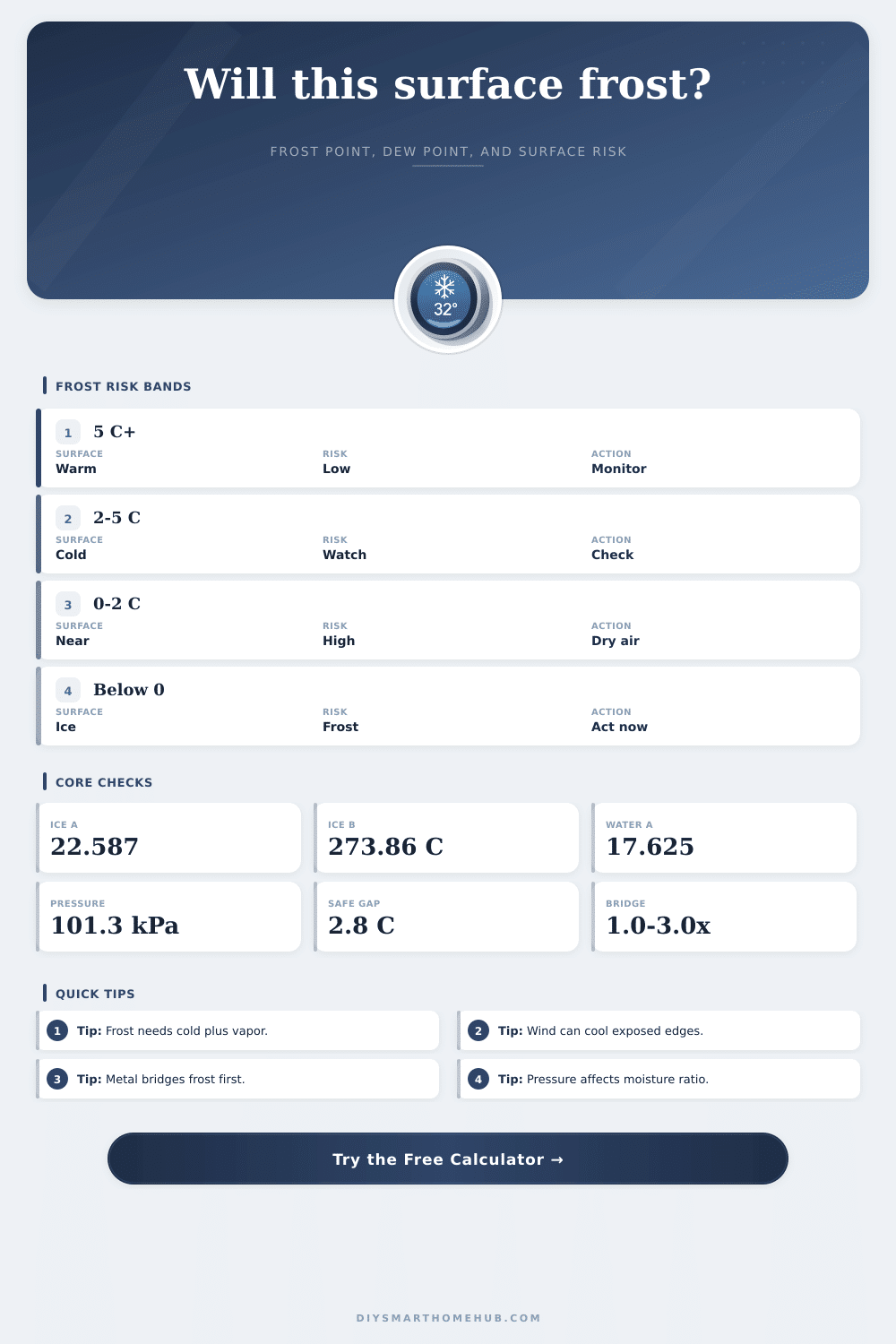
Dew point is solved over water, frost point over ice, then the adjusted surface is compared with the frost threshold and freezing line.
3Surface Material Grid
4Frost Reference Tables
| Adjusted margin | Freezing check | Risk band | Reading meaning |
|---|---|---|---|
| More than 9°F / 5°C | Above freezing | Low | Surface is clear of frost point plus margin |
| 4 to 9°F / 2 to 5°C | Near freezing | Watch | Small wind or humidity shifts can matter |
| 0 to 4°F / 0 to 2°C | At freezing | High | Surface is close to the frost threshold |
| Below 0°F / 0°C | Below freezing | Frost likely | Ice deposition or frozen condensate is likely |
| Material | Response | Frost hold | Penalty |
|---|---|---|---|
| Glass | Fast | Medium | 0.7°C |
| Bare metal | Very fast | High | 1.2°C |
| Plastic enclosure | Moderate | Medium | 0.4°C |
| Concrete or masonry | Slow | High | 0.8°C |
| Exposure | Cooling allowance | Use case | Risk effect |
|---|---|---|---|
| Still indoor air | 0.0°C | Interior wall or closet | Measured surface dominates |
| Light draft | 0.6°C | Door gap or window edge | Small margin reduction |
| Moderate exposure | 1.4°C | Garage, vent, or enclosure | Cold side can run lower |
| Outdoor exposed wind | 2.6°C | Camera, sensor, exterior trim | Frost threshold reached sooner |
| Scenario | Air condition | Surface | Likely watch point |
|---|---|---|---|
| Window edge | 68°F, 45% RH | 28°F glass | Spacer and lower sash |
| Camera housing | 35°F, 80% RH | 27°F metal | Windward face and screws |
| Garage sensor | 42°F, 70% RH | 30°F plastic | Mounting plate edge |
| Basement pipe | 58°F, 72% RH | 34°F metal | Pipe bend and hanger |
5Frost Point Tips
What’s frost? Frost is white ice that appears on objects like your windshield. It forms when water vapor turn directly into solid ice, skipping liquid state. Knowing what causes frost allow you to avoid condensation on windows, safeguard outdoor sensors, and also prevent frozen pipe in your basement.
What is the frost point and how does it differ from dew point? Here’s where the calculator helps with the math for us. The more we understands why these are inputs, the better we will interpret output.
How to Stop Frost From Forming
First, we have the air. There is air inside a space. Relative humidity and air temperature is two ways to describe this air. Then there is surface. This is something that the air touches. A cold pipe in a damp basement suck water out of the air until it become saturated. What happens if it is below freezing? It doesn’t land on the surface as water; it becomes frost. A warm wall will never be foggy, even in high-humidity environment, because its surface are above dew point.
People make several mistakes with this method. They see that their thermostat read sixty-eight degrees and think they are good to go in entire space. But they overlook that there is cold spots, called thermal bridges, where metal window spacers, exposed duct collars, and uninsulated pipe hangers often run much cooler different than their surroundings. To account for this, the tool lets you enter a thermal bridge factor, a number representing the strength of its ability to conduct heat away from surface. Bare aluminum holds frost better then insulated drywall. That’s why your camera housing may get covered with ice while adjacent brick wall stay nice and dry.
Another twist: wind makes things feel cooler. Moving air strips heat from surfaces more efficient than still air. Even if both rooms has the same air temperature, a sensor inside a drafty room will feel colder then one tucked into a closet. To account for this exposure to wind, the calculator subtracts an amount for cooling. It’s not much, but that little nudge can separate a false alarm from a true warning.
Atmospheric pressure also count (something that’s frequently overlooked in a house). Less atmosphere means fewer molecule of air. This affects the humidity ratio. So if you’re living high up where the air pressure changes, or working in an enclosed space under pressure, adjust this to keep your frost risk score relevant. It’s not all about relative humidity. Your information isn’t complete unless you factor in pressure.
What do those numbers mean? The page include some handy reference tables for translating the numbers into action. If you have at least a 5-degree buffer, you’re good; no danger of deposition even with a sudden rise in humidity. As the number gets closer to zero or lower, expect frost. At this point, passive monitoring lose its use. It’s time to do something: raise the surface temperature, insulate the cold bridge, or dry the air.
One mistake is guessing which spot is the coldest. The edge of a window pane, where metal draw heat, is always colder then its middle. The garage vent cover is warmer than the wall’s middle. Measure the thermal weak spots. That’s where frost will form first, and linger longest.
Controlling frost is controlling the difference between surface temperature and air temperature. While you may not be able to alter what’s happening out in the world, you can affect the microclimate around your equipment, windows, or pipes. Keep its surface warm so it does not fall below the frost point. Or maintain its dryness so that it never reaches a saturated level. To prevent frost, you should of do one of two things: stop it from forming by stopping the ice before it starts.
That said, it’s not typically the cold which cause the issue. It’s the cold combined with vapor that meets together. Without anything between.