Ceiling Fan CFM Per Watt Calculator
Compare fan airflow efficiency, room circulation rate, blade span fit, speed setting, motor type, and air-change target from measured CFM and watts.
⚙Quick Presets
📊Fan And Room Inputs
Efficiency Results
🌀Fan Spec Grid
📐Blade Span Reference
| Blade span | Typical room area | Common use | Airflow note |
|---|---|---|---|
| 29-36 in | 50-100 sq ft | Small office, nook | Use lower CFM targets |
| 42-44 in | 100-180 sq ft | Bedroom, den | Good for compact rooms |
| 48-52 in | 180-300 sq ft | Bedroom, living room | Most common all-rounder |
| 54-60 in | 300-450 sq ft | Open living space | Better sweep for wide rooms |
| 62-72 in | 450-700 sq ft | Great room, patio | Needs strong motor control |
⚡Motor Efficiency Bands
| Motor type | Typical CFM/W | Power behavior | Best fit |
|---|---|---|---|
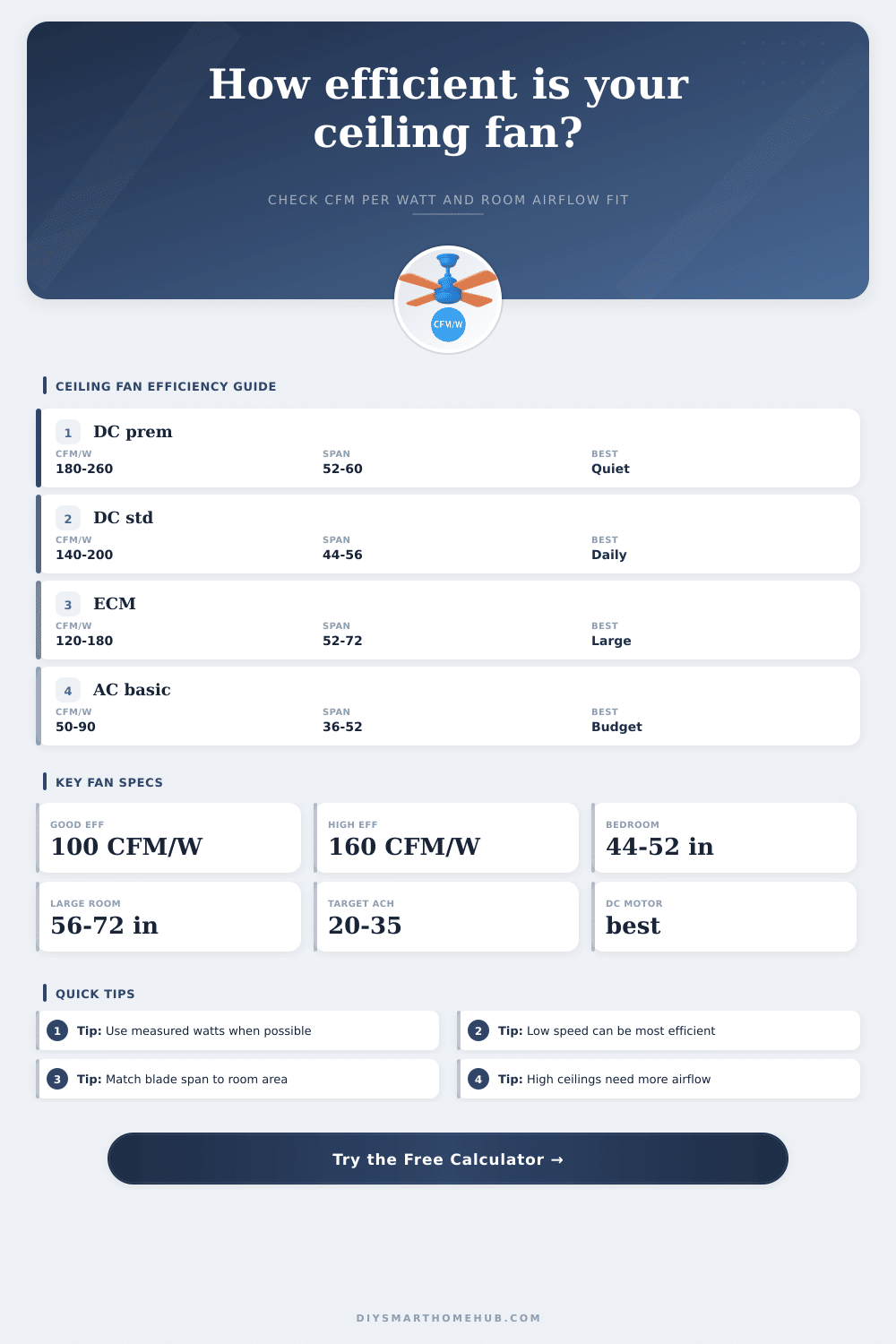
| DC premium | 180-260 | Very low watts at low speeds | Bedrooms and daily comfort |
| DC standard | 140-200 | Efficient across most speeds | General smart-home schedules |
| ECM large fan | 120-180 | Good torque for wide spans | Great rooms and high ceilings |
| Efficient AC | 90-140 | Moderate watts, durable motor | Retrofit or simple controls |
| Basic AC | 50-90 | Higher watts per CFM | Occasional-use rooms |
| Damp-rated outdoor | 70-130 | Efficiency varies by blade pitch | Porches, patios, sunrooms |
🏠Room Circulation Targets
| Room condition | Target passes/hr | Occupancy factor | Planning note |
|---|---|---|---|
| Sleeping or quiet room | 12-20 | 0.85 | Prioritize quiet low speed |
| Normal occupied room | 20-30 | 1.00 | Good default for comfort |
| Busy family room | 28-40 | 1.15 | Use more reserve airflow |
| Kitchen or sunroom | 35-55 | 1.30 | Heat load raises CFM need |
| High ceiling area | 30-50 | 1.15-1.30 | Volume rises quickly with height |
📋Common Fan Scenarios
| Scenario | Span | Airflow | Efficiency cue |
|---|---|---|---|
| Small bedroom DC | 44 in | 2800 CFM | High if below 20 W |
| Main bedroom | 52 in | 4200 CFM | Good around 100+ CFM/W |
| Open living room | 60 in | 7200 CFM | Strong at 140+ CFM/W |
| Patio fan | 56 in | 5200 CFM | Check damp-rated motor band |
| Great room | 72 in | 10500 CFM | Compare full-speed watts |
💡Efficiency Tips
You get a new high-efficiency ceiling fan and flip it on; and you’re still sweating. It says it’s low-wattage so that’s supposed to be good for your wallet, but it doesn’t seem to move much air. Why? Because efficiency is about converting electricity to movement; it does nothing about how much actual air gets moved by a fan. You could have one that uses very little power and yet moves hardly any air at all.
Wattage don’t tell the whole story; that’s what matters. It’s a tool for determining whether what you’re buying will work. You plug in the flow rate you measure and the power draw of the motor, and it tells you. A lot of folks believe a fan with a 52 inch blade span is suitable for every bedroom. Nope.
Why Airflow Matters More Than Wattage
You need enough airflow from the motor to mix cool air at the ceiling with the warm air coming off the floor. If not, you’re just stirring around warm air. This tool will let you know if your fan is doing anything but spinning. Efficiency is the cubic feet of air moved per watt consumed.
DC motors often exceed one hundred eighty CFM per watt. Their controllers dial in the precise amount of torque. Alternating current motors older than you may be able to muster fifty to ninety CFM per watt. That difference isn’t just about saving electricity; it’s also about thermal comfort. What good is a fan that burns up watts while heating your space?
What you’re after is low input, but high output… Air. Room size dictates the blade span you need, but it do not dictate the motor power. For instance, a forty-four-inch fan operates fine in a small den but has no business in a livig area of say, thirty-by-thirty. To make this clearer, the reference table connects common spans to square footage.
By selecting a fan with an incorrect span for the space, you’ll be running it full blast all the time. That’s wasteful of energy (and noisy), besides. Instead, start by choosing the correct span; next, select a motor capable of driving it without strain. One factor many installers neglect is the room’s ceiling height.
In general, a standard fan will suffice for ceilings up to nine feet tall. Past ten or even twelve feet, however, it takes more total airflow to offset that amount of vertical air travel. The calculation adjusts for ceiling height to ensure the fan is powerful enough to push air down into your space. This ensures the fan doesn’t circulate air right at the rafters where nobody sits.
The second number, target air changes per hour, indicates how frequently the room’s volume of air should be replaced. For most living spaces, 20-30 exchanges per hour are ideal. If bedrooms do not need to be soundproof, fewer air changes may be enough. Sunrooms and kitchens tend to require more due to solar gain or as cooking generates heat.
The occupancy factor in the tool accounts for people and body heat. Having more occupants mean that there will be more body heat, requiring the fan to work harder in order to keep everyone comfortablely. For direct current fans, low speeds are usually the most efficient. They pull a lot less power than high speeds and only push slightly less air (airflow in cubic feet per minute).
So if you’re looking to just have some air moving while you read/sleep, low is your best bet. If you come into a warm room, high is better for breaking up any stagnant air pockets. Then dial back down. It’s a small detail, but it makes the air from the fan feel better throughout the day.
Electricity doesn’t fall from the sky, but a ceiling fan’s purpose isn’t merely about saving electric money, it’s about managing your comfort. Watts are a side issue; the main task is blowing air around. But a ceiling fan’s purpose isn’t just about saving electric money (it’s about managing your comfort). Watts are a side issue; the main task is blowing air around.
Check two things: both power and airflow. Spend each penny buying some real cooling advantage. You want a breeze strong enough to make you feel cool. But not too much wasted. Do that math and you’ll have a quiet, comfy room all season long. That math adds up to something worth paying for.