HVAC Duct Velocity Calculator
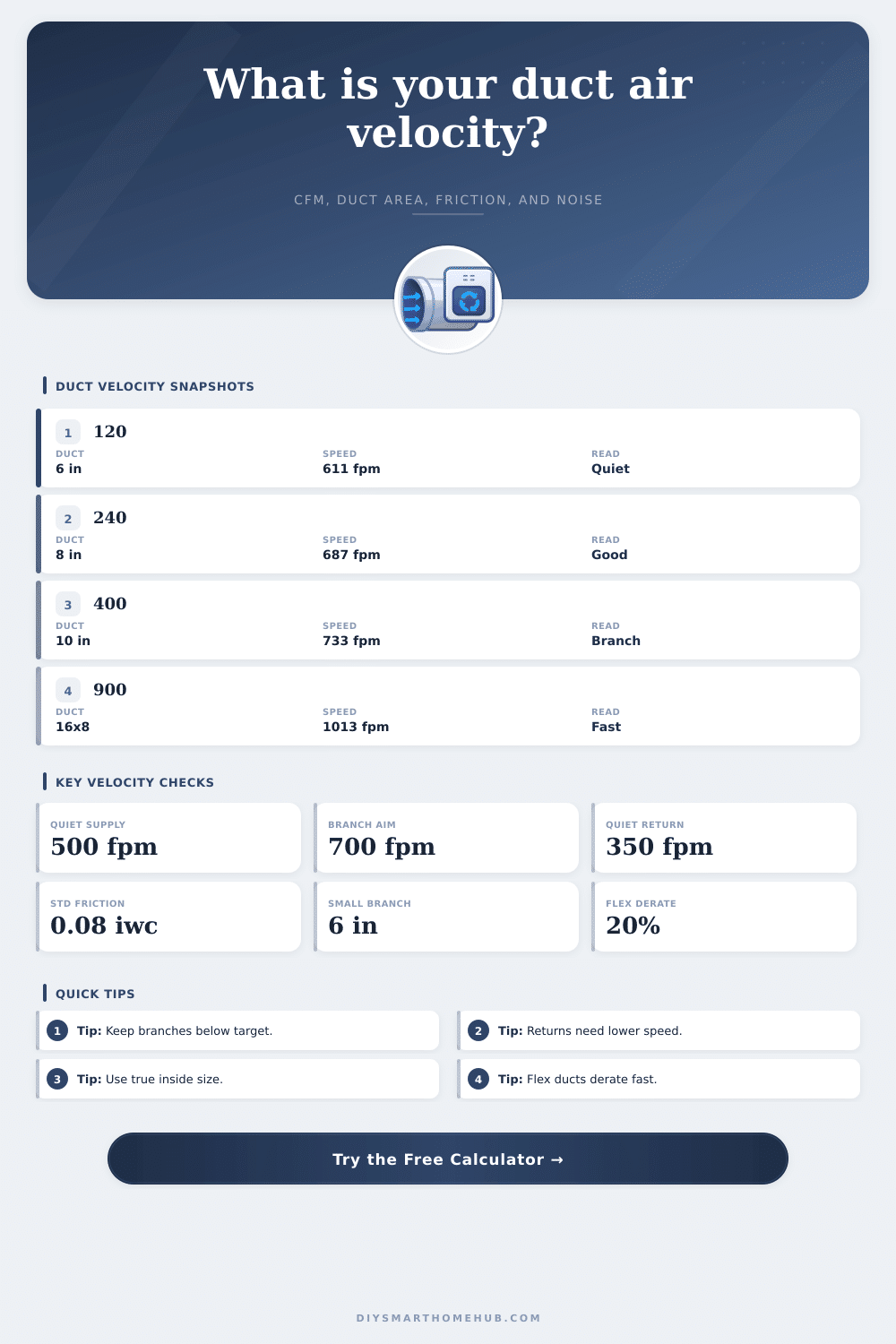
Check duct air speed from CFM and duct area, then compare it with supply or return mode, branch type, friction class, and noise target.
🏠Velocity presets
⚙Duct inputs
Duct velocity result
The selected duct area is being compared with the airflow and comfort target.
▦Duct size and spec grid
Soft delivery range for bedrooms, nurseries, and rooms close to registers.
Common working band for ordinary supply branches when the run is not excessive.
Lower return velocity helps reduce grille noise and pressure drop.
Typical residential design checks often compare runs near this per-100-ft band.
📊Reference tables
Round duct velocity at common CFM
| Round duct | Area | 150 CFM | 300 CFM | Typical reading |
|---|---|---|---|---|
| 5 in | 19.6 sq in | 1100 fpm | 2200 fpm | Usually small for HVAC supply branches. |
| 6 in | 28.3 sq in | 764 fpm | 1528 fpm | Useful for modest rooms, loud when pushed hard. |
| 8 in | 50.3 sq in | 430 fpm | 859 fpm | Comfortable branch size for many rooms. |
| 10 in | 78.5 sq in | 275 fpm | 550 fpm | Quiet at branch flow, useful for stronger zones. |
Rectangular duct area and equivalent round size
| Rect duct | Area | Eq. round | 300 CFM speed | Common use |
|---|---|---|---|---|
| 8 x 4 in | 32 sq in | 6.4 in | 1350 fpm | Low profile, not generous. |
| 10 x 4 in | 40 sq in | 7.1 in | 1080 fpm | Compact branch or toe-kick style path. |
| 12 x 6 in | 72 sq in | 9.6 in | 600 fpm | Strong branch with better noise margin. |
| 16 x 8 in | 128 sq in | 12.8 in | 338 fpm | Small trunk or low-noise return section. |
Velocity target by mode and noise target
| Mode | Quiet | Balanced | Performance | Use when |
|---|---|---|---|---|
| Supply branch | 500 fpm | 700 fpm | 900 fpm | Register noise is the main comfort limit. |
| Supply trunk | 650 fpm | 850 fpm | 1050 fpm | Air is still upstream of several branches. |
| Return branch | 350 fpm | 500 fpm | 650 fpm | Lower speeds reduce grille and filter noise. |
| Short straight run | 650 fpm | 850 fpm | 1050 fpm | Short paths can tolerate more velocity. |
Friction class and branch-type adjustments
| Setting | Calculator factor | Velocity effect | Pressure effect | Best fit |
|---|---|---|---|---|
| Low friction | 0.75 | No penalty | Lower loss proxy | Smooth metal and gentle fittings. |
| Standard | 1.00 | Base case | Normal loss proxy | Typical residential sheet metal. |
| High friction | 1.35 | Target trims 5% | Higher loss proxy | Internally lined or rougher ducts. |
| Flex branch | 1.45 | Target trims 20% | Highest branch drag | Flex duct with bends or sag. |
💡Practical sizing tips
You’ve probably heard the roar before it even starts: The technician closes the access panel and flips the switch, and suddenly your living room sounds like a jet engine taking off. It’s not only annoying… It’s also costly. Chances are, it’s because you have a duct that is too small running at too high a velocity (speed) to move air effectivly. Once that happens, not only does your ductwork become inefficient, but it also make you less comfortable.
Enter: Airflow velocity. By inputting your duct dimensions and airflow, the calculator crunches the numbers for you, so you don’t have to guess whether the design will be effective.
Why Air Speed Matters in Your HVAC System
When most homeowners envision their HVAC system they focus on temperature; what’s my thermostat set at? What does this do to my monthly bill? What they almost never think about is where the air goes, though. The truth is you has to move the air somewhere. If you try forcing too much of it through a small tube, it will move faster. The faster the air goes, the more friction it creates. The fan must struggle even more to overcome that friction. You can see it when you hear the registers blowing harder then normal… And see it on your energy bill as well. It’s a real tradeoff that far too many DIYers don’t realize until it’s too late.
It all starts with those inputs in the tool… And they are real world constraints. Cubic Feet per Minute (CFM) is the volume of air flowing through the system. Then there’s duct size (what kind of duct), how big does it have to be? Is it rectangular sheet metal or round metal? Either way, the cross sectional area defines how much space the air has to spread out in. If the cross section is small, then the air will have to accelerate; a larger one keeps the speed down. Those physical parameters gets converted by the calculator to a velocity number: feet per minute. That allows you to see right away whether your design is risky or not.
The rules change based off context: You want quiet air in the bedrooms (often <500 ft/min). In the attic, where there is a short run, you could probably push a little faster with no one noticing… The tool adjusts accordingly for target noise and branch type, making it suitable for your particular circumstances. And it accounts for friction class, meaning a smooth metal duct resists air flow less than a flexible insulated tube. Because flex ducts are easy to snake around joists, they’re popular; but they’re horrible for air flow if kinked. The calculator includes a penalty factor for high-friction situations to give you a more honest view of how it’ll go behind the sealed drywall.
Return air is treated differently than supply air. Supply fans blow fresh conditioned air into your rooms, while return grilles draw stale air back to the unit. To reduce noise, returns typically require lower speed and perhaps bigger ducts so you don’t get that loud vacuum cleaner effect in your hallway. The page’s tables of typical ranges by mode help you compare what your new design would be like against established standards. If it’s well above the balanced target, maybe you want to scale back the airflow a bit (or upsize the duct).
When you hit the fittings, you’ll find that elbows and transitions is going to cause turbulence, which causes noise. Even though your straight piece of duct might have an acceptable velocity, the sharp turn will still ruin it. When your duct flow is restricted by grilles or liners, you should then measure the net free area. In many cases, the open space on the back side of a decorative grille is much smaller than the duct that leads up to it. The new constraint is this bottleneck. The calculator assumes this by asking for the known duct area in some presets, so you can account for these factors directly. It makes you think through the chain’s weakest link.
Sizing matters. A branch that is too big can create too much static (pressure drop) and move air in and out of the room too slowly. This can make that area either too cold or too warm because the air does not exit the duct fast enough to lose its energy as it travels to other parts of the home. Too small a trunk can cause the same thing in the end room where the air has nowhere else to go but up and out of the duct, and it starves the distant rooms of air. The answer is somewhere in between. Finding that balance is about moving air efficiently while keeping comfortable air pressure and speed for the room, without the system blowing loud like a wind tunnel in your home.
Run the numbers: Look at the margin. A positive margin means you are operating slower than your target speed. This is good because it results in lower static pressure and quieter operation. Is there a negative margin? You’re forcing air too hard in that duct size. Time to bump up the diameter, maybe break the load into two smaller branches. Small tweaks now save big headaches later.
Why install all that expensive equipment only to have the delivery system choke on it? Think of your HVAC system as an artery, and the narrower passageways are places that put stress on the pumping system. The larger, unobstructed paths allow things to move freely with little resistance and keep a good speed, but don’t be too aggressive with the flex duct friction penalties. Aim to size the ductwork based upon the real load, not some hoped-for result.
Remember that invisible comfort is the goal. You will want to feel the temperature difference without hearing the machine that produces it, turning the roar into a quiet stream of air that makes your space more comfortable.