Fiber Optic Cable Pulling Tension Calculator
Estimate pulling tension, bend capstan effect, sidewall pressure, cable weight, conduit fill, pull length, and rated tension margin for indoor, outdoor, and home fiber pathways.
📌Fiber pull presets
⚙Cable and pull inputs
Fiber pull result
Calculated values appear after the first estimate.
Detailed pulling tension breakdown
🧮Cable and pull spec grid
Selected cable weight used in straight run and vertical lift formulas.
Maximum pulling load before applying the calculated safety margin.
Common pulling-radius planning ratio for fiber optic cable.
Selected conduit fill ceiling compared with cable area.
📊Fiber cable pulling reference
| Cable type | Typical OD | Typical weight | Pulling tension note |
|---|---|---|---|
| 2-fiber indoor drop | 3.0 mm / 0.118 in | 12 lb/1000 ft | Often 50-100 lbf; verify bend-insensitive drop cable data. |
| Duplex zipcord | 3.0 x 6.0 mm equivalent | 18 lb/1000 ft | Patch-style cable should use conservative pull limits. |
| Microduct fiber unit | 2.0 mm / 0.079 in | 5 lb/1000 ft | Low weight, but very low allowable pulling load. |
| 6-fiber indoor riser | 4.8 mm / 0.189 in | 25 lb/1000 ft | Good for short riser and media panel routes. |
| 12-fiber trunk | 6.5 mm / 0.256 in | 45 lb/1000 ft | Preterminated assemblies may have connector pulling-eye limits. |
| 24-fiber outdoor loose tube | 8.5 mm / 0.335 in | 75 lb/1000 ft | Usually higher rated tension when strength members are used correctly. |
| Armored indoor/outdoor | 10.5 mm / 0.413 in | 120 lb/1000 ft | High weight and stiffness raise bend pressure quickly. |
🔧Pull friction and bend table
| Path condition | Coefficient | Bend effect | Use in calculator |
|---|---|---|---|
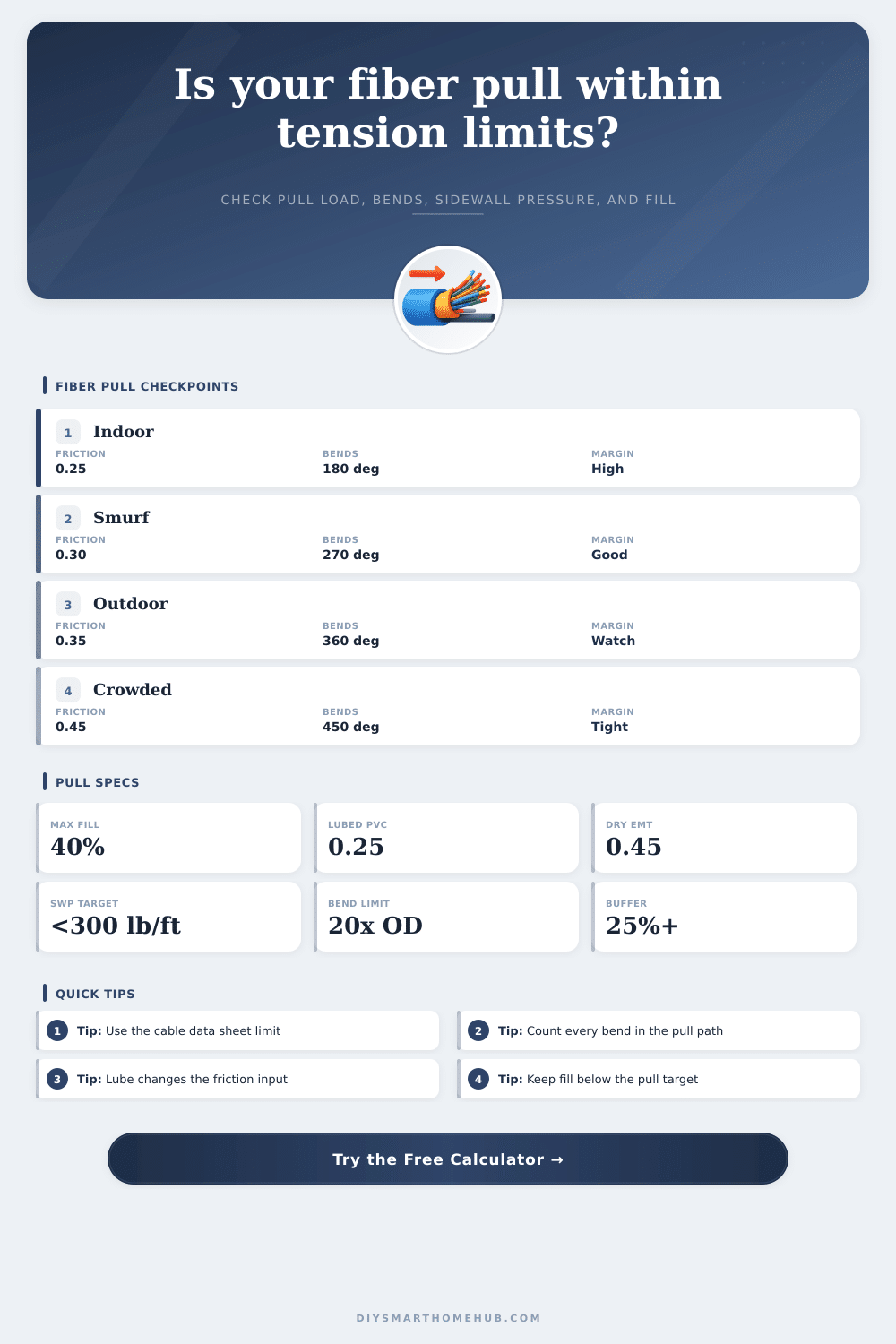
| Lubricated smooth PVC | 0.20-0.30 | Lower capstan multiplier | Use 0.25 for clean low-drag pulls. |
| Lubricated EMT | 0.25-0.35 | Moderate bend load | Use 0.30 when pull lube is applied evenly. |
| Dry EMT or flex | 0.40-0.55 | Bends dominate tension | Use 0.45 for conservative dry retrofit routes. |
| Crowded pathway | 0.50-0.70 | High friction and snags | Use a higher pull condition factor plus higher friction. |
📏Sidewall pressure and conduit fill table
| Check | Formula | Planning range | What it tells you |
|---|---|---|---|
| Sidewall pressure | tension / bend radius in ft | 100-300 lb/ft common target | High pressure at small-radius bends can stress the cable. |
| Bend arc length | radius x bend angle in radians | Adds to pull length | Large sweeps add length but reduce sidewall pressure. |
| Conduit fill | cable area / conduit area | 40% target often used | Higher fill usually means harder pulling and less room. |
| Tension margin | (max - estimated) / max | 25% or more preferred | Shows reserve against the rated pulling tension. |
🏠Common fiber pull size table
| Project pull | Typical length | Common bend count | Planning note |
|---|---|---|---|
| Media panel to office | 75-150 ft / 23-46 m | 2-4 bends | Usually tension-light unless conduit is crowded. |
| Attic fiber to access point | 100-220 ft / 30-67 m | 3-5 bends | Watch heat-rated cable and smooth bend sweeps. |
| Detached garage fiber | 150-350 ft / 46-107 m | 3-6 bends | Outdoor conduit friction and water-rated cable matter. |
| Vertical closet backbone | 80-250 ft / 24-76 m | 2-5 bends | Vertical lift adds cable weight directly to tension. |
| Retrofit camera conduit | 120-300 ft / 37-91 m | 4-7 bends | Fill and bend count often drive the result more than distance. |
✅Pull planning tips
Fiber optic cables snap. You don’t see them breaking, but you hear them break. There is a sharp crack and then you realize you just broke some pretty expensive network gear. Rarely is this because the cable was too short. Nope. You bent it around a tight corner or pulled on it to hard.
Installers think of fiber as just another type of ethernet wire. They’re wrong. Fiber doesn’t stretch. It’s made from glass (the core). And glass don’t stretch. It breaks.
Why Fiber Optic Cables Break
The math
The calculator above will do the math for you. It does the physics so you don’t have to think about it when holding a hefty cable in your hand. Knowing what those numbers mean change your planning for the job.
Coefficient of friction is the most important variable going into the equation. In general, pulling through clean, lubricated PVC conduit create minimal resistance. In the reference table, you may find a value in the 0.25 range. This tell you the additional force required to counteract surface drag. Now if that same conduit has been packed with other cables or is dry, then friction increases quick. The higher the friction coefficient, the more exponential the increase in pulling tension over distance. A manageable pull at the feeder become an impossible load halfway through the run.
Most pulls fail due to sidewall pressure in bends. Sidewall pressure occur when you take a cable around a bend. It touches side of that bend with great force. That’s known as the capstan effect. The more tension, the smaller the radius, the greater that force get. Eventually, if the sidewall pressure is too high, the inside fibers micro-bend. They don’t necessarily break right away. But they loses signal permanently.
The calculator asks for both bend angle and radius to see if your estimated tension will crush the cable against conduit wall. Small radii is dangerous, and wide sweeps are what you want.
There’s also the issue of gravity added with vertical lifts. Now you’re not just fighting friction. You’re also fighting actual weight of the cable when pulling fiber up a riser shaft. That doesn’t matter much on a lightweight drop cable where per-foot the cable itself weighs almost nothing, but an armored backbone cable are heavy. Fifty feet plus of vertical rise mean a direct weight addition to your top tension load. In a vertical run, you cannot ignore mass. This is what the tool does. It adds weight of the part being lifted to your base friction loads. This lets you know before you start the pull if your strength member and pulling eye can stands up to both drag and gravity.
Conduit fill is another limitation that can cause jobs to stop dead in their tracks. There’s no way for lubricant to do its job if your conduit is filled at eighty percent. And there’s no way for the cable to glide in with ease either. Snags are inevitable; friction is unpredictable. Maintaining fill levels below a safe target creates ample space for the cable to move freely and not bind against other wires or rough interior walls. It’s all about breathing room for the system.
You don’t want the fiber going from point A to point B… you want it to get there without any physical stress being applied to the glass. Do it without any increase in signal loss. Don’t force it if you have a low calculated margin. Add some lube. Cut out an extra bend. Route it another way.
But listen to that math before the cable breaks because it won’t lie as to where it will break, you should of checked for bends earlier. You’d of known sooner. Actualy, it would of been better.