Inverter Battery Bank Calculator
Estimate inverter backup runtime, AC load watts, surge margin, battery amp-hours, series and parallel layout, and maximum DC discharge current for home backup banks.
⚡Inverter backup presets
🔌Load and inverter inputs
🔋Battery bank inputs
Inverter bank breakdown
⚙Inverter and battery spec grid
📊DC bus voltage selection table
| DC bus | Typical inverter size | Current at 1,500 W AC | Best fit |
|---|---|---|---|
| 12 V | 300 W to 1,200 W | About 136 A at 92% efficiency | Router, lights, small fridge, short cable runs |
| 24 V | 800 W to 2,400 W | About 68 A at 92% efficiency | Office loads, freezers, RV-style inverter banks |
| 48 V | 1,500 W to 8,000 W | About 34 A at 92% efficiency | Critical panels, pumps, long runtime banks |
🔋Battery type reference table
| Battery type | Planning DoD | Efficiency behavior | Bank sizing note |
|---|---|---|---|
| AGM lead-acid standby | 45% to 55% | Higher voltage sag at heavy current | Use more Ah for long life and surge stability |
| Flooded deep-cycle lead-acid | 40% to 50% | Peukert losses rise on high discharge | Works best with conservative current per string |
| Gel lead-acid | 45% to 55% | Gentler discharge and charge profile | Avoid aggressive surge-heavy inverter loads |
| LiFePO4 deep-cycle | 75% to 90% | Flat voltage and strong cycle efficiency | Check BMS current against inverter surge demand |
| Lithium NMC pack | 70% to 85% | High power density, chemistry-specific limits | Use pack-rated continuous and peak current limits |
💡Backup load planning table
| Backup use | Typical AC watts | Duty cycle | Surge concern |
|---|---|---|---|
| Network and smart hub | 25 W to 120 W | 100% | Low, mostly electronics |
| Camera NVR system | 60 W to 250 W | 100% | Low unless displays are included |
| Refrigerator or freezer | 120 W to 450 W | 25% to 50% | Medium compressor startup |
| Sump or well pump | 700 W to 2,200 W | 5% to 25% | High motor startup surge |
| Critical circuit panel | 800 W to 4,000 W | 40% to 80% | Depends on motors and appliances |
🔧Battery layout comparison table
| Layout | Example | What changes | Design caution |
|---|---|---|---|
| Series only | 4 x 12 V 100 Ah = 48 V 100 Ah | Voltage rises, Ah stays the same | All batteries should match age and capacity |
| Parallel only | 2 x 12 V 100 Ah = 12 V 200 Ah | Ah rises, voltage stays the same | Balance cables and fuse each string |
| Series-parallel | 4S2P 12 V 100 Ah = 48 V 200 Ah | Voltage and Ah both rise | Keep parallel strings equal and monitored |
| Single module | 1 x 48 V 100 Ah = 48 V 100 Ah | Simple wiring, fixed BMS limit | BMS must support inverter peak current |
✅Inverter bank sizing tips
Devices like routers and lights requires constant power. They stop working during a grid failure. Backup inverters allow you to use an inverter battery bank as a backup power source for those device. They will take DC energy stored and convert it into useful AC electricity. Don’t worry about complicated engineering words, properly sizing the system is actualy just about making some honest calculations.
How much should it hold? How long do you want those essentials powered up at night? Is there anything else you’d like included with your backup plan? Should you protect your batteries from over-draining or cause breaker trips? Let the calculator on this page do all of that for you. It calculate how many amp-hours you’ll need, what size bank, whether you have enough margin for surges, and more. Use the calculator to help you avoid conversion errors between voltage and current.
How to Size Your Backup Power System
In general, you need to realisticly estimate your electrical load. Most people dramatically overestimate their steady draw, but under-estimate their surge. A router has minimal demand on electricity. On the other hand, your refrigerator’s compressor will produce 3x the watts it runs at when starting up. If you don’t account for this, your system will fail when the fridge turns back on after warming food and shutting off.
There should be distinct entries for always-on devices, intermittent usage (like TV watching), and anything with a motor. Motors aren’t efficient until they’re spinning. They takes a lot of power to get going and not much after. If you mash these figures into an average number, you risk two things: choosing an inverter that is too small and picking batteries that cannot deliver enough peak current quickly enough.
This is where battery chemistry come into the equation. Not all batteries are created equal. The limit of a lead-acid battery does not apply to a lithium battery. For example, you can’t run a flooded lead-acid cell below 50 percent and expect it to last long. Likewise, a lithium iron phosphate cell will take a deeper discharge with fewer ill effects. As the lithium gets lower, they retains their voltage much more reliably than a comparable lead-acid battery. In many cases, a smaller lithium bank will be able to match a bigger bank of lead-acid batteries. This becomes clear when you look at the depth of discharge goals laid out on the reference table within the tool. It details which types of batteries works well with different efficiencies.
Depending on what’s sensitive to your electronics, you want to keep voltage curve flat. And don’t forget to pay attention to current rating stamped onto your battery manufacturer spec sheet. Running higher than the rated peak or continuous current rating harms your batteries even if they still have some charge left.
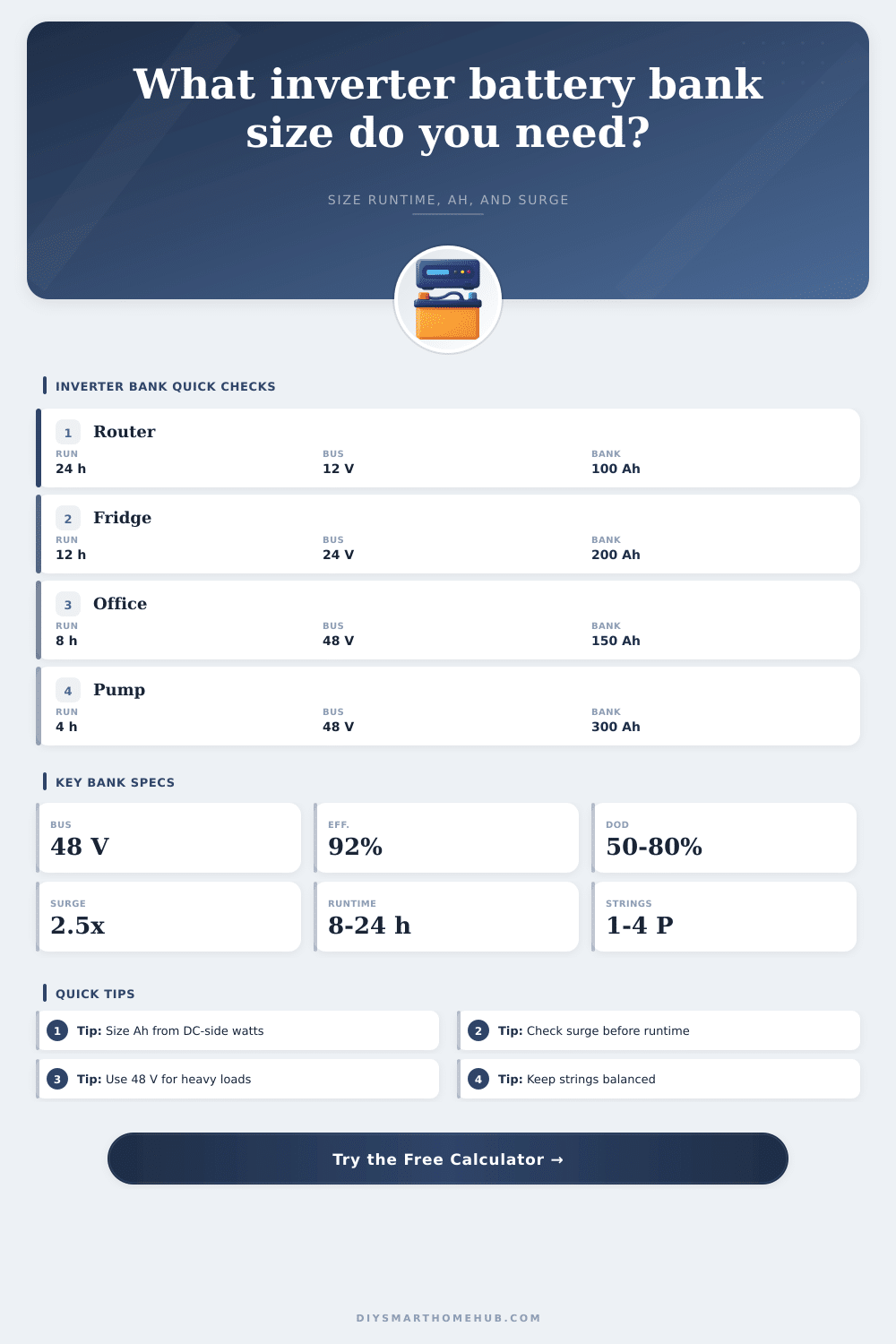
Another typical problem arises with voltage selection. For simple uses like charging a phone or powering lights, one small inverter on a 12v system works fine. Add heavy loads though and it’s game over fast. Current equals power divided by voltage. So if you draw one-thousand watts (1kW) off of a 12v system, that will push more than eighty amps through your wires. That generates heat and causes voltage drop. Switching to forty-eight volts dramatically lowers those current demand. Any usage beyond basic lighting needs the math to line up on higher voltages. You’ll waste less energy along the way due to your wiring. Your breakers/fuses can also be smaller. And your battery strings don’t need to work so hard to keep up with demand.
Batteries aren’t everything, either. Also important are cable length and thickness. Thin wire is basically a resistor. Longer runs steal more power on their way to your inverter. Plan your wire gauge accordingly based off the calculator’s voltage drop target. For residential systems, three percent is typical. That limits losses while still using less-than-industrial-grade copper.
Consider storage conditions of your batteries All chemistries degrade at lower temperatures; cold weather will hurt capacity. Below 60 degree Fahrenheit, lead acid batteries will see drastic amp-hour rating decreases. Lithium is more resilient but still needs care and feeding to avoid harm while recharging. The tool takes into account the coldest anticipated temperature for battery use and adjust available capacity accordingly so that you’re never expecting summer performance in the middle of a winter storm.
Design your system based off what you use, not the highest possible number. Give yourself some room for error. Add a little extra if it makes you feel better about the grid going down. Careful planning is the line between a painful outage and something that doesn’t even register. You should of planned ahead.