Ni MH Battery Charge Time Calculator
Estimate NiMH recharge time from cell capacity, series cells, charge current, C-rate, efficiency overhead, delta-V reserve, and safe trickle current.
Calculation breakdown
| Cell format | Typical capacity | Gentle current | Normal use |
|---|---|---|---|
| AAA NiMH | 600-1000 mAh | 60-100 mA | Remotes, sensors, small controls |
| AA NiMH | 1900-2500 mAh | 190-250 mA | Keypads, locks, handheld devices |
| Sub-C NiMH | 3000-5000 mAh | 300-500 mA | Tool packs and hobby packs |
| C NiMH | 3500-6000 mAh | 350-600 mA | Larger portable equipment |
| D NiMH | 8000-10000 mAh | 800-1000 mA | Emergency lighting and high runtime packs |
| C-rate | Current formula | Typical time before reserve | Charger expectation |
|---|---|---|---|
| 0.05 C | Capacity Ah x 0.05 | 24-30 hours | Maintenance or very gentle top-up |
| 0.10 C | Capacity Ah x 0.10 | 12-15 hours | Classic slow NiMH charger range |
| 0.30 C | Capacity Ah x 0.30 | 4-5 hours | Smart charger recommended |
| 0.50 C | Capacity Ah x 0.50 | 2.5-3.5 hours | Smart charger with temperature awareness |
| 1.00 C | Capacity Ah x 1.00 | 1.2-1.6 hours | Fast charger and suitable cells only |
| Series cells | Nominal pack voltage | Near-full charge voltage | Common pack example |
|---|---|---|---|
| 1S | 1.2 V | 1.45 V | Single AA or AAA cell |
| 2S | 2.4 V | 2.9 V | Compact remotes and small sensors |
| 3S | 3.6 V | 4.35 V | Cordless phone pack |
| 4S | 4.8 V | 5.8 V | Handheld device battery pack |
| 6S | 7.2 V | 8.7 V | RC and hobby receiver pack |
| 10S | 12.0 V | 14.5 V | 12 V nominal NiMH assembly |
| Scenario | Capacity and pack | Charge current | Estimated charge window |
|---|---|---|---|
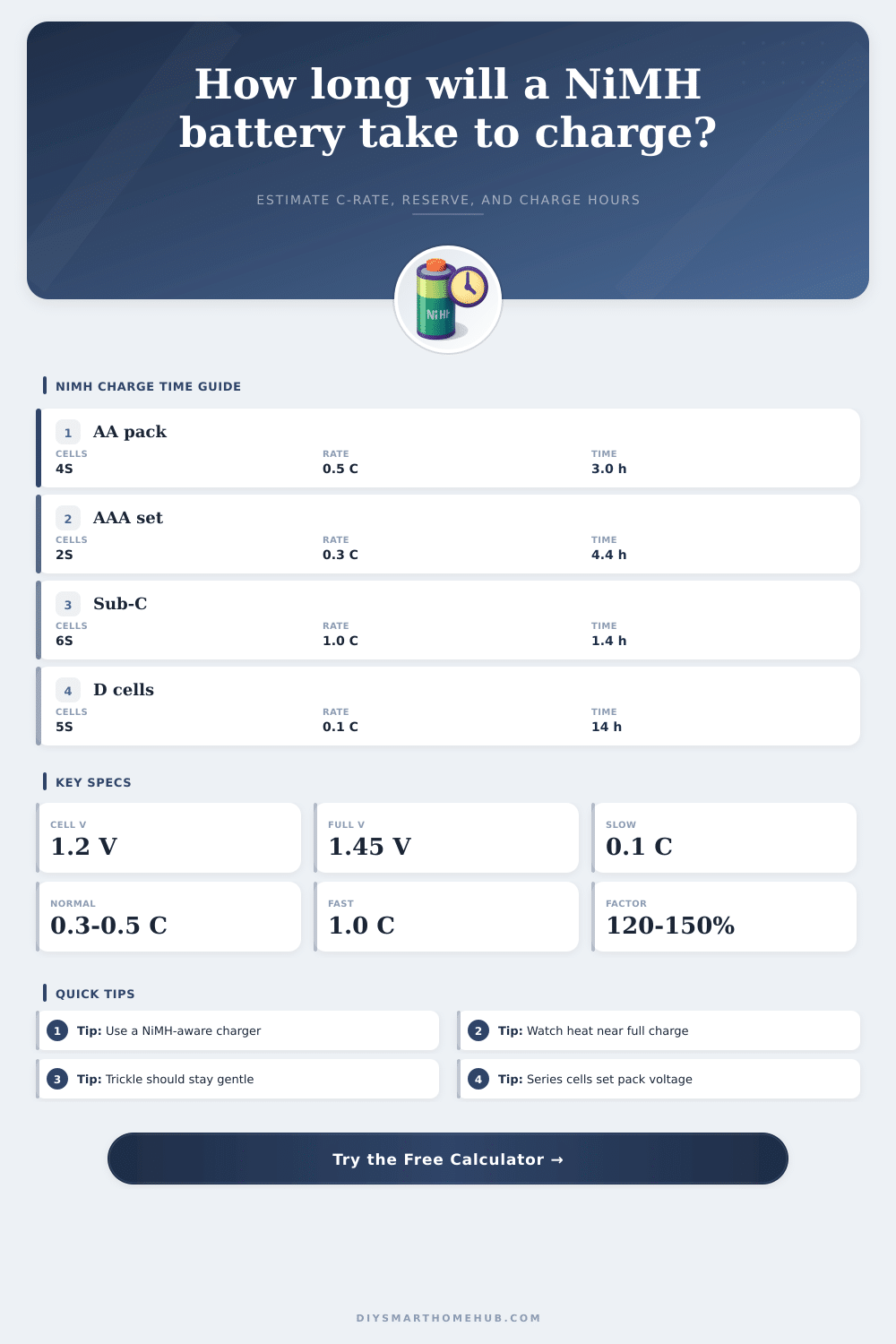
| 4 AA remote pack | 2000 mAh, 4S1P | 1000 mA, 0.50 C | About 3 hours from 20% to full |
| 2 AAA sensor set | 800 mAh, 2S1P | 250 mA, 0.31 C | About 4.3 hours from low to full |
| 6 Sub-C hobby pack | 4200 mAh, 6S1P | 4200 mA, 1.00 C | About 1.4 hours with fast termination |
| 5 D-cell light pack | 9000 mAh, 5S1P | 900 mA, 0.10 C | About 14 hours for a full slow charge |
At 0.3 C and higher, use a NiMH charger that watches negative delta-V and temperature rise; a plain timer is easier to misjudge.
If the pack remains on the charger, compare trickle current with cell capacity. C/40 is a conservative long-term planning limit.
You probably remember the glow of green LEDs on old cordless phones or satisfying click of a smart charger finishing its cycle. Those nickel-metal hydride (NiMH) batteries powering your hobby grade RC car also has proven themselves as reliable parts in emergency lighting too. Unlike lithium-ion cells, NiMH don’t require babysitting; and unlike disposable alkalines, they won’t die premuturely in cold temperatures. When it comes time to use ’em, they’ll be ready because NiMH batteries retains their charge. Knowing how to recharge them efficienty is therefore a valuable ability.
Enter your battery specs, target current and let the calculator above work the numbers for you. You won’t have to guess whether your pack is a dud or simply slow.
How to Recharge NiMH Batteries Safely
First thing to know about charging NiMH cells is that they’re not like filling up a bucket. They slows down as they get close to being full. That’s why there’s an efficiency factor. This is usually between 120% and 150%. That means, internally, your NiMH batteries has some resistance and lose some energy in the form of heat. So if you don’t account for that overhead, you’ll underestimate how long the charge takes. Which means you might remove it too soon (and thus not charged fully) or let it sit on charger too long (which damages battery slowly). It is a small variable, but it makes the difference between charging the battery correctly and damaging it.
The choice of C rate also make an important difference. Charging slow (point-one C) is cool, and very forgiving. You might leave it plugged in overnight with no worries; its gentle current will produce almost zero heat. Going fast (one C) is hot, needs a smart charger that monitors negative delta-V drops, these indicate that cells are fully charged. If not monitored, you’ll overcharge, which reduces capacity and may cause leaks. Note that the table on the page link current rates to expected times. As you double your speed, you half the waiting time… But increase the danger if your charging equipment isn’t protected.
A lot of hobbyists don’t think about pack configuration, but this does add another layer of complexity. Cells wired in series keeps the same capacity but add more voltage. So the charger will need to deal with more voltage but not more current per cell. Cells connected in parallel multiply capacity, but you must balance them carefuly or one weak cell will drag down the entire string. Without thinking too hard, the tool figures all that out for you. Just tell it how your batteries are configured (series or parallel) and it converts their raw mAh rating into real-world hours. Tell it what state of charge you’re at and what the desired level is, and then it tells you how long it will take to go from point A to B.
Many do not know but performance also vary with temperature. For NiMH the optimum charging temp is about 25C or room temperature. Hot batteries can run away in fast charges and cold batteries doesn’t take current well at all. Moddern chargers have both voltage sensing and thermal rise monitoring for a secondary shutoff event so they will cut off before harm comes. Charging in a cold garage will take longer. Consider warming the pack up gently before charging.
A fully charged battery on a trickle charge need very little current (often around C/40) to avoid gas buildup and loss of capacity. The worked examples shows this by providing some realistic charging times for typical setups, such as a four cell AA pack or a six cell Sub-C tool. The higher capacity, slow-charged D-Cell pack takes many hours to charge fully, while a small set of AAA batteries charges much faster. This illustrates the compromise between convenience and power density. Typically, you want to match the charger speed to your downtime. Fast charge it with a smart unit if you only have an hour before you need that battery back again. Let it trickle in gently if you could of afford to wait overnight for increased battery life.
NiMH batteries last much longer if you treat them well. They’re not magic energy sponges, they’re a chemical system that loves controlled and regular input. Once you understand how temperature, efficiency, and current play off each other, what was once blindly plugging something in becomes consciously managing your power resources. That green LED glow no longer represents a mystery light that you ignore until it dissapears again, instead, it signals healthy operation.