TV Size Calculator
Estimate a comfortable screen diagonal from seating distance, viewing angle, resolution, aspect ratio, and the usable wall width around your display.
🎛Room Presets
📏Viewing Inputs
Calculation Breakdown
⚙Device / Spec Comparison Grid
37.5 in wide
47.9 in wide
56.7 in wide
65.4 in wide
74.1 in wide
85.4 in wide
3840 pixels wide
7680 pixels wide
📊Viewing Angle Reference
| Use case | Target angle | Diagonal formula for 16:9 | What it feels like |
|---|---|---|---|
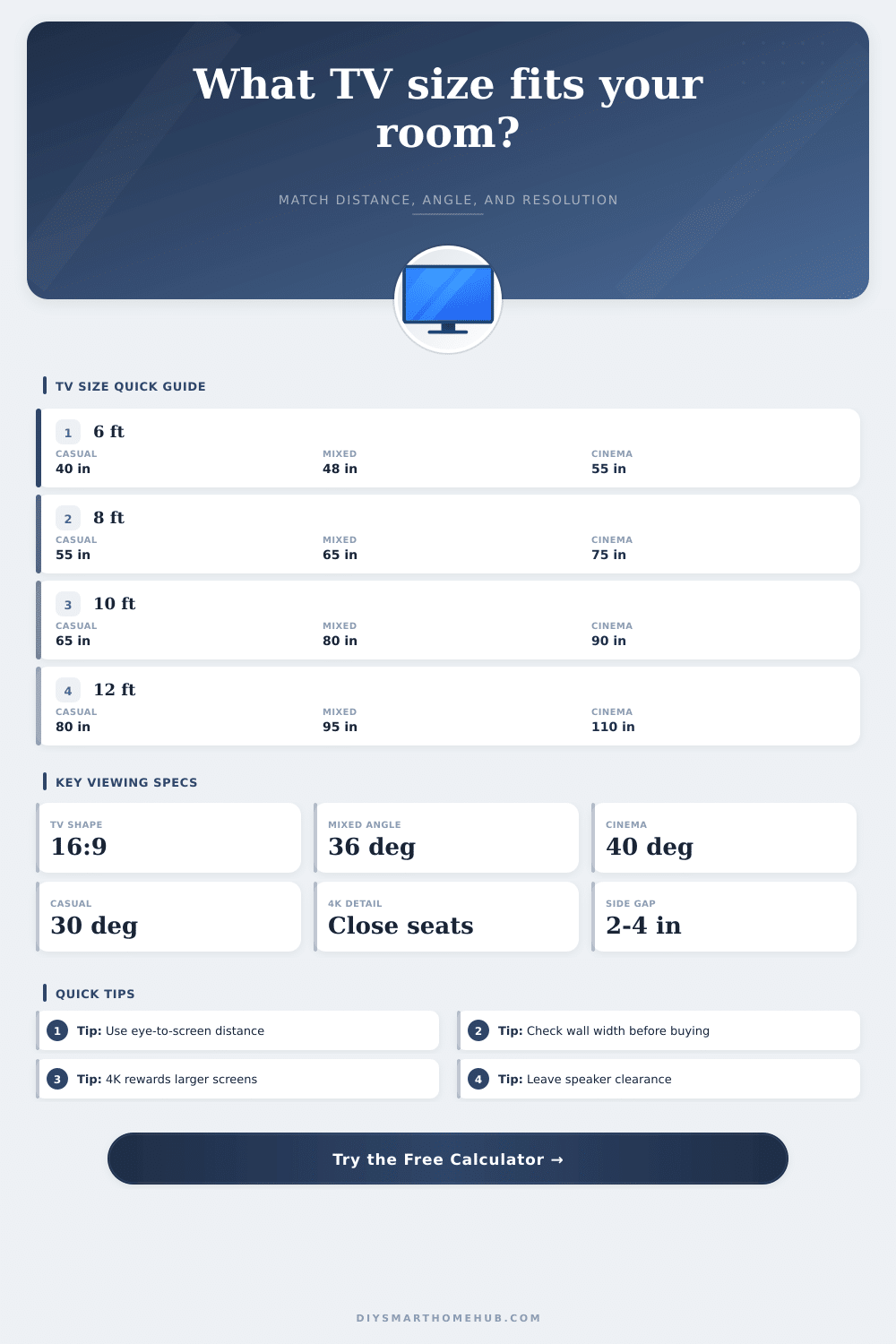
| Casual TV, news, background viewing | 30° | Distance in inches × 0.625 | Relaxed and forgiving for mixed seating |
| General streaming and smart TV use | 36° | Distance in inches × 0.746 | Balanced scale for movies, sports, and shows |
| Cinema-style movie watching | 40° | Distance in inches × 0.835 | Theater-like size without feeling extreme |
| Immersive gaming or front-row theater | 45° | Distance in inches × 0.950 | Large and absorbing, best with high resolution |
📺Common 16:9 TV Sizes
| Diagonal | Screen width | Screen height | 30° to 40° seating range |
|---|---|---|---|
| 43 in / 109 cm | 37.5 in / 95 cm | 21.1 in / 54 cm | 4.3 to 5.7 ft / 1.3 to 1.7 m |
| 55 in / 140 cm | 47.9 in / 122 cm | 27.0 in / 69 cm | 5.5 to 7.3 ft / 1.7 to 2.2 m |
| 65 in / 165 cm | 56.7 in / 144 cm | 31.9 in / 81 cm | 6.5 to 8.7 ft / 2.0 to 2.6 m |
| 75 in / 191 cm | 65.4 in / 166 cm | 36.8 in / 93 cm | 7.5 to 10.0 ft / 2.3 to 3.0 m |
| 85 in / 216 cm | 74.1 in / 188 cm | 41.7 in / 106 cm | 8.5 to 11.3 ft / 2.6 to 3.5 m |
| 98 in / 249 cm | 85.4 in / 217 cm | 48.0 in / 122 cm | 9.8 to 13.1 ft / 3.0 to 4.0 m |
🔍Resolution Detail Distance
| 16:9 diagonal | 1080p detail limit | 4K detail limit | 8K detail limit |
|---|---|---|---|
| 55 in | 7.2 ft / 2.2 m | 3.6 ft / 1.1 m | 1.8 ft / 0.5 m |
| 65 in | 8.5 ft / 2.6 m | 4.2 ft / 1.3 m | 2.1 ft / 0.6 m |
| 75 in | 9.8 ft / 3.0 m | 4.9 ft / 1.5 m | 2.4 ft / 0.7 m |
| 85 in | 11.1 ft / 3.4 m | 5.5 ft / 1.7 m | 2.8 ft / 0.8 m |
| 98 in | 12.8 ft / 3.9 m | 6.4 ft / 1.9 m | 3.2 ft / 1.0 m |
🏠Room Size Examples
| Room scenario | Typical seat distance | Balanced size | Cinema size |
|---|---|---|---|
| Desk gaming or small den | 5.5 ft / 1.7 m | 49 in | 55 in |
| Bedroom wall opposite bed | 8 ft / 2.4 m | 72 in | 80 in |
| Apartment sofa | 9 ft / 2.7 m | 81 in | 90 in |
| Main living room | 10 ft / 3.0 m | 90 in | 100 in |
| Open-plan room | 13 ft / 4.0 m | 116 in | 130 in |
💡Calculation Tips
Choosing the best television size involve looking at several specific factor. The two most important factor are the viewing distance and the viewing angle. People should not use the square footage of the room to determine the size of the television to be purchased.
The size of the television should not be too small for the viewing distance, nor should the television be too large for that same viewing distance. Using a television size calculator will allow people to determine the best television size for there distance and viewing angle. The distance between the viewer’s eyes and the screen are the primary measurement for televisions.
How to Choose the Right TV Size
This distance will dictate the limit of the viewing angle. For viewers who sit farther from the television, a smaller size television can be viewed comfortabley. Viewers who want to take up a larger portion of the viewer’s field of view will require a larger size for televisions.
These distance can be entered into the calculator along with the viewing angle preference to determine the diagonal size of televisions that would provide the best viewing experience. The resolution of the television can also play a role in the size of the television. 4K televisions has a higher pixel density than other resolutions.
This means that people can sit closer to their televisions without having their images made up of individual pixels. For those who choose a very large television, it is important to ensure that the resolution of the television is high enough. High resolution will prevent the image quality from looking soft.
The television size calculator will warn people if the resolution of the televisions that are available are too low for the television size that is chosen. If people are sitting a very large distance from their televisions, they may not require such a high resolution as an 8K television. In addition to the distance required to view the televisions, there are also physical constraint for the televisions within the living room.
The size of the televisions refer to the diagonal length of the screen. The televisions also have other physical dimensions, such as the width of the screen. Even if the diagonal measurement of the televisions is large, the width of the screen may be too large for the wall in the viewer’s living room.
The viewers have to take into consideration the width of the wall and any other object that may be in the way in the living room. Televisions size calculators will allow viewers to subtract the width of any object that will be near the television. If the size of the televisions is too large for the available space, the televisions may crowd those other objects in the living room.
The viewing angle that is selected for the televisions will play a role in the size of the televisions that are recommended to the viewer. A viewing angle of 30 degrees are a good viewing angle for living rooms with many viewer moving around the televisions. Viewers who want to stream content from various device will use a viewing angle of 36 degrees.
Viewers who want to immerse themselves in the content on the televisions will want to use a viewing angle of 40 degrees. This viewing angle can be adjusted in the televisions size calculator so that viewers can see the impact that a different viewing angle will have on the size of the televisions. People should also consider the eye level when choosing the distance between the viewers and the televisions.
The distance from the floor to the televisions is not the distance that should be used. The distance from the viewer’s eyes to the televisions is the distance that should be measured. The distance between the viewer’s eyes and the televisions will determine the viewing angle.
Viewers can use a tape measure to accurately measure the distance from their eyes to the televisions before inputting this distance into the television size calculator. The last factor to consider when purchasing televisions of any size is the lighting in the living room and the furniture that is in the way. If the living room also has a window, there may be glare onto the televisions screen.
In this case, the televisions may have to be positioned differently. The size of the televisions and the layout of the living room will impact how many televisions are needed and how big they should be. The size of televisions calculator will provide the viewers with an idea of the size of the televisions that they should purchase.
However, people should use this tool to make an intentional choice about the size of the televisions that they will purchase for their living rooms based off their viewing distance, viewing angle, and the available space on the walls.