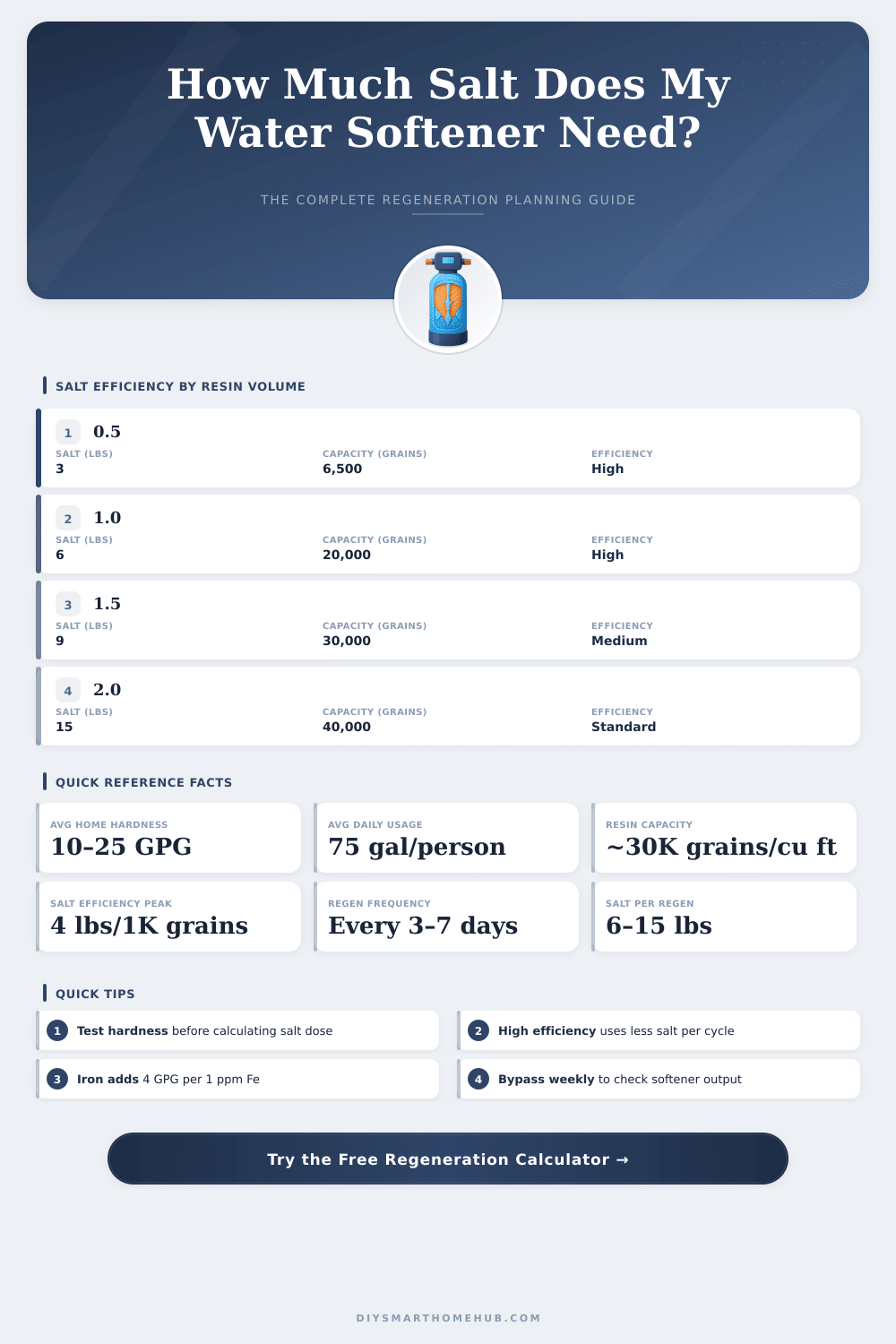
💧 Water Softener Regeneration Calculator
Calculate salt dose, regeneration frequency, and resin capacity based on your water hardness and household usage
| Resin Volume (cu ft) | Salt at 4 lbs/K (lbs) | Salt at 6 lbs/K (lbs) | Grains Capacity | Metric Equiv. (kg salt) |
|---|---|---|---|---|
| 0.5 | 3 | 4.5 | 8,000 | 1.4 – 2.0 kg |
| 0.75 | 4.5 | 6.75 | 12,000 | 2.0 – 3.1 kg |
| 1.0 | 6 | 9 | 20,000 | 2.7 – 4.1 kg |
| 1.5 | 9 | 13.5 | 30,000 | 4.1 – 6.1 kg |
| 2.0 | 12 | 18 | 40,000 | 5.4 – 8.2 kg |
| 2.5 | 15 | 22.5 | 50,000 | 6.8 – 10.2 kg |
| 3.0 | 18 | 27 | 60,000 | 8.2 – 12.2 kg |
| Hardness (GPG) | 2 People / 1.5 cu ft | 4 People / 1.5 cu ft | 4 People / 2.0 cu ft | 6 People / 2.0 cu ft |
|---|---|---|---|---|
| 5 GPG (soft) | Every 14 days | Every 7 days | Every 10 days | Every 7 days |
| 10 GPG (moderate) | Every 10 days | Every 5 days | Every 7 days | Every 5 days |
| 15 GPG (hard) | Every 7 days | Every 3–4 days | Every 5 days | Every 3 days |
| 20 GPG (very hard) | Every 5 days | Every 2–3 days | Every 4 days | Every 2–3 days |
| 30 GPG (extreme) | Every 3 days | Every 1–2 days | Every 2–3 days | Daily |
| Household | Hardness (GPG) | Salt Per Regen (lbs) | Est. Regens/Year | Annual Salt (lbs) |
|---|---|---|---|---|
| 2 people | 10 | 6 | 36 | 216 lbs |
| 4 people | 15 | 9 | 73 | 657 lbs |
| 4 people | 20 | 12 | 91 | 1,092 lbs |
| 4 people | 30 | 15 | 182 | 2,730 lbs |
| 6 people | 20 | 12 | 146 | 1,752 lbs |
| 6 people | 25 | 15 | 182 | 2,730 lbs |
Water softeners answer well for homes with hard water. They inhibit the mineral buildup in installations, machines and tubes. The regeneration process forms key part of those devices.
It ensures that the softener operate well, refreshing the resin beads that removes the minerals from the water. According to the time those beads kovrigas by means of minerals from the hard water and require purification. You calls that cleaning cycle regeneration or occasionally recharge.
How Water Softeners Regenerate
Like this it restores to the device the power to remove minerals. That results in whiter dishes, softer hair and less buildup in every water flow.
At everyday usage the resin saturates by means of calcium and magnesium. When it reaches its working limit it no more can soften water until you removes those minerals. Regeneration flushes out the captured minerals.
Later the device can again produce soft water. Because softeners remove only certain amount of calcium and magnesium at a time more hard water requires more common regenerations. The cyclical incidence depends of factors as water hardness and usage levels.
For instance unit of 16,000 grain requires regeneration less commonly than unit of 8,000 grain.
The regeneration process normally has five steps. They are fill, brining, brine rinse, backwash, and fast rinse. During the process the resin backwashes by means of salty liquid.
That brine one reverse flushes through the device for remove the calcium and magnesium ions that the resin absorbed. Some devices have a brine tank for store the salt. All softeners preserve water in the bottom part of the tank so that the salt do not twist in big hard block that you calls bridging.
Some units fill the brine tank during the whole time others only just before the regeneration.
New softeners operate commonly very smart. Many own 28-day override. That forces the system regenerate automatically, even if the resin bed did not fill.
Like this you keeps it well taken care. Some types regenerate according to usage, no only according to time. You can also manually launch regeneration by means of the buttons on the digital screen.
If the system is metered itself regenerates after reach certain limit. That answers most for large households. For optimum mode you control the salt level startigu the cycle backwash the system and measure the water hardness.