Water Softener Hardness Setting Calculator
Convert test-strip or lab numbers into a programmed hardness setting, then see the daily grain load and a practical regeneration interval for common softener sizes.
📋Scenario Presets
Preset ready: City Condo Stable Supply. Use it as a starting point, then match the hardness, metals, and water use to your own raw-water test.
⚙Specific Setting Inputs7 fields
Imperial mode accepts hardness in grains per gallon and water use in gallons per day. Metric mode converts hardness from mg/L as CaCO3 and water use from liters per day.
📊Programming Results
Sizing note: the calculator uses a practical usable-capacity reference for each nominal softener size so you can see whether the chosen setting leads to a healthy cycle length.
📘Model Reference Grid
📈Reference Tables
Hardness classification
| Band | GPG | MG/L | Read |
|---|---|---|---|
| Soft | 0-3.5 | 0-60 | Low scale |
| Moderate | 3.5-7 | 60-120 | Some spotting |
| Hard | 7-10.5 | 120-180 | Common softener case |
| Very hard | 10.5+ | 180+ | Heavy scale risk |
Compensation method guide
| Method | Iron | Mn | Best fit |
|---|---|---|---|
| 3x iron | 3 gpg | 0 gpg | Valve with iron field |
| 4x blend | 4 gpg | 4 gpg | General planning |
| Mn heavy | 4 gpg | 8 gpg | Manganese well |
| Round-up | Whole gpg | Whole gpg | Programming step |
Daily softened water guide
| Household | Gal/day | L/day | Pattern |
|---|---|---|---|
| 1-2 people | 60-120 | 227-454 | Compact home |
| 3-4 people | 150-240 | 568-908 | Typical family |
| 5-6 people | 260-360 | 984-1363 | Heavy laundry |
| Well spikes | +15% | +15% | Seasonal swing |
Softener size reference
| Nominal | Usable ref | @20 gpg | Typical fit |
|---|---|---|---|
| 24k | 20k grains | 1000 gal | Small home |
| 32k | 27k grains | 1350 gal | Most homes |
| 48k | 40k grains | 2000 gal | Larger family |
| 64k | 54k grains | 2700 gal | High demand well |
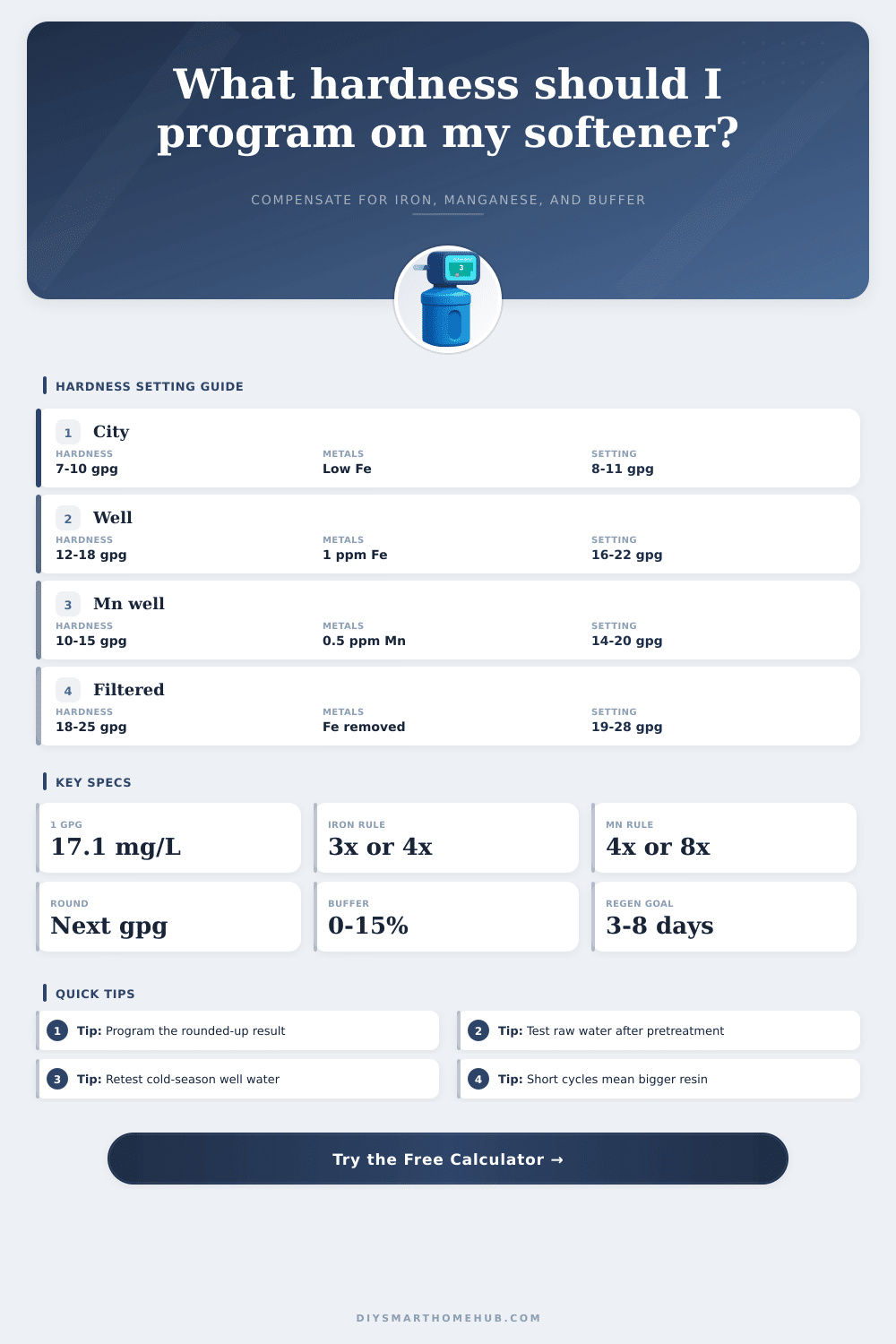
Programming methods vary by valve and water chemistry, so use the table rows to pick the compensation style that best matches your softener manual and pretreatment layout.
💡Calculator Tips
If an iron filter or oxidation step sits ahead of the softener, program from the post-filter sample. If the softener treats raw well water, use the raw-water test instead.
A perfect hardness setting on an undersized softener can still regenerate too often. If the estimate falls below three days, capacity or pretreatment usually deserves a second look.
The hardness of water depends on the amount of calcium, magnesium and lime in city or well water. Before choose the best water softener for your home, it matters to check the hardness of the water. You estimate it according to the total amount of settled solids (TDS) in a volume of water.
The hardness measure by means of grains in chevron (gpg) or milligrams in liter (mg/L). When a city report points it in mg/L (ppm), share by means of 17.1 for convert to gpg.
Check Water Hardness and Adjust Your Water Softener
Understanding the hardness are inherent for the good mode of water softener. Those devices remove the minerals that causes troubles, protect the plumbing system, extend the lifetime of devices and improve the water quality. The resin beads of the softener seize the minerals from the water.
Later it cleans itself by means of saltwater, so salt water, regularly. You call that procedure regeneration or refresh cycle. In the regeneration the device rinses the beads by means of salty water, dump the minerals and reset the surface of the beads for attract new minerals.
The hardness level decide only the chance of regeneration of the softener. Higher value forces it refriŝigi himself more often. It does not settle the problem in the base.
it Is possible never ignore the precise hardness level. The softener require the real hardness number, so that its regeneration rhythm and salt dose suit. Good softeners must produce water without hardness, no an fikritan value.
Set the softener to “softer” value does not help. The ideal hardness fix for water softener usually lay between 25 and 35 gpg, but it depends of the real water hardness. For instance, for 18 gpg you can add 2 gpg for compensatory changes, so set in 20.
If is iron, count the compensated hardness number and add it to the fix. Too high fixvaloro cheat the unit think that the resin deplete more quickly than genuinely, what forces more common regeneration and bigger salt consumption.
After setting of the new salt dose for the wanted level, do additional cycle and check the hardness repeatedly. Extremely hard water maybe requires additional salt for keep the conditioning pretty. For help, install sediment filter in front the softener.
While regeneration, you can use iron softener for permanently soft water. Hardness is the amount of calcium, magnesium and lime in water. Matter to receive tested water by means of good test kit or of the local water authority.