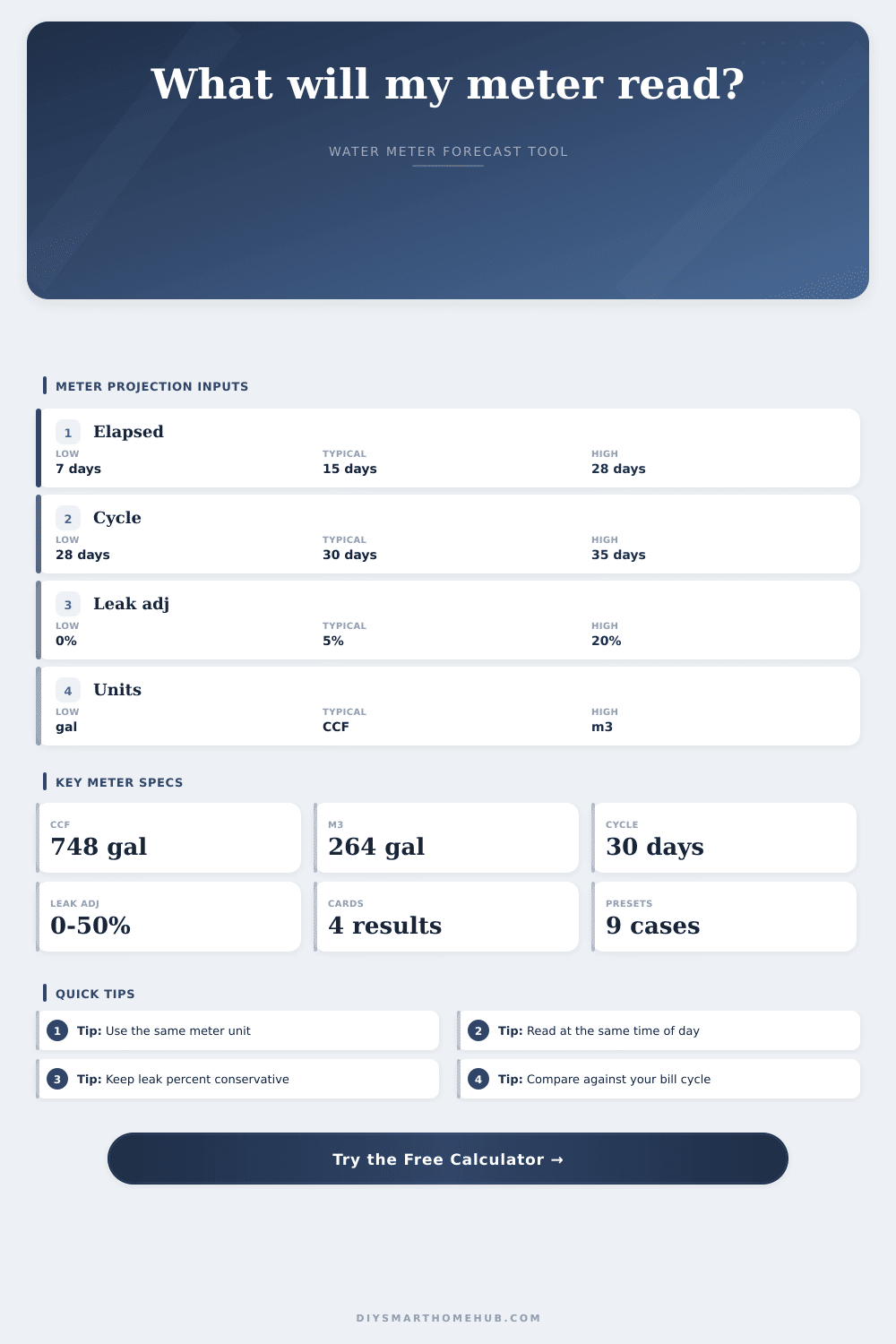
Water Meter Reading Projection Calculator
Project a water meter end reading from your previous reading, current reading, elapsed days, billing-cycle length, meter unit, leak adjustment, and expected daily change.
Projection breakdown
| Step | Formula | Purpose | Output |
|---|---|---|---|
| Measured use | Current minus previous | Find water already used | Elapsed-cycle volume |
| Adjusted use | Measured x (1 - leak %) | Remove abnormal leak share | Normal-use volume |
| Usage rate | Adjusted use / elapsed days | Estimate daily use | Units per day |
| End reading | Current + future days x daily rate | Forecast meter reading | End-cycle reading |
| Meter unit | Gallons | Liters | Common billing view |
|---|---|---|---|
| 1 gallon | 1 gal | 3.785 L | Direct gallon meters and portals |
| 1 CCF | 748.052 gal | 2,831.685 L | Hundred cubic feet billing |
| 1 cubic meter | 264.172 gal | 1,000 L | Metric meter register or app |
| 1,000 gallons | 1,000 gal | 3,785.412 L | Useful converted reporting unit |
| Scenario | Daily rate range | Cycle pattern | Projection note |
|---|---|---|---|
| Single apartment | 45 to 90 gal/day | Stable indoor use | Small changes are visible in short reads |
| Couple or condo | 90 to 170 gal/day | Moderate fixtures | Two-week reads usually project well |
| Family household | 180 to 360 gal/day | Laundry and baths | Weekend patterns can raise averages |
| Irrigation season | 400+ gal/day | Outdoor demand | Use daily change when watering begins |
| Adjustment | When it fits | Projection effect | Best paired input |
|---|---|---|---|
| 0% | Normal usage period | Keeps all measured use | Target daily rate |
| 5% to 10% | Minor running fixture or guests | Slightly lowers future-use rate | Expected daily change |
| 15% to 25% | Known short leak event | Removes a clear abnormal share | Elapsed days |
| 30%+ | Major event already stopped | Strongly reduces projection rate | Current meter reading |
Gallons
Use this when the register, utility portal, or smart water monitor reports direct gallon readings.
CCF
Use this when bills show hundred cubic feet. The calculator converts each CCF to 748.051948 gallons internally.
Cubic meters
Use this for metric meters. Each cubic meter is converted to 264.172052 gallons and 1,000 liters.
Adjusted forecast
Use leak adjustment and expected daily change together when the past days are not representative of remaining days.
A water meter is like A SPEEDOMETER, except that you check it before the bill comes in. A bill is a receipt, not a forecast. The waters long gone by then; the money’s already spent.
When you track your meter during the course of a billing cycle, situation shifts: A behavior change or a leak becomes something you can catch, while there’s still time to do anything about it. That said, calculating what the next reading will be is simply an exercise in algebra (albeit a tedious one that you’ll have to perform in your head with a flashlight). Fortunately, the web page run the calculation for you. Just give it the past reading, the present reading and the number of days since. It will tell you how fast you’re using up your water (your daily usage rate).
How to Read Your Water Meter
That single number is the key to knowing whether everything are running normally around your house, or whether someone has let something get out of hand. The average household has some level of everyday usage, which doesn’t change much. Maybe one person use fifty gallons per day, maybe a family uses two hundred. Odds are good, if your “adjusted” daily rate is around that amount, then you’re fine. But if it spikes up to four hundred, you’ve got a problem.
Plumbing problems like leaks gets covered in the leak adjustment input. Did you fill a pool? Did you leave a toilet running for two days? Subtract that out. You don’t want the calculator to assume that you lead a normal life where there’s always water everywhere. Predict what you think your future will look like … and keep in mind that it should of being based on typical behavior. Not mistakes.
But the billing cycle is never exactly thirty days. Some utilities is every twenty eight days. Others may be 35 days due to holidays. So if you always predict for thirty days but then get a bill for thirty two days, your prediction will be off. And this tiny amount matters if you’re attempting to remain below some threshold in a tiered rate structure.
On the page is a reference table that shows the impact on the ultimate number based off different cycle length. Match your projection period with the actual number of days since your last bill. Not sure? Look at your last statement. It’s not the units that count; it’s the dates.
There are other units of measurement too. Some meters shows direct gallons, CCF, and even cubic meters. A CCF refers to one-hundred cubic feet. That’s around seven hundred and forty-eight gallons. Don’t confuse those units; it’ll mess up your projected read. Luckily, the tool does all of the conversions for you. But you has to choose the right kind of units first.
For example, if your bill says 5.2 CCF don’t enter 5.2 in the gallon field. Choose the unit that corresponds with whatever appears on your meter face (or your digital portal). You can only get a reliabel result by being consistent.
Seeing what your numbers are has a psychological effect. Knowing the exact number of gallons you’re using every day creates awareness of habits. Maybe washing clothes on Sunday drive your usage high. Perhaps leaving the irrigation system running too long on Tuesday does it. Seeing it makes you aware and gives you some control. You no longer have to guess.
Small changes are easily made: turn the hose off sooner. Repair that dripping faucet. Little changes accumulates in a month’s time.
In conclusion: A water meter is nothing more than a counter. It doesn’t judge; it simply tells the truth. Trying to anticipate that truth is just projecting. Estimating where you’ll be before the bill comes is taking control of the story. From there, you’re no longer surprised by a charge, you’re in control of your resources.
Next time you look down at that dial spinning around and around, it won’t just show you a number. It will show you a prediciton.