Voltage Drop Percentage Calculator
Estimate voltage drop, voltage drop percentage, delivered voltage, and maximum one-way wire length from voltage, load amps, wire length, gauge, conductor material, phase, power factor, allowable drop, and conductor temperature.
⚡Project presets
⚙Calculator inputs
Voltage drop result
Results update from the selected conductor size, material, phase, power factor, and temperature.
📋Calculation breakdown
🧰Selected wire spec grid
📊Voltage drop reference tables
Preset comparison
| Preset | Typical run | Wire | Target |
|---|---|---|---|
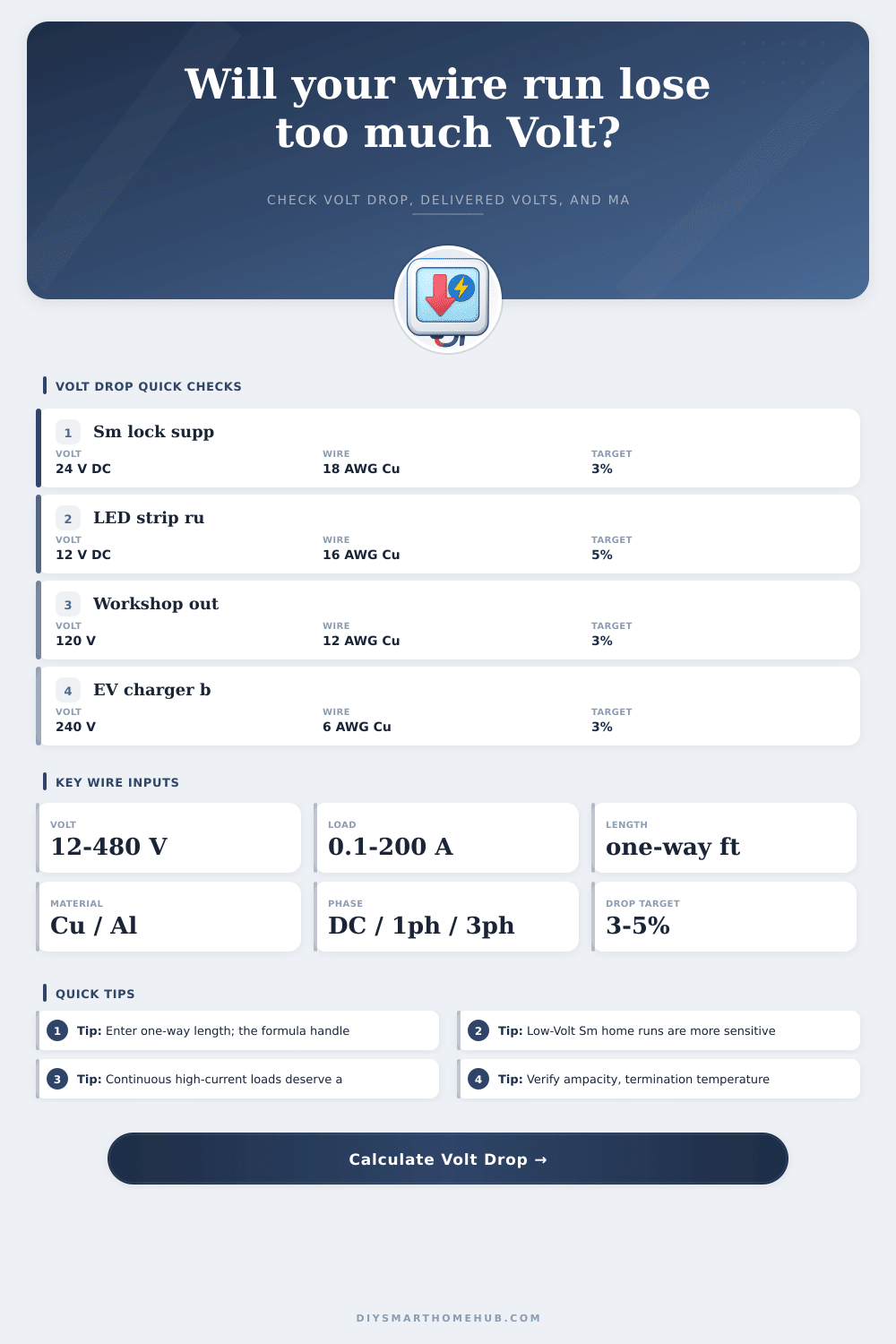
| 24 V smart lock | 0.8 A over 80 ft | 18 AWG copper | 3% |
| 12 V LED strip | 4 A over 25 ft | 16 AWG copper | 5% |
| 120 V workshop | 15 A over 75 ft | 12 AWG copper | 3% |
| 240 V EV charger | 40 A over 90 ft | 6 AWG copper | 3% |
| 480 V 3-phase | 60 A over 220 ft | 3 AWG copper | 3% |
Common conductor resistance at 75 C
| Size | Copper ohm/kft | Aluminum ohm/kft | Typical use |
|---|---|---|---|
| 18 AWG | 7.95 | 13.0 | Low-voltage control |
| 14 AWG | 3.14 | 5.15 | Lighting branch |
| 12 AWG | 1.98 | 3.24 | 20 A branch circuit |
| 10 AWG | 1.24 | 2.04 | Longer branch run |
| 6 AWG | 0.491 | 0.808 | EV, feeder, large load |
Formula guide
| Circuit | Voltage drop formula | Max length formula |
|---|---|---|
| DC two-wire | Vd = 2 x I x R x L / 1000 | L = Vd x 1000 / (2 x I x R) |
| Single-phase AC | Vd = 2 x I x L x (R x PF + X x sin phi) / 1000 | L = Vd x 1000 / [2 x I x Z] |
| Three-phase AC | Vd = 1.732 x I x L x (R x PF + X x sin phi) / 1000 | L = Vd x 1000 / [1.732 x I x Z] |
| Percentage | Drop % = Vd / system voltage x 100 | Allowable Vd = voltage x target % |
Planning targets
| Run type | Common target | Why it matters |
|---|---|---|
| Smart home sensors | 2-3% | Small power supplies can fault or chatter near minimum voltage. |
| LED strips | 3-5% | Drop can cause visible dimming and color shift on long runs. |
| Branch circuits | 3% | Often used as a design recommendation for branch-circuit drop. |
| Feeder plus branch | 5% | Total drop target commonly used for good equipment performance. |
| Motors | 3% running | Starting current may create a momentary larger sag. |
💡Voltage drop tips
Perhaps you’ve experienced problems before you knew what was wrong. When compressor kicked on, the lights in your shop dimmed. Maybe your smart doorlock acted up after a particuler long run from the breaker. Those LEDs at the end of the strip in your basement was bluer then the rest due to insufficient voltage.
Electricity travels to its destination (the load), but there’s always resistance in wire. That resistance robs electricity of some of its pressure and converts it to heat. It’s called voltage drop. On paper, this sounds like just a few tenths of a volt… but those numbers accumulate at longer distances especially with lower voltages.
Why Voltage Drop Matters
When homeowners plan a circuit, most think only about wire gauge. I mean, if I have a 20-amp breaker, I just go with 12 AWG. But here’s the thing: not only is thicker better, but distance that power has to cover also matters. If I need to run 50 feet of wire, I’m going to need greater cross-sectional area than if I had to run ten feet. Why? Because delivering good quality of power require more cross-sectional area as the distance increase. Because delivering good quality of power requires the same amount of cross-sectional area, regardless of distance.
So the calculator above takes that into account (it figures out the math for you). It take into account both gauge and length. It also takes into account your system type, such as three-phase power. Single-phase AC? DC systems? All of this make a difference in the amount of resistance you’re going to encounter in the round trip back to the source, which affects the shape of how current flow.
Percentage drops are unforgiving in low-voltage applications. A one-volt drop is an eight percent drop in your 12 volts of landscape lighting. By the end of the run, those bright white LEDs turns into dim, warm bulbs. That same absolute voltage drop won’t be an issue in high-voltage systems such as a 240-volt EV charger. It’s just three volts which is only about one percent of total.
The calculator adjusts those sorts of things and shows you both the actual delivered voltage and the percentage. Then you know exactly what the load see instead of looking at some abstract wire size chart.
The other complicating factor that most do-it-yourselfers forget about till it’s too late is type of material. Although copper is the norm because it’s the best, cheaper aluminum is lighter and therefore appealing if you’ve got long feeder runs. There’s just one catch: Conductivity. Because aluminum have about 60 percent of the conductivity of copper, you typically has to step up two wire sizes to achieve equivalent performance. When you specify your conductor material, the tool takes all that into account. Meaning you don’t have to remember any conversion tables when you’re standing in the hardware store with a spool of Romex in your hand.
Temperature also enters the equation. As wires heat up under load, they expand and their inside resistance increases. That might be the difference between a borderline acceptable drop and something unacceptable on a hot summer afternoon.
Another trip-up variable is power factor. If you’re wiring for compressors and/or motors, this will be important. The power factor of resistive loads such as heating elements or incandescent bulbs is one. In other words, current and voltage are in perfect step. Inductive loads (such as air conditioners) lag; therefore they create what’s known as reactance which increases the effective impedance of the circuit. Neglecting it could cause an overly optimistic assessment of voltage delivered. It is a small thing. But it does matter when you’re attempting to prevent an otherwise sensitive motor from overheating because of under-voltage conditions.
The page includes a handy table of reference which lists standard settings, so there’s no starting-over from zero each time around. For instance, with your smart lock, will 18-gauge wire suffice? Or should you use 16-gauge to be sure the drop stays below three percent? Typically we want to be below five percent overall from transformer to the appliance, and below three percent at any branch circuit point along the way. That ensures electronics functioning in a narrow range of voltages aren’t stressed, won’t fail prematurely, and will run well.
Planning your wiring correctly saves money on electricity bills. It will also save you time on repairs and lengthen lives of your motors. It keeps your smart home gadgets working as commanded and prevents those annoying circuit trips from happening. Voltage drop doesn’t reveal itself until it’s too late; by knowing how much voltage drop there’ll be beforehand, you can control the results. Whether you’re plugging in an EV charger or flipping a light switch, you want that juice coming in nice and strong. Treat that wire with respect, respect for the load and the distance, and it will do its job while staying out of the spotlight.