Thermostat Deadband Range Calculator
Calculate heating and cooling setpoints, control differential, comfort range, cycles per hour, and compressor minimum off-time from one thermostat profile.
Detailed control breakdown
| Control type | Deadband range | Differential range | Usual CPH target |
|---|---|---|---|
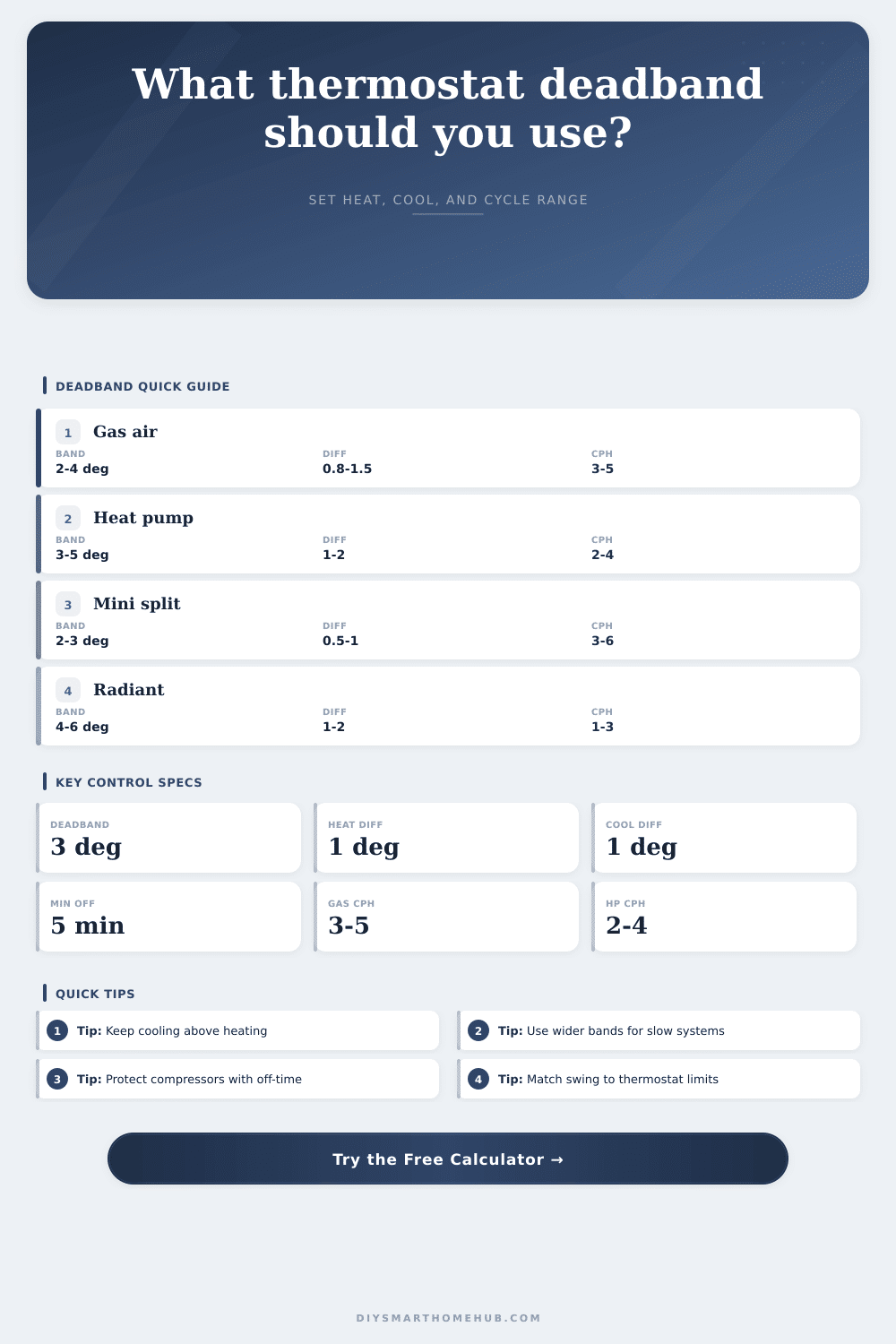
| Gas furnace with central AC | 2°F to 4°F between heat and cool | 0.8°F to 1.5°F swing | 3 to 5 heating, 2 to 4 cooling |
| Air-source heat pump | 3°F to 5°F between modes | 1°F to 2°F swing | 2 to 4 cycles per hour |
| Inverter mini split | 2°F to 3°F between modes | 0.5°F to 1°F swing | 3 to 6 modulation checks per hour |
| Radiant floor or boiler zone | 4°F to 6°F between modes | 1°F to 2°F swing | 1 to 3 cycles per hour |
| Electric resistance heat | 2°F to 4°F between modes | 0.7°F to 1.5°F swing | 4 to 6 cycles per hour |
| Dual-fuel heat pump | 3°F to 5°F between modes | 1°F to 2°F swing | 2 to 4 cycles per hour |
| Differential swing | 1°F/hour drift | 2°F/hour drift | 3°F/hour drift |
|---|---|---|---|
| 0.5°F swing, 10 min runtime | 1.0 CPH | 1.7 CPH | 2.4 CPH |
| 1.0°F swing, 10 min runtime | 0.9 CPH | 1.5 CPH | 2.0 CPH |
| 1.5°F swing, 10 min runtime | 0.8 CPH | 1.3 CPH | 1.7 CPH |
| 2.0°F swing, 10 min runtime | 0.8 CPH | 1.2 CPH | 1.5 CPH |
| Minimum off-time | Heat gain 1°F/hour | Heat gain 2°F/hour | Heat gain 3°F/hour |
|---|---|---|---|
| 3 minutes | 0.05°F minimum swing | 0.10°F minimum swing | 0.15°F minimum swing |
| 5 minutes | 0.08°F minimum swing | 0.17°F minimum swing | 0.25°F minimum swing |
| 8 minutes | 0.13°F minimum swing | 0.27°F minimum swing | 0.40°F minimum swing |
| 10 minutes | 0.17°F minimum swing | 0.33°F minimum swing | 0.50°F minimum swing |
| Scenario | Center setting | Deadband | Best starting differential |
|---|---|---|---|
| Occupied family room | 71°F to 72°F center | 3°F to 4°F | 1°F for heat and cool |
| Bedroom comfort zone | 69°F to 71°F center | 2°F to 3°F | 0.5°F to 1°F |
| Large open-plan zone | 72°F center | 4°F to 5°F | 1°F to 1.5°F |
| Radiant slab zone | 70°F center | 5°F to 6°F | 1.5°F to 2°F |
| Vacation hold | 68°F to 76°F separated | 6°F to 10°F | 1°F to 2°F |
A thermostat is essentially a switch that flips back and forth between heating and cooling cycles. When set incorrectly, it will flip on and off quickly. You’ll notice your AC running for a few seconds, then nothing, then maybe run again in a minute or two. Cycling rapidly like this can wear down your equipment faster then it would if operated normally.
To solve this problem, we need to learn about something called the deadband, the range of temperatures where one unit turns off while the other turns on. Properly adjusting this band will stop your systems from fighting each other. And it will keep you comfortable so much you won’t even think about your thermostat at all.
How to Set Your Thermostat Deadband
If only we could tell you! That’s why I put together this little calculator for you (above). It do all of this math for you if you just input your equipment type and your comfort center size. Then it will handle the math so you don’t have to guess whether a tight swing or a wide band suits your home better. And it calculates where your heating cut-off meets your cooling start-up point to ensure there is no overlap.
In other words, how far apart should they be so one isn’t running while the other is? Because running both cooling and heating at the same time is the single most expensive thing you can do with an HVAC system. The deadband essentially serves as a buffer area between cycles.
For most people, a three- or four-degree range work fine for their system. They typically have central air conditioning and a conventional gas furnace. This lets it warm up a few degrees without re-engaging the heat. You’ll notice that if you reduce the deadband too far (say to a one degree difference), your thermostat becomes twitchy. Every time somebody opens the door or the sun hits the window, the compressor kicks in again. Constantly restarting like this puts a lot of wear on mechanical parts in just one season.
With radiant floor heating, however, which reacts much more slowly, that equation is completely thrown out of balance: It takes hours, not minutes, for the slab to heat up or cool down. And if you set a too-narrow deadband, what happens? Your thermostat will kick off well short of reaching its target setting, which means a constant state of semi-operation. And inefficiency. To allow the thermal mass in the floors ample opportunity to absorb and then shed heat, you’re looking at a larger swing… Sometimes five or six degrees, in the deadband.
The chart below (click to enlarge) shows how control types pair with ideal differential ranges:
The other side of the coin involves heat pumps, which frequently require some minimum amount of time off. This is done to protect the compressor from restarting under high pressure. You’ll need to set your deadband wide enough that it doesn’t attempt to cycle back on during this cool down period. Otherwise, it’s going to remain switched off until the safety timer expires. This means you will have to wait out the safety timer uncomfortably cold in winter and hot in summer. Here again, there’s no “both-and” option. For heat pumps, it’s one or the other: you have to choose between comfort and making your equipment last longer.
Everyone programs their thermostat to some fixed number and leaves it be. What most don’t know is that the setpoint combined with the swing determines how often the system kicks on. That’s determined by the swing, in degrees, around your set point. If you set a one-degree swing (so you want 71 degrees), then when it heats, it will come on at 71.5 and shut off at 72.5. Double the degree swing and you cut the cycling rate in half. For most compressors, more is less, meaning fewer cycles are usually more efficient. This works as long as you’re not bothered by the temperature swinging so much.
There’s another less obvious aspect: humidity control. Even if the indoor temperature doesn’t change much, running the air conditioning more often will remove moisture from inside your house. If you live in a humid climate, you might find that tightening the deadband just a little will make your home feel better (even at the cost of increased energy usage). Trade off of dry vs. Cheap.
So there you have it: Thermostat tuning is ultimately all about the meeting point between mechanical limitations and human tolerance. On one hand, you desire enough runtime to adequately condition the air. But on the other hand, you don’t want the damn thing running up every 5 minutes because then you’d never get any peace and quiet. Tune accordingly for your actual home behavior in extreme weather conditions. Don’t assume default factory settings are correct.
If done right, the deadband will make the tech go away. All you’ll be left with is a silent house. You will also have constant comfort. That is the real reward of getting the range just right.