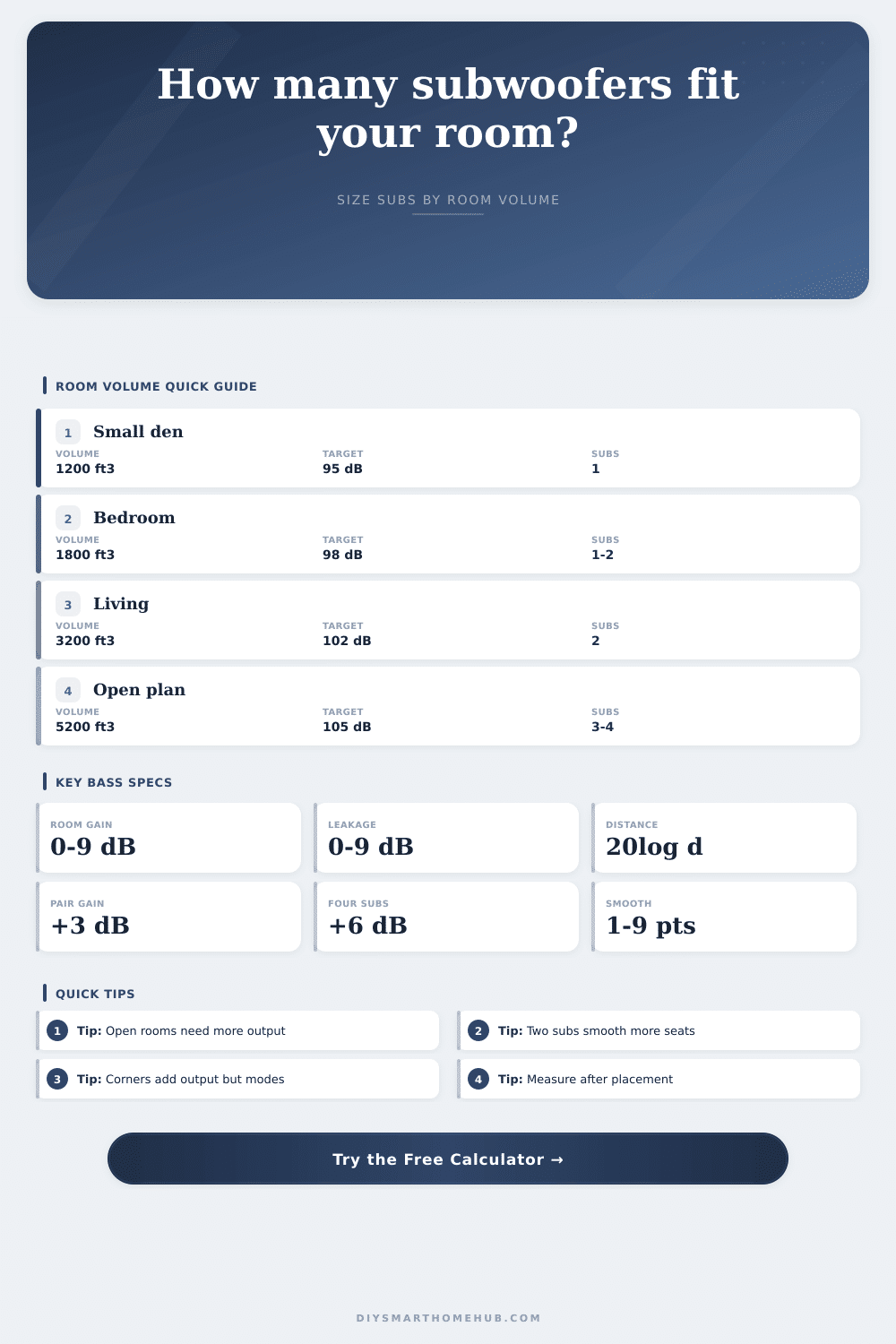
Subwoofer Count by Room Volume Calculator
Estimate how many subwoofers a room needs from volume, bass SPL target, listening distance, room gain, open-plan leakage, subwoofer output class, and placement efficiency.
Calculation breakdown
| Room class | Approx volume | Typical target | Starting sub count |
|---|---|---|---|
| Small bedroom or den | 900-1500 ft³ / 25-42 m³ | 92-98 dB | 1 compact to sealed sub |
| Medium media room | 1500-2500 ft³ / 42-71 m³ | 98-103 dB | 1 strong or 2 moderate subs |
| Large living room | 2500-4000 ft³ / 71-113 m³ | 100-105 dB | 2 subs for output and smoothing |
| Open-plan great room | 4000-6500 ft³ / 113-184 m³ | 102-108 dB | 3-4 subs or higher output class |
| Very large / lofted space | 6500+ ft³ / 184+ m³ | 105+ dB | 4+ subs or reference output |
| Factor | Calculation role | Typical range | Count effect |
|---|---|---|---|
| Room volume | Large rooms reduce effective room gain | +0 to +9 dB gain | Bigger rooms need more output |
| Listening distance | 20log distance from 1 meter, softened for bass | 6-14 dB loss | Far seating raises count |
| Open-plan leakage | Subtracts pressure support from connected spaces | 0-9 dB penalty | Open rooms raise count |
| Placement factor | Boundary or corner loading changes output | -2 to +4 dB | Efficient placement lowers count |
| Multiple subs | Output gain uses 10log(sub count) | +3 to +8 dB | More subs add output |
| Modal smoothing | Distributed sources reduce seat-to-seat variation | 1-10 score | Two or four subs improve consistency |
| Placement pattern | Output factor | Smoothing factor | Best calculator use |
|---|---|---|---|
| Mid-wall single | -2 dB | Low | Conservative output estimate |
| Front wall near boundary | +1 dB | Moderate | Common living room setup |
| Corner loaded | +4 dB | Variable | Maximum output in small rooms |
| Opposite wall pair | +3 dB pair gain | High | Smoother front-to-back bass |
| Four distributed subs | +6 dB output | Very high | Best multi-seat consistency |
| Scenario | Volume | Sub class | Likely result |
|---|---|---|---|
| Bedroom music system | 1248 ft³ | Sealed 10 in | 1 sub, modest target |
| Small sealed theater | 1664 ft³ | Sealed 12 in | 1-2 subs, smoother with pair |
| Media room family seating | 2880 ft³ | Ported 12 in | 2 subs for coverage |
| Open-plan living area | 5544 ft³ | Ported 15 in | 2-4 subs depending target |
| Reference basement theater | 3744 ft³ | Dual-driver | 2-3 subs with headroom |
Press play and you’ll instantly know if your room is ready to rock with some bass heavy action. We aren’t just talking about volume. We are talking about whether the bass add depth, or if it just rattles your teeth and turns into a muddy mess that shakes floorboards uncontrollably.
The majority of folks go to buy a subwoofer by measuring driver size. Bigger cone = better sound…right? Well no, physics doesn’t give a rip what the marketing material say. Physics deals with air volume in your space and the ability to move pressure in that air.
How Many Subwoofers Do You Need?
Everything hangs together around the room size. If you have an 8-foot-ceilinged small den, it will contain considerably less acoustic energy then some large open-plan space. That physical fact is what makes the calculator on this page useful; it’ll help you figure out the number of sub necessary for the space.
How does it do that? It takes your room measurements and translates them into a target SPL; sound pressure level. This then gives you an idea about how much clean output you’re after to reach your target loudness at the sweet spot.
Perhaps you’re thinking, “hey I got a big room so just one heck-of-a-sub will be fine.” Guess again. The calculator incorporates a couple of factors that play against each other. Room gain can increases low frequencies in a small room, while distance loss decreases your bass levels as you push your rear end farther from the speakers. So getting the equation right means avoiding either purchasing gear that’s wildly overkill or too weak.
Once you select the correct count, placement matters. Using the walls as a tool (corner loading) greatly increases the output, but also tends to compound the room mode effect where some frequencies vanishes while others boom. So, we’re seeing an increase in popularity of enthusiast-level distributed systems. By placing two or four subwoofers on opposite walls, they’ll even out the differences. Instead of only hearing the sweet spot in the middle of the room, this approach result in about equal bass response for every seat in the room.
Below is the reference table used in the tool which demonstrates how common subwoofer counts corresponds to room class. As you can see, a standard media room usually handles output plus consistency with a pair of subwoofers. That’s no coincidence. Rather, it’s a reaction to the complex standing waves occurring between those parallel walls.
The silent killer of home theater performance is leakage. Low-frequency energy will escape into any nearby spaces, such as a hallway or kitchen if they flow into your listening space. That’s going to reduce the possible room gain you would of experienced with a closed box design. Factor in the open plan leakage, and it can push the suggestion towards adding more subwoofers or a higher output class. Failure to do so results in a system that sounds thin regardless of how loud you crank the volume. You’re basically pumping air into a leaky bucket.
It is a frustrating problem to diagnose without measuring the actual acoustic environment. There are as many ways to build a subwoofer system as there are rooms for them. It’s all about compromise: budget, physical placement limitations and available space. Fortunately, you have some control over what fills your room, but you don’t have much control over its actual size.
Correctly positioned, an appropriate number of subs creates a foundation that supports instead of complicates the sound. Whether you want to “feel” or simply “hear” the bass, do it at every frequency with clarity throughout the range. An extended, tight low end will bring other parts of the audio spectrum into focus in comparison.
Calculate your volumes first, then adjust your positioning plan and trust the acoustic results to guide the purchase. With that method, you’ll spend money on something that makes things better… Not worse, to listen to.