Speaker Toe-In Angle Calculator
Calculate stereo speaker toe-in from speaker separation, listening distance, listener offset, and preferred axis crossing point, with triangle side lengths and delay offset checks for the left and right channels.
Formula breakdown
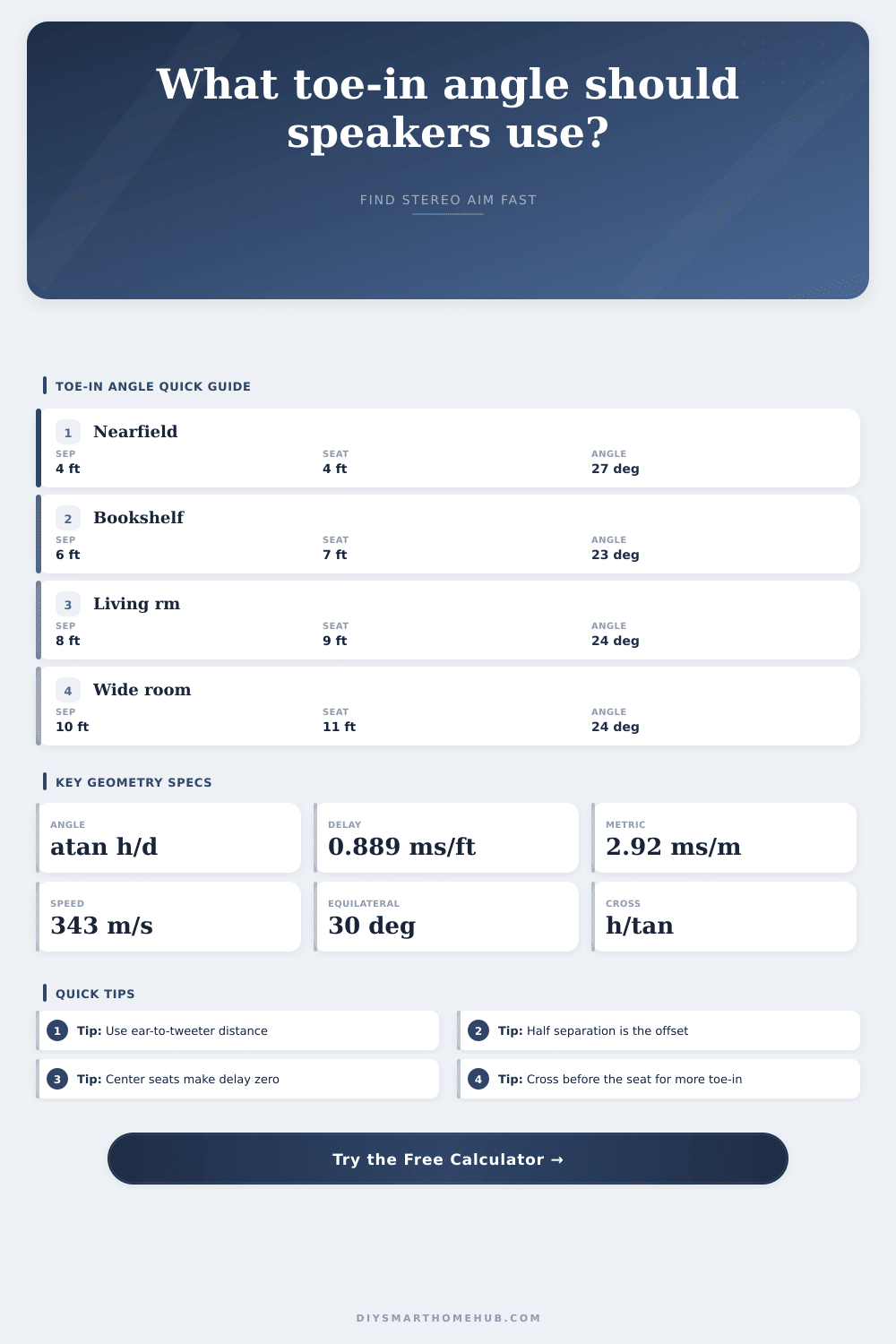
| Speaker layout | Separation | Listening distance | Angle to listener | Axis behavior |
|---|---|---|---|---|
| Nearfield desk | 4 ft / 1.22 m | 4 ft / 1.22 m | 26.6° per side | Axes meet near the head position. |
| Compact bookshelf pair | 6 ft / 1.83 m | 7 ft / 2.13 m | 23.2° per side | A mild behind-seat cross reduces toe-in slightly. |
| Equilateral stereo triangle | 8 ft / 2.44 m | 6.93 ft / 2.11 m | 30.0° per side | Classic 60° included listener angle. |
| Living room mains | 8 ft / 2.44 m | 9 ft / 2.74 m | 24.0° per side | Works well with axes at or just behind listener. |
| Wide stereo wall | 10 ft / 3.05 m | 11 ft / 3.35 m | 24.4° per side | Large spacing still lands near common angles. |
| Aim style | Crossing point | Toe-in change | Best fit | Formula note |
|---|---|---|---|---|
| No toe-in | Never crosses | 0° | Very wide dispersion speakers | Angle is zero, tan angle is zero. |
| Behind listener | 1 to 4 ft behind | Less than listener aim | Wider sweet spot | angle = atan(offset / longer distance). |
| At listener | Ear position | Geometric reference | Precise center imaging | angle = atan(offset / seat distance). |
| Before listener | 1 to 3 ft in front | More than listener aim | Narrow rooms or strong side walls | axis distance is shorter, so angle rises. |
| Manual toe-in | Computed from angle | User supplied | Verifying current placement | cross = offset / tan(manual angle). |
| Distance difference | Time offset | Metric equivalent | Planning signal |
|---|---|---|---|
| 0 ft | 0.00 ms | 0.00 m | Centered listener; no left/right distance trim needed. |
| 0.5 ft | 0.44 ms | 0.15 m | Small but measurable in precise stereo setups. |
| 1 ft | 0.89 ms | 0.30 m | Common with slightly off-center seating. |
| 2 ft | 1.78 ms | 0.61 m | Receiver distance trim or seat centering is useful. |
| 4 ft | 3.56 ms | 1.22 m | Large image pull toward the closer speaker. |
Remember the first recording you realy listened to? It sounded like someone was singing into two box. Instead, the voice seemed to hang in space between the two speaker, as if it were in the middle of room. You thought this was magic until you jumped three feet over to one side. Then the image went away in center and the bass got muddy. Your ears was no longer getting the same sound information.
To get the sweet spot again doesn’t mean purchasing higher-end speaker. It has more to do with geometry. To use this, just enter size of your room into calculator above and it does all the math for you. No more trying to convert measurements and no more wondering what coefficient to use.
Why Speaker Placement Is Important
What is realy important is what you do before pressing that calculate button. Measure from where your ears are when seated. Most people will measure to the back of their head or to seat cushion. It is not where your actual ear are. It is where the sound wave strike the pinna. It is not the sofa frame. Did you know some people sit further down different than they believe? Thus, they have a smaller listening distance than their tape measure indicate.
We don’t often acknowledge just how important speaker separation can be. Chasing a ghost image by sitting close to wall and having your speakers widely separated will result in a dramatically diminished sweet spot. As the angle between your head and the speakers get narrower, so does the sweet spot. When it’s time for a tight set up like monitors on a desk, the need for exact toe-in becomes most important because there’s no wiggle room here. You’re inches away from source then. In a spacious living room, margin of error increases a bit, but the physics remain unchanged.
Your brain find the center channel at that all-important crossing point of the axes. The reason is the aim mode setting. People mistakenly think that speakers ought to be aimed right at your ear. In one seat that’s fine. Shared listening spaces like a sofa? Then aim a bit past listener; this makes a broader stereo window. When you scoot around you feel as if the soundstage has grown larger and become stronger. You sacrifice precision for comfortabley. On the other hand, if your walls is very close and reflective, you may need to cross the axes in front of yourself to get beyond early reflections. Tradeoffs: precision vs. Stability.
You’ll see the channel delay offset as well, which is how far out of sync the sound are on each speaker. That tells you how distant each speaker will seem to someone sitting directly in middle. Sitting dead center, zero. Sit one foot over to the right, and you’re going to hear the sound in your left ear before you do in your right. The calculator displays that delay in milliseconds. If your receiver can trim based off distance, you can adjust for those times to get things tighter. It might not be centered. It helps you keep the phase tight anyway.
How hard can I be with those angles? The harder the surface, the more aggressive it throws sound back at you. Soft furnitures absorb sound. A soft rug and walls of book shelves don’t reflect as much energy back in the room. There’s less stray noise contaminating the direct signal and therefore you can aim more directly at the listener. You’re aiming more directly at the listener. In an empty box room, or a room covered in tile, the reflections dominates. Toeing in more aggressively reduces those bouncing waves that blur the sound.
Distortion ratings and frequency response curves… We get hung up on those numbers. And yeah, those numbers count. But without a firm geometric base, all those measurements don’t help when every time you walk into room, it sounds like the stereo image has collapsed. Mediocre sounding speakers can sound coherent if their foundation is solid geometry. Great ones can sound immersive as well. Expensive stands and laser levels aren’t required here. All that’s needed is a tape measure, a protractor app on your phone and a little patience.
You should of used one. When you get those angles right, what was once a driver on each side sounds like one. Where there’s supposed to be a center channel, now there’s one. Instruments remains in lane. The focus shifts from the hardware to the performance. There are just two boxes pointing at you. But when they point just right, they dissapears completely.