Smart Pet Door Size Calculator
Calculate clear pet-door opening width, opening height, step-over height, flap and cutout allowance, multi-pet sizing, and RFID unlock range from real pet measurements.
Pet 1
Pet 2
Pet 3
Pet door size ready
Run the calculator to size the clear opening, flap, rough cutout, and RFID range.
| Measurement | Formula or rule | Why it matters | Calculator output |
|---|---|---|---|
| Opening width | Max chest + 2 x side clearance + fur + multi-pet allowance | Prevents shoulder rub while keeping a smart flap reasonably snug. | Clear passage width |
| Opening height | Max shoulder + head clearance - step-over | The top edge must clear the tallest pet even when the bottom edge is raised. | Clear passage height |
| Step-over | Step height / smallest shoulder height | Small and senior pets struggle when the threshold is a large share of shoulder height. | Step ratio and warning |
| Flap panel | Clear opening + flap swing clearance on all sides | The moving flap and gasket need space beyond the clear pet passage. | Flap panel target |
| Rough cutout | Flap panel + frame allowance on all sides | Frame lips, trim, and tunnel sleeves require a larger cutout than the passage. | Cutout target |
| RFID range | sqrt(setback2 + side2 + vertical2) + speed x latency + signal allowance | The tag must be detected early enough for the smart latch to unlock before contact. | RFID range margin |
| Pet profile | Typical chest width | Typical shoulder height | Step-over target | Clearance note |
|---|---|---|---|---|
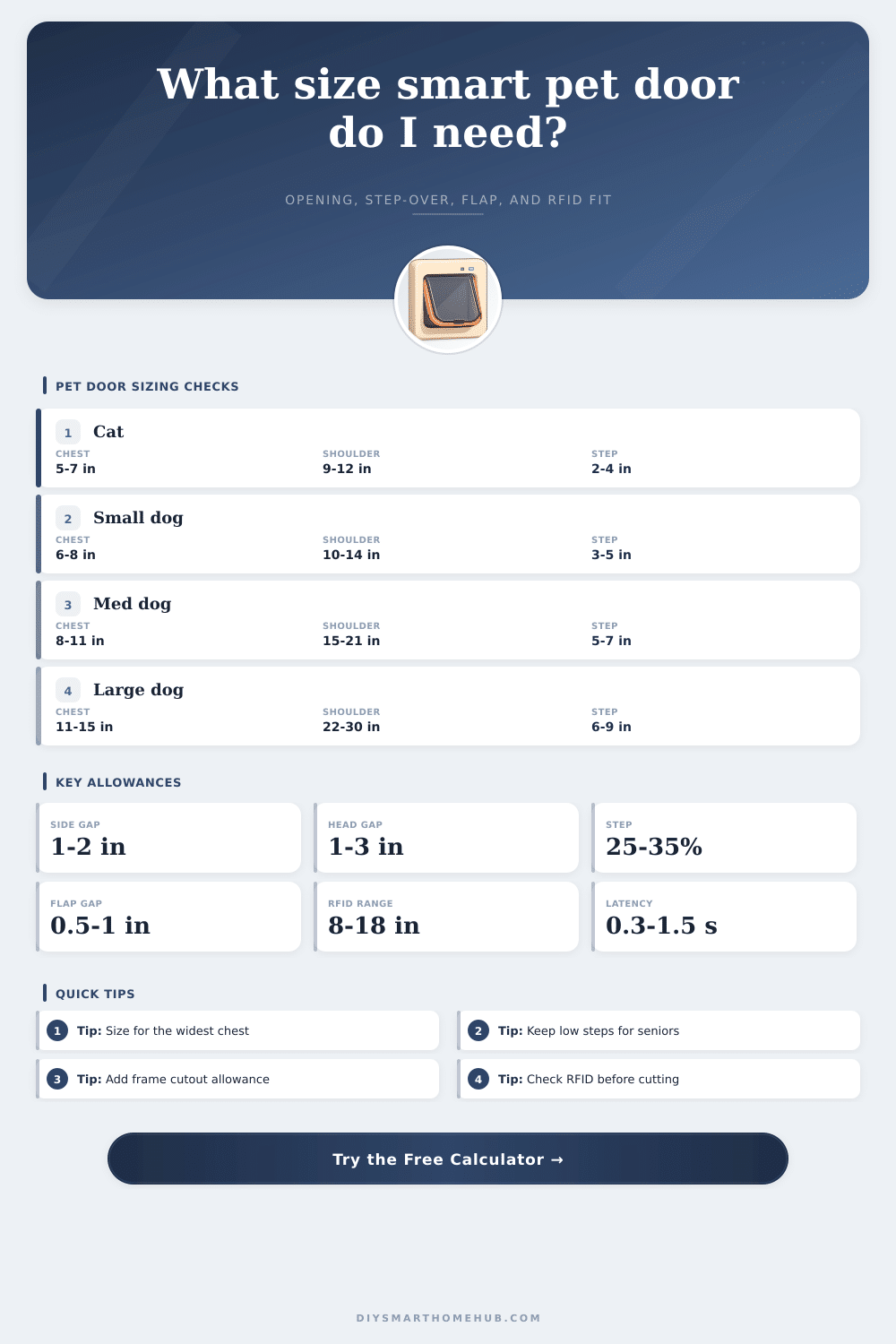
| Average cat | 5 to 7 in / 13 to 18 cm | 9 to 12 in / 23 to 30 cm | 2 to 4 in / 5 to 10 cm | Use a low threshold and modest side clearance. |
| Toy or small dog | 6 to 8 in / 15 to 20 cm | 10 to 15 in / 25 to 38 cm | 3 to 5 in / 8 to 13 cm | Step-over often matters more than total height. |
| Medium dog | 8 to 11 in / 20 to 28 cm | 16 to 22 in / 41 to 56 cm | 5 to 7 in / 13 to 18 cm | Add head clearance for relaxed passage. |
| Large dog | 11 to 15 in / 28 to 38 cm | 23 to 30 in / 58 to 76 cm | 6 to 9 in / 15 to 23 cm | Check flap weight and frame opening limits. |
| Smart-door RFID variable | Conservative planning value | Effect on range | When to increase it |
|---|---|---|---|
| Reader setback | 1 to 3 in / 3 to 8 cm | Moves the reader away from the tag path. | Thick doors, tunnel kits, metal skins, or deep trim. |
| Side approach allowance | 2 to 5 in / 5 to 13 cm | Allows the pet to approach off center. | Wide pets, angled ramps, or tight hallways. |
| Unlock latency | 0.3 to 1.5 seconds | Requires earlier detection while the pet is moving. | Cloud-linked locks, older batteries, or slow latches. |
| Signal safety allowance | 1 to 3 in / 3 to 8 cm | Protects against collar swing and weak reads. | Long fur, dangling tags, or collars that rotate. |
| Preset | Pets counted | Clear opening estimate | Step-over check | RFID note |
|---|---|---|---|---|
| Indoor Cat | 1 | Calculates live | Calculates live | Calculates live |
Installing a smart pet door in your door or wall can give you some control and your dog freedom. But unlike decor, it’s more about measuring carefuly than looks. That’s because when you cut in, that door or wall become smaller. You want to get the size right.
The formula above does all the figuring for you, and also accounts for adjustments and conversions. You do not need to eyeball whether you should of added another inch. Measuring the collar instead of the chest are a trap (though most people do it that way). Pets aren’t hard objects. Their shoulders turns and their fur compresses as they walk in and out of a collar flap. Measure widest point along the ribcage when the pet is standing naturaly.
How to Measure for Your Smart Pet Door
Don’t base the size of the opening purely based off your shoulder-width measurements. Your dog will rub against the frame then. This make noise, and it grinds away at the door. The tool automatically increases side clearance and fur allowance so the passage is tight enough to block pests and drafts without rubbing sides. It balances comfort and security.
Calculating heights is more complicated (it’s not just about measuring with a tape measure… It’s also about geometry). It involves both shoulder height and how high threshold sits above ground. For a small dog or older cat, a tiny step can present a challenge. The calculator compares the step ratio vs. The shoulder height of your pet, and alerts you if the step is more steep. Some of us prioritize draft protection by having a higher bottom edge… but this requires a senior pet to jump (rather than step) over, making the door useless. Biomechanics gets ignored when people optimize for weather protection.
RFID is used for smart doors that has some sort of delay between being detected and being unlocked. That’s enough time that your dog should have room before the flap so that lock can disengage in time. System delay, detection range and approach speed are all factors it take into accounts. If your setup won’t work in practice with your dog hitting a closed door, it tells you that and helps you know there is some margin. You don’t waste time troubleshooting hardware issues after installation.
The biggest challenge is that multi-pet homes complicate things. Typically they all has to be sized to accommodate the biggest pet. Build it for the golden retriever but then your little chihuahua think it looks huge. The solution was to create one size that accommodates both with enough tolerance that it’s right for everybody. It can’t make the largest one happy at the expense of upsetting other living in the home.
Before doing any cutting, review what those numbers translate into on your wall frame. The tunnel depth and the lip around the frame mean that the rough cutout will be bigger than clear opening. Mark once, measure twice… Make sure there’s room in your wall cavity to fit new hardware. What good does a perfectly sized door do if it won’t fit inside the structure you’re trying to modify?
You can stop staring at the back door at midnight once you nail down the size. Because of the plan for the sizes, the hole in your wall is now weather-tight, your pets have some independence, and you’ve got your privacy back. It becomes an easy weekend do-it-yourself upgrade instead of a headache of a DIY job. It’s exactly what you thought it would be!