Setback Temperature Difference Calculator
Estimate thermostat setback difference, indoor-outdoor delta T, degree-hours avoided, recovery load, and whether the HVAC capacity has enough pickup margin.
Full setback breakdown
| Setback difference | Best duration | Load effect | Recovery behavior |
|---|---|---|---|
| 2°F to 3°F | Short holds or sensitive rooms | Small degree-hour reduction | Usually quick with little pickup load |
| 4°F to 6°F | Sleep or mild away periods | Moderate load reduction | Often recovers within one normal cycle |
| 7°F to 10°F | Workday away or overnight heating | Strong load reduction when held long enough | Needs spare HVAC capacity for fast recovery |
| 10°F+ | Long vacancy or unused zones | High degree-hour reduction | May require staged recovery and comfort limits |
| Home type | Approximate UA range | Metric equivalent | Typical note |
|---|---|---|---|
| Small efficient apartment | 150 to 350 Btu/h per °F | 80 to 185 W/K | Shared walls lower envelope exposure |
| Modern compact house | 350 to 650 Btu/h per °F | 185 to 345 W/K | Good air sealing and insulation |
| Average existing home | 650 to 1,000 Btu/h per °F | 345 to 528 W/K | Common mixed insulation and leakage |
| Large or leaky home | 1,000 to 1,800 Btu/h per °F | 528 to 950 W/K | High exposure or older enclosure |
| Capacity margin after envelope load | Expected recovery | Thermostat behavior | Setback adjustment |
|---|---|---|---|
| Less than 10% | Slow or incomplete during extreme weather | Long continuous run, auxiliary heat risk | Use a smaller setback or longer preheat window |
| 10% to 20% | Usable but not fast | Recovery may take multiple cycles | Favor moderate setbacks during design weather |
| 20% to 35% | Comfortable recovery range | Usually recovers predictably | Good fit for daily smart schedules |
| More than 35% | Fast pickup potential | Shorter recovery time if airflow is adequate | Can support deeper setbacks if comfort allows |
| Scenario | Setpoint change | Hold time | Degree-hour estimate |
|---|---|---|---|
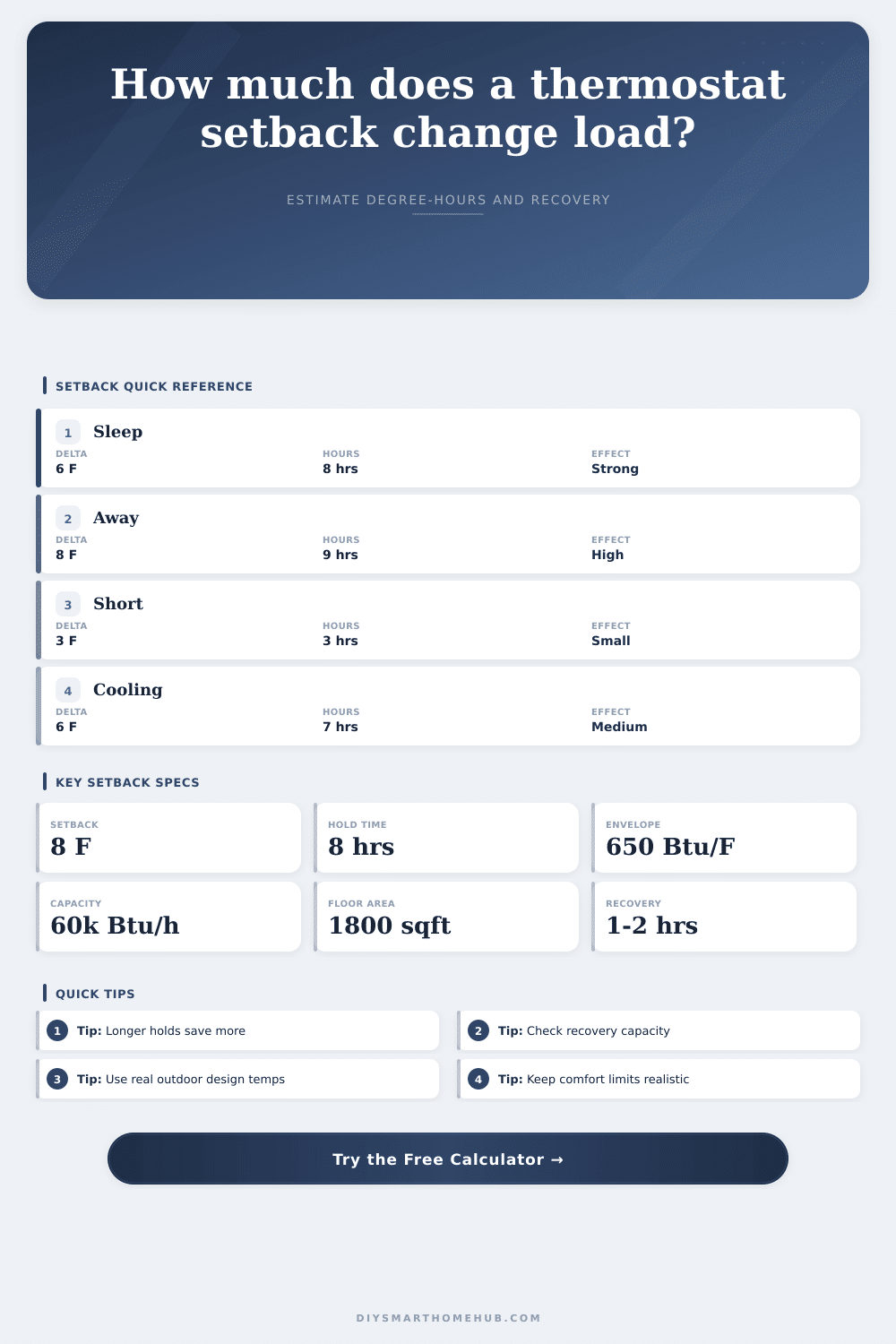
| Winter sleep setback | 68°F to 62°F | 8 hours | Up to 48°F·h avoided |
| Workday heating setback | 70°F to 62°F | 9 hours | Up to 72°F·h avoided |
| Cooling afternoon setup | 75°F to 82°F | 7 hours | Up to 49°F·h avoided |
| Short evening setback | 68°F to 65°F | 3 hours | Up to 9°F·h avoided |
The thermostat on your wall is a liar. But it’s lying by omission. It shows that it wants temperature to be sixty-eight degrees. What it cares most about though is how fast heat flows out off your house, i.e., how much your walls insulate.
So should you turn off the heating (or cooling) while away? Should you setback? And there lies the rub: There’s a thing called the recovery load and you’re often battling that. According to the myth, warming up a cool house cost more energy than maintaining its warmth overnight. That’s where physics disagrees. It may not agree with your comfort level. Before you wake up shivering in the morning, find out if your system can catch up.
How to Save Energy with Your Thermostat
Here’s the math. You input some parameters, and the calculator above crunches them. It turns those parameter into degree-hours and then into estimates of the time required for recovery. Most people get the first critical parameter, the heat loss rate through envelope, wrong. This is the number of British thermal units your house lose each hour to the outdoors for every degree that the inside temperature differ from the outdoor temperature. An older, leakier house could lose a thousand or more; newer ones in tighter construction might lose a few hundred. Over-estimate that figure, and it will suggest smaller setbacks than necessary. Under-estimate it, and you may program in too-rapid a warmup, something your furnace isn’t capable of doing. Because all the rest of calculations depend on that first one, getting it right is critical.
More than depth: Energy savings also depend greatly on duration. Two hours at a 10-degree setback won’t shift the needle much in terms of overall consumption. What matters is the degree-hours you avoid over time. This is why the load reduction come from avoiding those accumulated hours. Six degrees over an eight-hour sleep period generates a large thermal gap, and your HVAC system doesn’t need to fill it. In effect, it’s borrowing energy from the outdoor temp; letting the house cool down toward the level of that night air instead of fighting against it. Sounds counterintuitive to let comfort slide, but the physics of heat transfer favor patience.
Capacity; Not Energy: In most homes, energy isn’t really the limiting factor (it’s capacity). Your furnace can only put out so much heat, and once the setback is over, your house must not only keep up with what it was doing but also recapture all of that lost heat while fighting off the cold air outside. On a bitter winter morning, your heating system may be barely keeping the house at sixty-eight degrees. It might not have had the strength left to make the extra push needed to get things back on track.
This chart (on the page) shows how much time you’d expect to recover compared to amount of “capacity margin” your system has. For example, it sounds like you would of need more than 10% capacity margin to reliably reach your desired temp by the time you wake up. That means a smaller setback, while saving less energy, will actualy keep you more comfortable. Why? Well, one reason has to do with recovery time.
You might notice that smart thermostats sometimes try to kick on at strange times of day. This isn’t because they’re dumb (though it feels like it). Instead, it is an effort to spread out the load so they don’t overload the electricity and trip a breaker, or turn on those inefficient, noisy little heat strips. This is where understanding your home’s thermal mass comes into play. If you have a home with thick walls and masonry floors, it will warm slowly, cool slowly. It has high inertia. If you have a light-frame apartment, it will heat quickly and cool quickly. The envelope and floor area inputs helps the tool understand how much energy the structure itself stores, not just the air.
Before putting the deep setback to use in a cold snap, though, test how much farther your system can go in milder conditions. If you find yourself noticing that the house takes forever to recover after a small two degree swing, then your margin of capacity is probably thin. Aggressive setbacks will be uncomfortable in this situation. Ultimately, you’re looking to achieve predictability; not only as a means of saving money, but because a house that recovers smoothly makes you feel like you’ve got control of it. When things lag behind your schedule, you start to think something is broken even though it’s working perfectly given its physical limits.
In summary, it’s not about finding a magic number. It’s about getting to know your home and how well its building envelope holds heat. It is also about how your equipment can make up for whatever holes you dig into it. And then once you have those parameters dialed-in, you’ve got some idea what type of schedule will satisfy human comfort while honoring the laws of thermodynamics. Your thermostat becomes a partner in controlling the flow of energy, instead of an enemy lying to you.