Refrigerant Volume Calculator
Estimate tubing, receiver, coil, or custom refrigerant volume, then convert that space into liquid fill volume and charge mass using refrigerant density, fill target, and service reserve.
📌Service Presets
⚙Volume Inputs
The calculator uses cylinder volume for tube or receiver sections, adds accessory allowance, applies a fill target, then multiplies liquid liters by the selected refrigerant density at the entered liquid temperature.
Volume and Charge Snapshot
Run a calculation to compare internal volume, filled liquid volume, density, and total refrigerant mass.
🧪Selected Refrigerant Specs
R-410A
Liquid density
1.0 liter hold
Typical operating target
📊Common Tube Internal Volume
| Tube ID | in3 per ft | Liters per m | Typical role |
|---|
These values assume a simple cylinder based on measured inside diameter, not nominal copper size.
📈Liquid Density Comparison
| Refrigerant | 40 F density | 100 F density | Safety | Common use |
|---|
📏Receiver Shell Quick Volumes
| Inside diameter | Straight height | Internal volume | 75% fill liters | Typical use |
|---|
📒Fill Target Guide
| Application | Fill target | Buffer | Why it changes |
|---|
A nominal 3/8 inch tube can have different true inside diameters depending on wall thickness. A few hundredths of an inch changes every foot of calculated internal volume.
When liquid temperature climbs, density drops and liquid expands. A receiver shell that looks safe at 60 F can become too full at 100 F if the operating fill target is too aggressive.
When you installs a new split system, you have to determine the correct amount of refrigerant to charge into the system. If there is to little refrigerant, the system will exhibit high superheat and weakly cooling performance. Too much refrigerant will cause liquid refrigerant to enter the compressor during a pull-down cycle of the compressor.
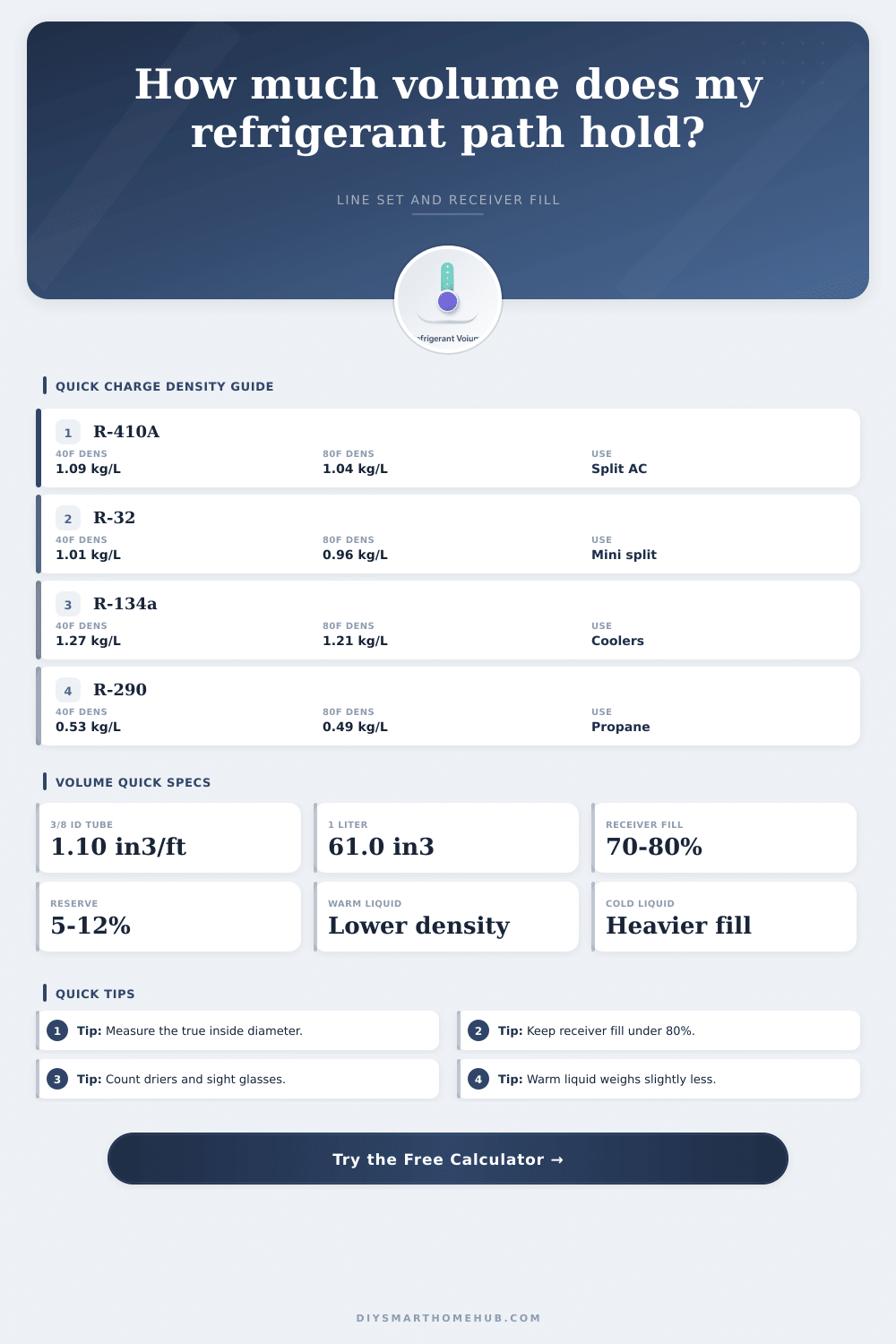
You can calculate the refrigerant charge by looking at the factory labels of the system, but these assumes perfect conditions within the system and dont account for the additional refrigerant volumes added by the risers, driers, and sight glass. The technician can calculate the volume of refrigerant that will occupy the system by determining the internal space of the system and mapping its internal space. For instance, a 3/8-inch liquid line can hold 1.1 cubic inch of refrigerant per foot of inside diameter of the tubing.
How to Find the Right Amount of Refrigerant
However, the volume of refrigerant in the system also include the volume of the fittings. To calculate the tubing inside diameter, it is best to measure the inside diameter of the copper tubing rather then using the nominal size of the copper tubing. The temperature of the refrigerant will also impact the amount of refrigerant that can be contained within the system.
As the temperature of the refrigerant increase, its density will decrease. For instance, R-410A refrigerant have a density of 1.09 kg per liter at 40 degrees Fahrenheit but 1.04 kg per liter at 80 degrees Fahrenheit. Because refrigerant density change with the temperature, you must also account for the temperature of the refrigerant when charging the system with refrigerant.
Receivers add complexity to the refrigerant charge because receivers requires surge space. The receiver should not be filled to 100 percent of its capacity. Instead, technicians should aim for a fill level of between 70 and 80 percent of the receiver capacity.
If the technician fills the receiver to 85 percent of its capacity on a warm day, there is a potential overfill of the system due to the thermal expansion of the refrigerant. Additionally, coils also adds to the volume of the refrigeration system. Due to the number of circuit in the system, hairpin bend, and distributor nozzles in the refrigeration system, coils add to the total volume of the system.
Refrigerant technicians must include a service reserve in the refrigerant charge calculation. A service reserve is an additional five to twelve percent of refrigerant charged to the system that account for refrigerant leaks, system trims, and refrigerant riser. Including a service reserve allow technicians to have a reserve in case of any refrigerant loss that may occur during normal operation.
Many refrigeration technicians makes mistakes when they charge a refrigeration system with refrigerant. Many technicians fail to account for refrigerant line fitting. Additionally, many technicians fail to account for the fact that 90-degree bend in refrigeration system tubing add to the length of the refrigerant tubes.
Other technicians fail to account for the volume that accessories like driers occupy in the refrigeration system. Other technicians do not account for refrigerant density change in different part of the refrigeration system. Finally, some technicians fill the receiver to the sight glass level on the receiver.
Technicians will use manifold gauge to fine-tune the refrigeration system, but using the calculated refrigerant charge provides technicians with a baseline from which to make refrigerant adjustments. Using a calculated refrigerant charge based on the system’s calculated volume, refrigerant temperature, and service refrigerant reserve allow technicians to fine-tune the refrigerant system to provide a precise amount of refrigerant to the refrigeration system. They should of checked there calculations more carefully to avoid errors.
Alot of people make mistakes with the moddern systems.