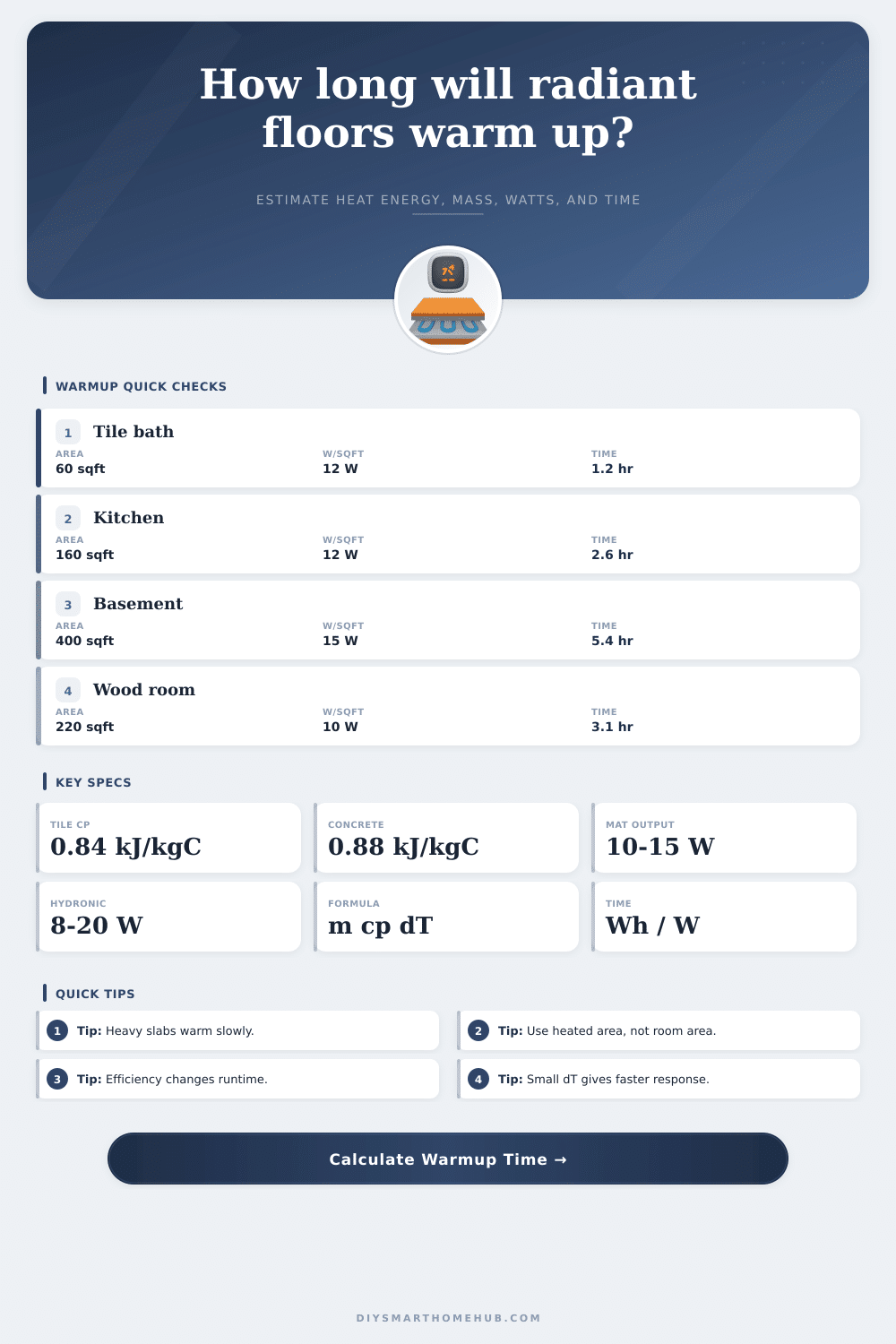
Radiant Floor Warmup Time Calculator
Estimate floor heat energy from assembly mass, specific heat, temperature rise, heater watts per square foot, heated coverage, and system efficiency.
| Finish | Density | Specific heat | Typical thickness | Warmup behavior |
|---|---|---|---|---|
| Porcelain or ceramic tile | 2200 kg/m³ | 0.84 kJ/kg°C | 0.25-0.50 in | Good heat transfer, moderate mass |
| Natural stone tile | 2600 kg/m³ | 0.79 kJ/kg°C | 0.38-0.75 in | Higher mass, slower but steady |
| Luxury vinyl plank | 1400 kg/m³ | 1.20 kJ/kg°C | 0.16-0.28 in | Light finish, faster response |
| Engineered wood | 650 kg/m³ | 1.60 kJ/kg°C | 0.38-0.62 in | Lower conductivity, use conservative output |
| Low-pile carpet assembly | 300 kg/m³ | 1.40 kJ/kg°C | 0.35-0.60 in | Low mass but insulating surface |
| System type | Typical output | Metric equivalent | Best use | Warmup note |
|---|---|---|---|---|
| Electric loose cable | 10-15 W/sq ft | 108-161 W/m² | Bathrooms, small rooms | Fast when embedded shallow |
| Electric mat | 12-15 W/sq ft | 129-161 W/m² | Tile rooms | Predictable heated coverage |
| Hydronic overpour | 8-20 W/sq ft | 86-215 W/m² | Large zones | Depends on water temperature |
| Staple-up hydronic | 6-12 W/sq ft | 65-129 W/m² | Retrofit bays | More lag through subfloor |
| Insulated panel | 8-14 W/sq ft | 86-151 W/m² | Quick-response floors | Lower stored mass |
| Project size | Floor assembly | Area | Heater output | Typical warmup estimate |
|---|---|---|---|---|
| Small bathroom | Tile over thinset | 60 sq ft | 12 W/sq ft | About 1-2 hours |
| Kitchen zone | Tile over 1 in gypsum | 160 sq ft | 12 W/sq ft | About 2-4 hours |
| Basement slab | Concrete slab response layer | 400 sq ft | 15 W/sq ft | About 5-9 hours |
| Wood living room | Engineered wood over panel | 220 sq ft | 10 W/sq ft | About 3-5 hours |
| Hydronic screed | 1.5 in gypsum or concrete | 300 sq ft | 14 W/sq ft | About 4-7 hours |
Thin Electric Tile Mat
Lowest thermal mass when cable is close to the surface. Warmup time is usually controlled by tile thickness, heated coverage, and the chosen temperature rise.
Hydronic Overpour
More stored heat because gypsum or concrete surrounds the tube. It takes longer to reach target but tends to hold temperature more evenly.
Basement Slab
Large mass and edge losses dominate. Use a conservative efficiency factor if the slab edge or underside is not well insulated.
On a chilly morning, you step from a shower into a bathroom with tile floors, and BAM! Your toes feel like ice cubes. That’s why you add radiant flooring… But it’s also the reason such projects often go wrong. “Why doesn’t it make me warm immediately when I turn on the heat?” you think. It’s all about physics.
Radiant floors is essentially a thermal battery; they must be charged, and it requires time. Failure to anticipate the wait mean both higher energy bills and the perception that your system is sluggish. The problem is how heavy it is. Stone is heavy; concrete is heavy. They are dense materials that hold their heat. That means it will stay warm and steady but doesn’t transmit energy quick. It has to raise temperature of the actual material, which takes time.
Why Radiant Floors Take Time to Warm Up
When you put in your exact layers into the calculator, those equations works out the answer for you. No need to guess what coefficient to use, or worry about how slowy your floor holds heat. Know exactly how long to give the system before declaring it ineffective.
Many homeowners think that a bathroom and a basement slab are comparable since they both feature tile. Wrong. An electric mat installed underneath ceramic tile in a small powder room warm up within an hour. When you apply the same watt density to a massive slab in your basement covered by four inches of concrete it will take half a day. It’s not about the heater… it’s about volume of material you’re attempting to warm.
You have to account for the density of each layer, including the subfloor. You also need to consider the thickness of the screed and specific heat capacity of each layer. These are numbers; that means efficiency counts. Poorly insulated sub-slab is like pouring your energy directly onto ground instead of heating your home above it. That’s wasted effort, and not sent out into space. A conservative efficiency factor accounts for energy leaking below the slab. These values are common for material properties (check the reference table).
How does this influence your decision? It will change the timeline, no matter how it look. Natural stone is heavy and slow to warm. Vinyl heats quickly and is light. The popular assumption is that more power = faster warm up. Nope. More power also mean higher electric bills and blowing heat into empty room. The trick is knowing which metric matters.
What’s being measured? How do you align your schedule to the pace of your floor? Wanting really-hot floors when you wake up at 6AM? Turn on the floor at midnight. That super-heavy slab have a long thermal lag. It won’t respond quickly enough. Want fast response times? Get a lightweight assembly. But turn it off quickly, or it will lose its heat fast.
A nice feature that most installers miss is you can compensate for rooms with heated coverage. A large portion of your floors will be covered by cabinets, tubs and toilet. Those aren’t going to get heated. The calculator breaks out the true heated square feet versus total room size. So you won’t get frustrated expecting the whole room to warm up in 2 hours and only half of floor is doing anything.
Patience vs. Comfort: Radiant heat is a game of compromise. Either the thermal mass is high or the response time is fast. In most assemblies, you won’t get both. So what number works for you? Figure out your lifestyle’s comfort level and match it to the numbers.
When you realize how long it will take your floor to warm up, you stop fighting against it. Insulate well, plan accordingly, and don’t fight when it first gives off a cold shock. It’s the little things that make radiant systems worth it. Respect the thermal mass and stop expecting it to perform like an air duct. Instead, enjoy a floor that gradually heats up, steadily. And that’s only possible when you plan properly instead of frantically adjusting the thermostats.