Psychrometric Enthalpy Calculator
Calculate moist-air enthalpy, humidity ratio, dew point, specific volume, and HVAC load from dry-bulb temperature with either relative humidity or wet-bulb inputs, plus pressure or elevation correction.
📌Psychrometric Presets
Choose a common home HVAC measurement pattern, then replace the readings with your actual entering and leaving air data.
⚙Air State Inputs
🧭Psychrometric State Grid
📊Calculated Air Properties
📘Psychrometric Reference Tables
| Air state | Dry bulb | RH | Enthalpy |
|---|---|---|---|
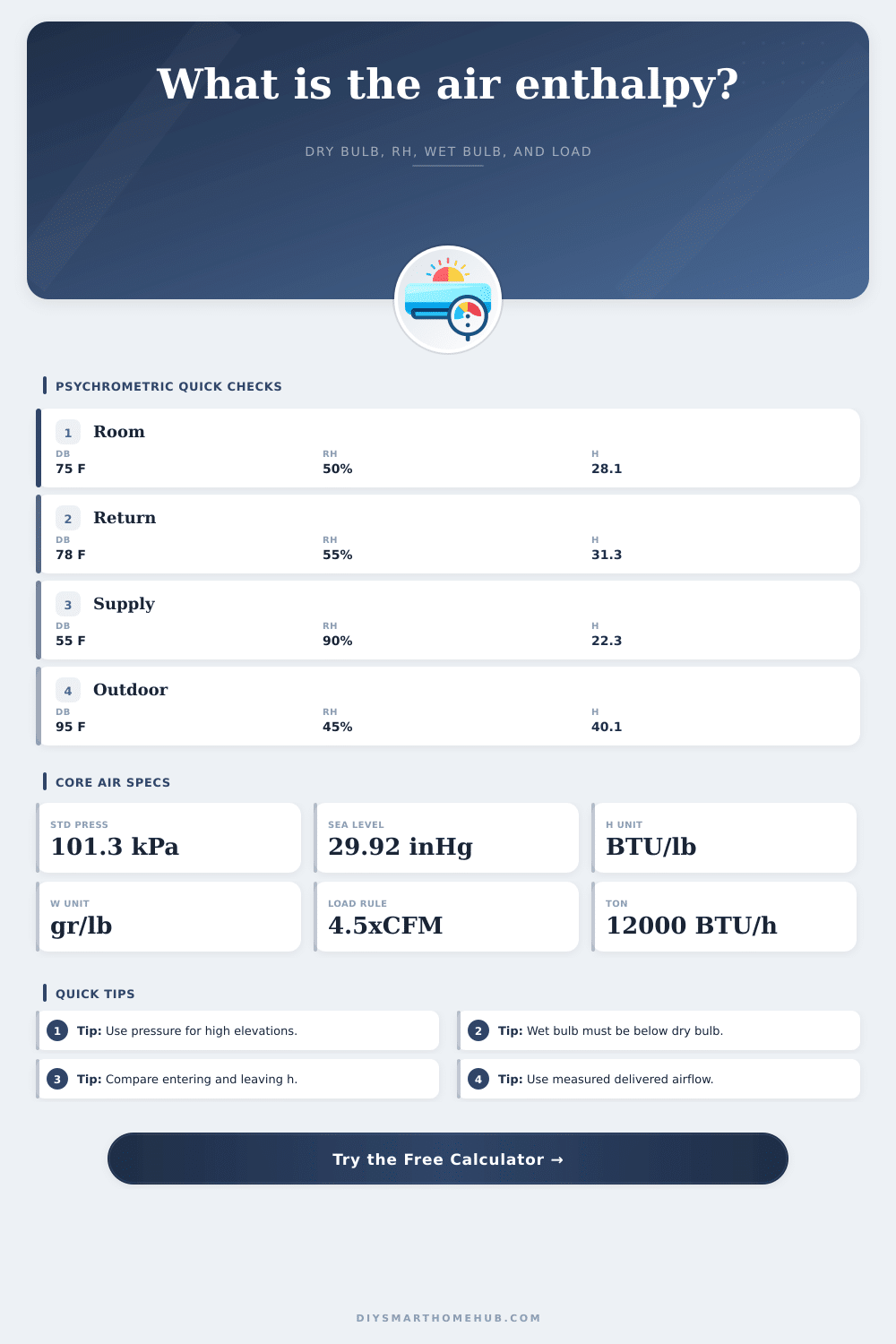
| Comfort room | 75 F / 23.9 C | 50% | 28.1 BTU/lb / 65.3 kJ/kg |
| Warm return | 78 F / 25.6 C | 55% | 31.3 BTU/lb / 72.7 kJ/kg |
| Cooling supply | 55 F / 12.8 C | 90% | 22.3 BTU/lb / 51.9 kJ/kg |
| Humid outdoor | 90 F / 32.2 C | 60% | 42.4 BTU/lb / 98.6 kJ/kg |
| Dry winter indoor | 70 F / 21.1 C | 25% | 21.1 BTU/lb / 49.1 kJ/kg |
| Formula | Expression | Primary use | Unit |
|---|---|---|---|
| Saturation pressure | 0.61094 exp(17.625T/(T+243.04)) | RH and dew point | kPa |
| Humidity ratio | 0.62198 Pv / (P - Pv) | Moisture mass | kg/kg |
| Enthalpy | 1.006T + W(2501 + 1.86T) | Total heat | kJ/kg |
| Load | dry-air mass flow x delta h | BTU/hr or kW | rate |
| Dew point | Magnus inverse from vapor pressure | Condensation check | F or C |
| Elevation | Pressure | Load effect | Why it matters |
|---|---|---|---|
| 0 ft / 0 m | 101.3 kPa | Baseline | Standard sea-level calculations |
| 1000 ft / 305 m | 97.7 kPa | Small drop | Humidity ratio slightly higher |
| 3000 ft / 914 m | 90.9 kPa | Moderate drop | Less dry-air mass per CFM |
| 5000 ft / 1524 m | 84.3 kPa | Noticeable | Use pressure-corrected loads |
| 7000 ft / 2134 m | 78.2 kPa | High impact | Airflow tons change materially |
| Scenario | Entering | Leaving | What to compare |
|---|---|---|---|
| Cooling coil | Return air | Supply air | Delta enthalpy and grains removed |
| Dehumidifier | Room inlet | Discharge | Moisture rate and sensible heat |
| ERV or HRV | Outdoor side | Supply side | Humidity ratio transfer |
| Evaporative cooler | Outdoor air | Cooler outlet | Wet-bulb approach and W rise |
| Duct leakage | Known supply | Suspect register | Enthalpy gain through attic path |
💡Psychrometric Tips
For most of us, heating and cooling means temperature control: you are hot, set the AC lower, and voila… Relief. But there’s more to heat than what shows up on your thermostat. There is also hidden energy (in moisture, or water vapor) along with sensible energy (what thermometer can measure). That invisible portion of the equation is subject of psychrometrics. Half of the story goes unnoticed if all you do is monitor dry bulb temperature. To use our analogy, if you’re estimating without doing the math, you will get it wrong.
With the calculator above, you put in initial conditions for humidity and airflow rate. It calculates the rest for you. This prevents you from having to make estimates and do manual conversions. Recognizing this dual nature help shape how you see any HVAC system.
Why Total Heat Matters More Than Temperature
Enthalpy is a single number representing total amount of heat contained in an air parcel. It captures both latent heat required for evaporation or condensation and sensible heat of temperature itself. No matter if it’s humidity from a swampy environment or simply a warm sunny day. More energy equals higher enthalpy. As you cool down AND remove moisture at the same time, the total value drop. Looking at the reference table on the page, you’ll notice that even though a dry hot day contains less total energy then a cooler moist day outdoors, its enthalpy is lower. Understanding these shifts in outdoor conditions allow us to choose the right refrigerant charge point and coil size
While volume flow is important, mass flow is critical for accurate load calculations. Enthalpy is described in terms of pounds of dry air, whereas cubic feet per minute measures volume flow. A cubic foot of air has a certain amount of weight (air is pretty heavy), but that weight varies with elevation: The higher you go, the lighter each cubic foot gets. Less thermal mass means less water vapor. It’s thin air.
You can tell calculator what your elevation is, or what the barometric pressure is, and it’ll adjust for that. When I used to work in Denver, I’d forget about it until August when our AC bill came back from repair shop like 3x normal. That is, until I remembered I was 5,280 feet above sea level, and the charts didn’t factor that into their load assumptions (which is why they don’t always work out in the mountains).
Less precision on formulas? More accuracy on input. Input is less accurate. These formulas are typical industry ones based off basic thermodynamics. They include saturation vapor pressure curves, and they treat the air as an ideal gas. That’s fine. What changes equation is how well you can measure. Calibrated digital probes read dry bulb, wet bulb and (if you like) RH. A simple psychrometer will do too.
Evaporative cooling capacity are measured by the wet bulb temp. This makes it key. If wet bulb is low even when air is hot, then the air is very dry and cools readily, but it contains minimal water to absorb. Conversely, if wet bulb is close to dry bulb, things is getting saturated, that’s a large latent load. Measuring both allows you to see this: the whole reason for measuring both.
The performance envelope of a system are defined by the transition from entering to leaving air. How much humidity was stripped? How much enthalpy was removed? This is your total cooling capacity. The greater difference between the change in enthalpy and the change in temperature, the more cooling is needed. A large temperature drop with a small delta enthalpy means it’s a sensible-only load (solar radiation or maybe heat gain through walls). Big change in enthalpy and small change in temp, and you’re battling latent loads (infiltration, cooking, people). Systems typically fail to balance this in homes because coils is optimized for one curve or the other.
In cold climates, dry winter air becomes another issue. Because the body loses heat faster through accelerated skin evaporation, we perceive that the air feels cooler than what thermometer says. When you increase the relative humidity, it doesn’t add that much additional enthalpy but it increases our perception of comfort. That’s why humidifying systems let you set thermostats lower but be just as happy with it.
The program also computes humidity ratio and dew point to demonstrate where condensation threats are on your cooling surfaces or ducts. If you keep the air leaving above the dew point, you won’t get mold growing inside return plenum.
In short, psychrometric analysis makes vague feelings of discomfort something tangible: an engineering target to shoot for. It eliminates guesswork; no more wondering why a space feels dry or clammy. You can watch the precise energy balance move back and forth between the sensible domain and the latent domain. The total heat content of your air is starting place for every good decision you make, whether it’s sizing a unit or trying to diagnose why a room is not comfortable. The numbers lay out exactly what the hardware has to achieve. When you realize that total heat content is the real money of comfort, temperature simply becomes a line item on a very large ledger.