Pressure Tank Drawdown Calculator
Estimate usable drawdown, acceptance volume at cut-out, pump runtime, and cycles per hour from tank size, precharge, switch pressures, pump flow, and active water demand.
Pressure Tank Drawdown Results
Calculation Breakdown
| Switch setting | Precharge | Drawdown ratio | 20 gal tank |
|---|---|---|---|
| 30/50 psi | 28 psi | 29.4% | 5.9 gal |
| 40/60 psi | 38 psi | 26.2% | 5.2 gal |
| 50/70 psi | 48 psi | 23.7% | 4.7 gal |
| 40/70 psi | 38 psi | 36.4% | 7.3 gal |
| Tank volume | 40/60 drawdown | Cut-out acceptance | Best fit |
|---|---|---|---|
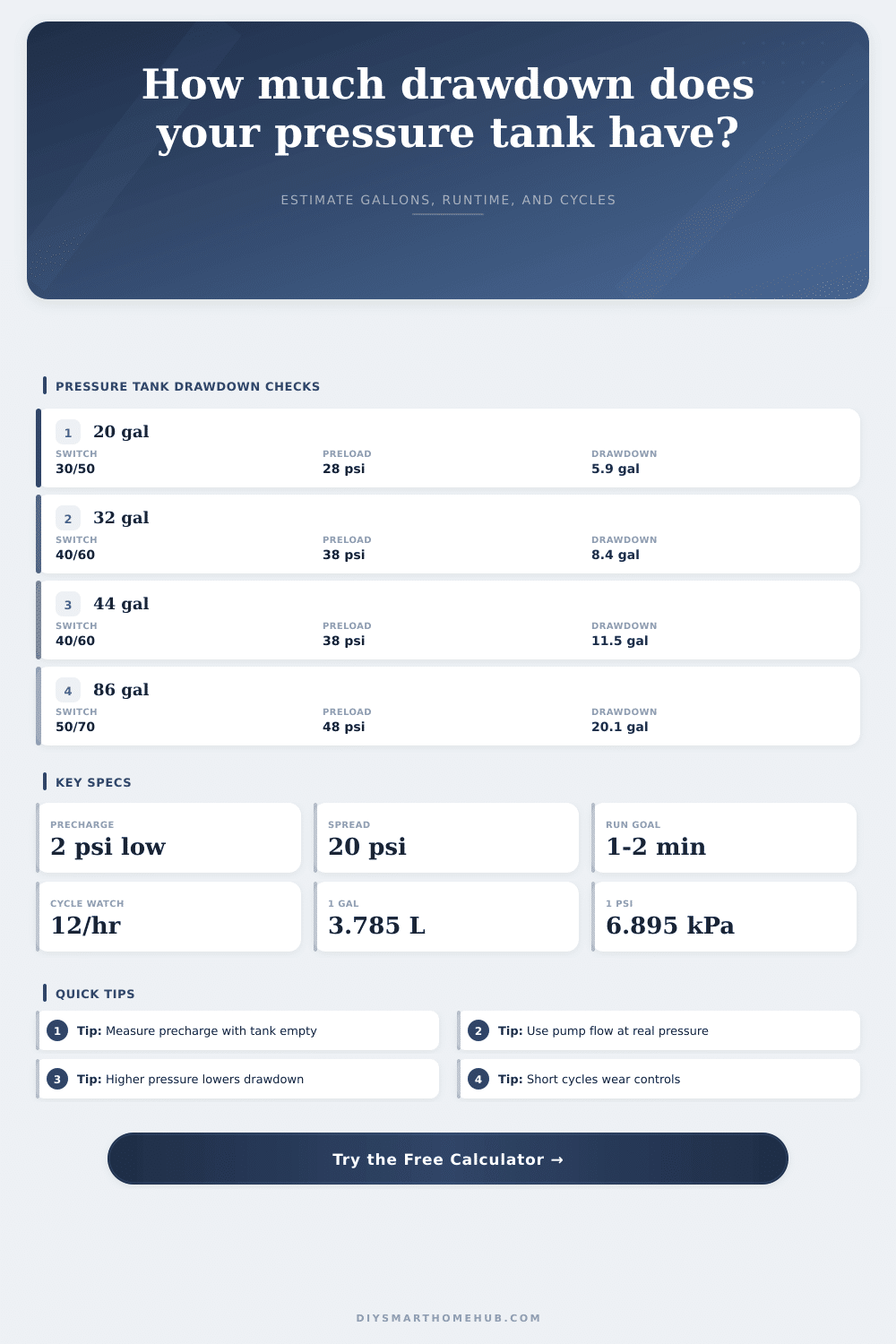
| 20 gal | 5.2 gal | 8.0 gal | Small cabin |
| 32 gal | 8.4 gal | 12.8 gal | Small home |
| 44 gal | 11.5 gal | 17.6 gal | Family home |
| 86 gal | 22.5 gal | 34.4 gal | Large demand |
| Pump flow | Demand flow | Drawdown | Refill runtime |
|---|---|---|---|
| 7 gpm | 1.5 gpm | 5.9 gal | 1.07 min |
| 10 gpm | 2.5 gpm | 8.4 gal | 1.12 min |
| 12 gpm | 5 gpm | 11.5 gal | 1.64 min |
| 15 gpm | 9 gpm | 22.5 gal | 3.75 min |
| Factor setting | Model value | What changes | Use when |
|---|---|---|---|
| Optimistic nameplate | 1.05x | Raises output | Nameplate agrees |
| Correct precharge | 1.00x | Ideal model | Tank is tested |
| Typical bladder | 0.95x | Small real loss | Normal aging |
| Aged or waterlogged | 0.72x | Large loss | Fast cycling |
And it all starts with a sound: Not the soft rush of water filling a sink, but rather the sudden mechanical lurch of a well pump engaging. Three seconds later, the pump disengage. A minute later, the pattern repeats. And it repeats again and again.
That regular thump-thump means one thing: something’s gone wrong with the pressure tank, the pump it’s trying to kill, or its controlling mechanism, the pressure switch. Homeowners think the pump motor is at fault, but 9 times out of 10, the problem lie within the steel drum in basement or crawlspace. It’s about storing not supplying water; it’s a storage problem, not a supply problem.
Why Your Well Pump Turns On and Off Too Often
The pressure tank is designed to protect the pump and store enough water so the pump run only when needed. This allows for short runs that don’t require the pump to run continuously. As that buffer dissapears, the pump engages, then disengages repeatedly, a condition called short-cycling.
With the calculator above, you can turn those pressure numbers into specific gallons stored and minutes running. And save yourself a guess about why your system sounds poorly made.
But how do we know what drawdown is? How much usable water is inside a 32 gallon tank labeled as such? That’s easy: it isn’t thirty-two gallons. This is because there’s a diaphragm or rubber bladder between the water and the air. And those two things are constantly tugging on each other.
One of them is pressurized and kept just slightly under the threshold at which the pump kicks back on. Typically it’s two psi lower than that. So when you open up a faucet, water leave the tank and the air expands to fill the void. What volume of water can be removed from the tank until it lowers the pressure to the point that the pump restarts itself? This is your drawdown.
And this is also where folks go astray. They purchase a larger tank thinking they’ll get double the water. But if they don’t set the air precharge properly, they may end up with only twenty percent more then what they had previously. The physics of the situation dont allow any wiggle room.
The higher you set your cutout pressure, the less water will fit into the remaining space. You’re essentially trading away volume for pressure head. This sets the tone for how efficiently your entire system performs.
So what story do the inputs you provide to the tool tell? Well, the starting line is the precharge pressure. Too high and you have a solid block of air in your tank, not good, can’t take up any water. Too low and you’ve got no room for water because the bladder will try to fold inward on itself, or worse yet, you’ll end up with a water-logged tank.
Older systems often lose air slowly over the years until the tank ends up full of incompressible water. At that point, it’s basically cycling the pump every time you open a tap. To deal with that fact of life, the calculator has a drawdown factor. Your brand new bladder may work close to max, but if your tank is old, it could be operating at seventy percent of its potential. That factor allows you to adjust for what you actualy have now rather than what was true when it came off the assembly line.
The remaining two key variables are pump flow and water demand. With a twenty-gallon a minute pump and a one gallon a minute draw, the tank fills right back up. So the pump fires briefly and then sits idle. It is an efficient cycle. But, with several toilets/showers/laundry running simultaneously in a high demand house, the drawdown empty rapidly. The pump is working overtime trying to catch up before it can shut off again. In this case, cycles per hour become less meaningful as a measure. The pump may never get a chance to rest.
The table on the page provides a reference which shows the impact of different switch settings in terms of usable volume. Generally, the greater difference between cut-in/cut-out pressures, the more drawdown there will be, but also the greater fluctuation in faucet pressure you’ll endure. It’s a choice. What’s more important to you, long runtime or consistent pressure?
The point of sizing the tank properly isn’t necessarily getting exactly the right one, it’s more about staying away from the extremes. Too big and the tank will sit there waiting for your water to go stale or warm. Too small and the pump fries. Somewhere in between is the sweet spot, where the pump stops before it wastes electricity but runs long enough to do its job well.
How long does it take? And how often does it run? The tool estimates that, which helps you find a middle ground or something close to it. Is my existing set-up sustainable? Or will I need to upgrade soon? That tool removes the guessing from the equation. What you’re trying to find is not so much water pressure as system longevity.
Remember that rhythmic clanking that started off this post? Hopefully, that sound should of never become the norm. With the proper combination of water, air, and pressure settings, the pump will start up and shut down quietly and smoothly. You can simply sit back and listen to the flow instead of the machinery humming behind the walls.