Pool Volume Calculator
Estimate pool gallons, liters, surface area, average depth, cubic feet, and turnover flow rate for rectangular, round, oval, and kidney-shaped pools.
Calculation breakdown
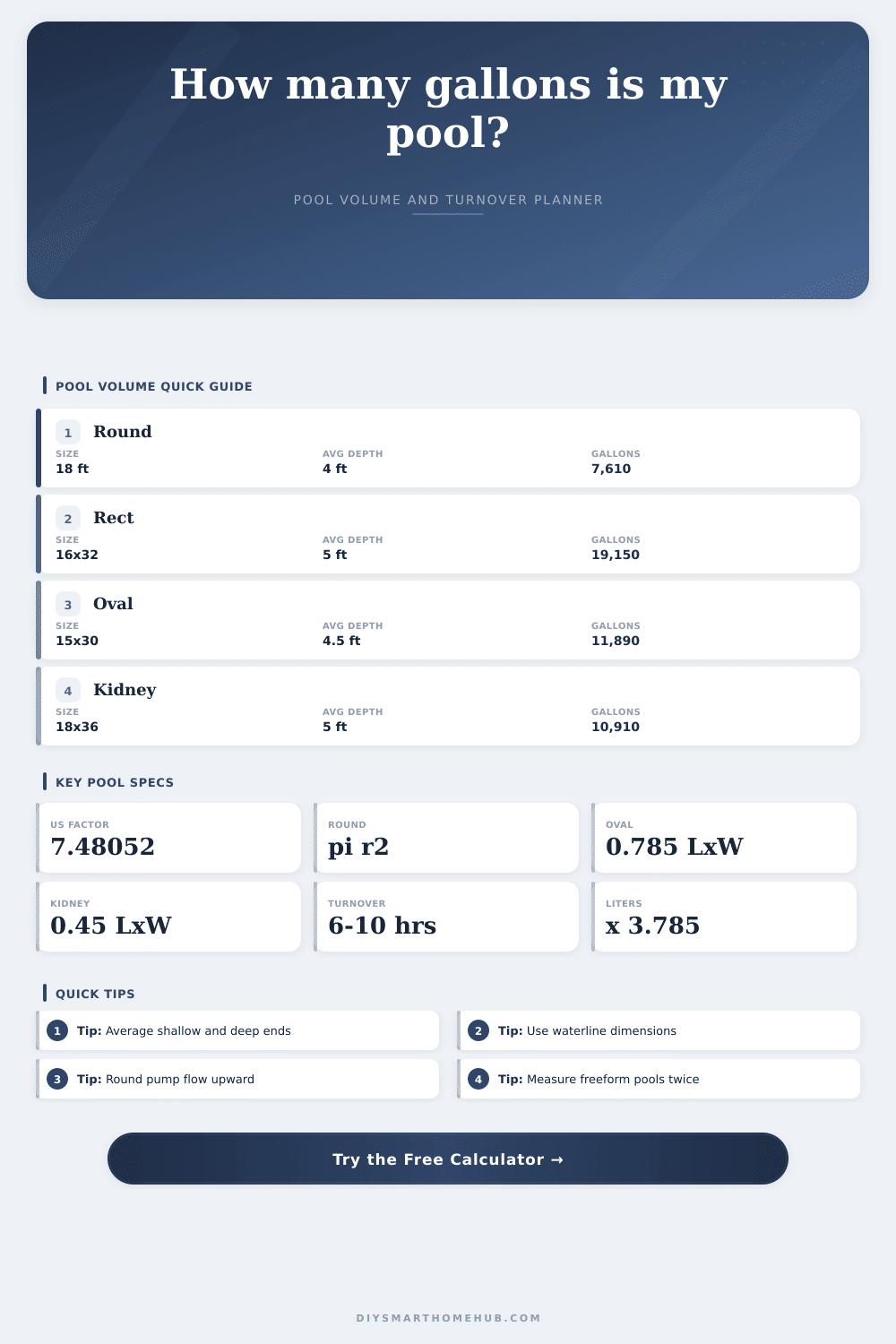
| Pool shape | Surface area formula | Volume formula | Best measurement note |
|---|---|---|---|
| Rectangular | Length × width | Length × width × average depth × 7.48052 | Measure straight inside waterline dimensions. |
| Round | pi × (diameter / 2)² | Surface area × average depth × 7.48052 | Use one clean diameter across the waterline. |
| Oval | pi × (length / 2) × (width / 2) | Surface area × average depth × 7.48052 | Use longest length and widest width. |
| Kidney | Length × width × 0.45 | Surface area × average depth × 7.48052 | Use a conservative freeform area factor. |
| Pool volume | 6 hour turnover | 8 hour turnover | 10 hour turnover |
|---|---|---|---|
| 10,000 gal | 27.8 gpm | 20.8 gpm | 16.7 gpm |
| 15,000 gal | 41.7 gpm | 31.3 gpm | 25.0 gpm |
| 20,000 gal | 55.6 gpm | 41.7 gpm | 33.3 gpm |
| 30,000 gal | 83.3 gpm | 62.5 gpm | 50.0 gpm |
| Example pool | Dimensions | Average depth | Estimated volume |
|---|---|---|---|
| Small round above-ground | 18 ft diameter | 4.0 ft | 7,610 gal / 28,806 L |
| Compact rectangle | 12 ft × 24 ft | 4.5 ft | 9,694 gal / 36,701 L |
| Family rectangle | 16 ft × 32 ft | 5.0 ft | 19,150 gal / 72,491 L |
| Large oval | 18 ft × 36 ft | 5.0 ft | 19,036 gal / 72,059 L |
Rectangular
Most exact when walls are straight. It usually gives the highest area for the same length and width.
Round
Uses diameter only. A small diameter error is magnified because radius is squared.
Oval
Good for capsule-style pools when the waterline fits an ellipse more closely than a rectangle.
Kidney
Approximates freeform water area as 45% of the bounding length by width rectangle.
The fact is: You don’t really “own” a swimming pool. Each year, you “rent” one from the weather. The rental fee consist of water bills, chemical expenses, and periodic freakout session triggered by forgetting just how much water you’re keeping in that thing.
This is why the pressure gauge on the filter jump off its perch. The way most homeowners thinks about their pool’s dimensions is as something approximated, an estimate derived from the scale of the deck or the contour of the backyard. It’s this estimation that can get you in trouble. You might buy too much chlorine and spend too much money. Or you might buy too little, which is a recipe for algaegeddon that will turn your blue paradise into a swamp in days.
Why You Should Use a Pool Calculator
Determining the correct amount of water to keep inside is the most crucial part of pool upkeep, and the most frequently neglected. After entering your own dimensions (and if you want to skip having to remember some strange geometry formula), the calculator do all the work for you.
For example, it knows a freeform kidney shape isn’t simply a rectangle missing four corner. It also understands oval, round, and rectangular shapes. It also incorporates a general conversion factor of about 7.48 gallons per cubic foot, though what’s really nice is that it take into account your input for depth. You don’t enter one number for “depth”, instead, it has you enter shallow and deep separately so it can take the average. Why? Because pools are almost never flat bottomed. If they have a gradual slope with a tanning ledge followed by a deep end, that average need to be correct. Otherwise, you’ll dose your chemicals based off thousands of gallons.
The tricky thing is getting your measurements right. You need to measure the interior water line (not the top of the deck or outside edge of the coping) because that’s what the calculator use. Many folks measure from the outside and then guess their pool size is five to ten percent larger. That means ten percent more chemical are being dumped into a non-existent space. This puts your wallet at risk and could possibly shock your water unnecesarily.
For a round pool, just measure from one side to the other through the middle of the water. For oval/kidney/etc., measure the widest point and the longest length. For those types, there is some area factors applied (i.e. For kidney pools, you multiply the length by the width and then by 0.45 to help calculate the true surface area.
The tool also tells you the turnover rate (which most casual owners don’t care about, but every serious enthusiast does). What’s turnover? It means how many times per day your pump cycle all the water in your filter. Generally speaking, industry standards recommend between 6 and 10 hours as the max turnover period. If you have a small pump and big volume, then you’re going to have long turnover which means there’s too much stagnant water just sitting in the corners waiting to get cleaned.
The reference table on the page spell it out, it shows you exactly how many gallons per minute you’ll need to get the desired turnover time. That’s helpful when it is time to upgrade a pump or troubleshoot why the water never seems to clear up.
Accurate volume information is essential for chemical treatment. You add so much of one thing per thousand gallons to shock your pool. So if you’re off on your volume measurement, you have the wrong concentration. That is inconvenient. It is also unsafe and bad for the water balance. Too little chlorine will mean bacterial growth. Too much will harm the vinyl liner and irritate skin.
The calculator also provides the liters/cubic feet. This might come in handy when shopping for chemicals in metric containers or working with contractors who used to thinking in other units.
You might think it’s as simple as picking leaves off the surface, but maintaining a pool is more complex. There are three things: geometry, hydraulics, and chemistry. Measuring accurately, knowing what those numbers mean, makes the pool no longer seem like some strange beast; it becomes a manageable system. You’ll have clear water, your equipment will run at peak efficiency, and you’ll be able to enjoy the pool more different than fight against it. Get accurate measurements and the rest follows.