Pellet Stove Pipe Calculator
Estimate equivalent vent length, horizontal pitch rise, vertical draft reserve, and a conservative 3 in versus 4 in vent suggestion for pellet stove layouts before final manual and code checks.
📏 Quick Layout Presets
🔧 Vent Layout Inputs
Layout Breakdown
📊 Key Vent Specs
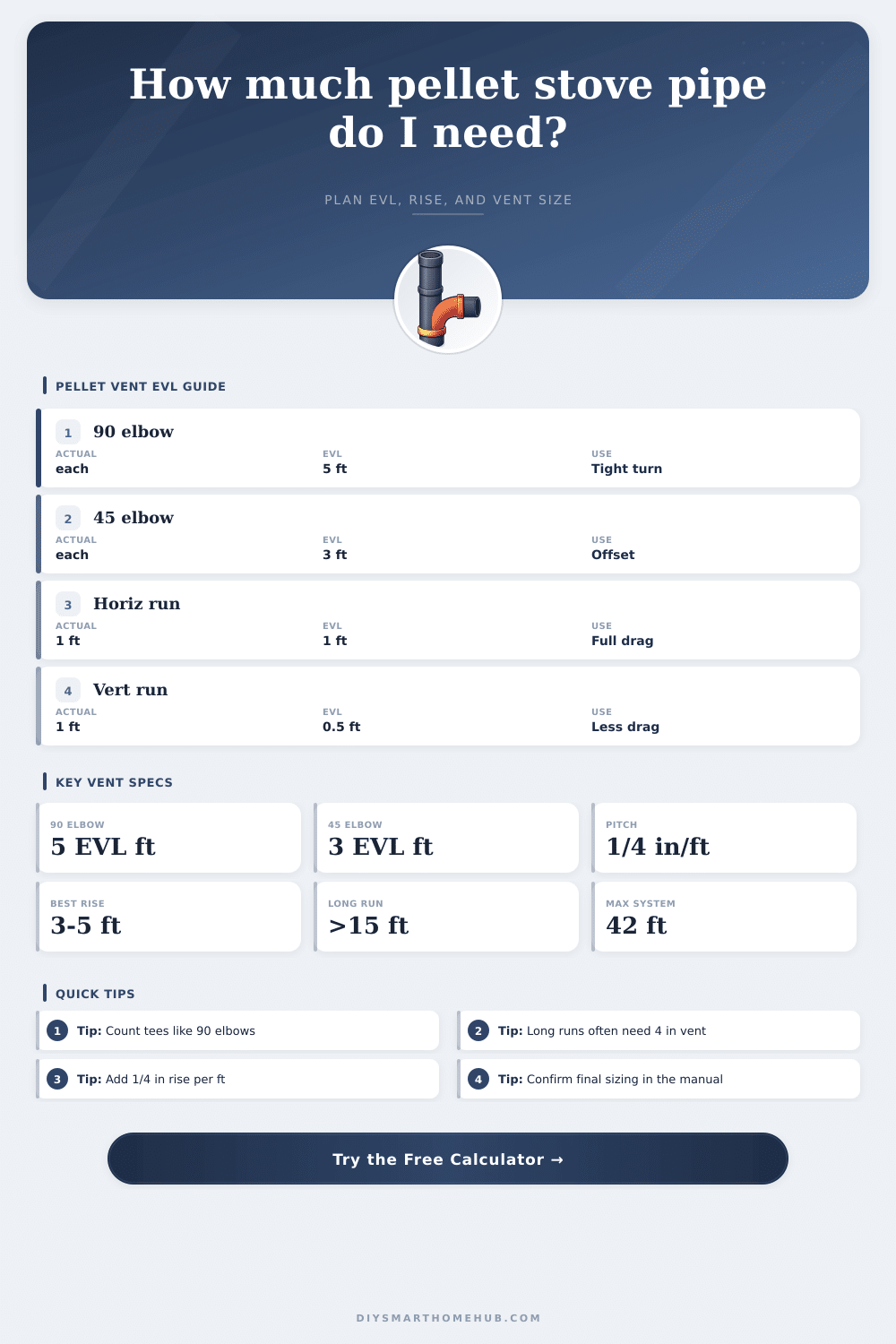
Many pellet vent charts treat each 90-degree elbow or tee as 5 ft of equivalent vent length because hard turns add major resistance.
A 45-degree elbow still adds drag, but it is easier on the exhaust stream than a full right-angle turn.
Horizontal pipe should rise as it runs, which helps carry fly ash toward the termination instead of letting it settle.
Several manuals call for 3 to 5 ft of vertical rise to improve natural draft reserve and power-outage behavior.
Once actual vent length moves past roughly 15 ft, many manufacturers begin steering typical layouts toward 4 in vent.
More than two 90-degree turns or tees usually means higher ash loading and more resistance than a short 3 in path likes.
DuraVent lists 42 ft as the overall assembled-length cap for PelletVent Pro, making long chase runs worth checking early.
Exterior vertical runs typically need wall straps at 8 ft intervals, plus support around tees and direction changes.
📋 Equivalent Length Reference
| Component | Actual Measure | EVL Factor | Planning Effect |
|---|---|---|---|
| Straight horizontal pipe | 1 ft actual | 1.0 ft EVL | Full resistance value for each foot of horizontal run. |
| Straight vertical pipe | 1 ft actual | 0.5 ft EVL | Lower resistance than horizontal pipe, which is why vertical rise helps. |
| 45-degree elbow | Each fitting | 3.0 ft EVL | Useful for offsets, but still worth counting before you add another bend. |
| 90-degree elbow | Each fitting | 5.0 ft EVL | Most common resistance jump in pellet vent sizing charts. |
| Clean-out tee | Each fitting | 5.0 ft EVL | Count it like a hard turn because it disrupts flow and catches ash. |
| Horizontal cap section | Cap body only | Manual specific | Leave cap resistance to the appliance maker and listed vent system. |
📐 Diameter Screening Guide
| Condition | 3 in Usually Works | 4 in Usually Safer | Why It Matters |
|---|---|---|---|
| Short sidewall exit | Yes, if the run is compact | If the collar already requires 4 in | Short, low-resistance runs preserve draft without oversizing the vent. |
| Actual straight length over 15 ft | Rarely preferred | Recommended | Longer vent runs add ash friction and often trigger a 4 in upgrade in manuals. |
| More than two 90-degree turns or tees | Sometimes marginal | Recommended | Extra hard turns spike resistance fast, especially on cold starts and at low burn. |
| Altitude around 6000 ft with 12 EVL ft | Borderline | Preferred check | Higher elevation reduces draft margin, so the same EVL behaves like a tougher run. |
| Existing chimney reline | Only if the stove manual allows it | Common starting point | Relines are tall and can include offsets or flex transitions that deserve more diameter margin. |
| Manual chart shows 4 in only | No | Required | The appliance manual and listed vent instructions always win over any generic estimate. |
📈 Common Pellet Vent Layouts
| Layout | Straight Pipe | Est. EVL | Typical Outcome |
|---|---|---|---|
| Short rear exit, one 90, one tee | 7 ft | 14 EVL ft | Often still 3 in if altitude stays low. |
| Wall exit plus 4 ft exterior rise | 8 ft | 16 EVL ft | Good candidate for checking 4 in if turns stack up. |
| Interior vertical through roof | 12 ft | 11 EVL ft | Vertical-heavy layouts often draft better than they look. |
| Masonry chimney reline | 18 ft | 19 EVL ft | Usually where a 4 in plan becomes the safer starting point. |
| High-altitude cabin with offsets | 10 ft | 21 EVL ft | Altitude and elbows together usually push sizing upward. |
| Tall exterior stack with tee cleanout | 16 ft | 18 EVL ft | Actual length stays under the cap, but diameter margin still matters. |
🛠 Practical Planning Notes
It is easy to count only straight pipe and forget that a tee plus two elbows can add 15 EVL ft by themselves. That is often the difference between a compact 3 in layout and a 4 in recommendation.
If the calculator lands near a threshold, verify the exact stove manual, local code, and listed vent instructions. Appliance-specific vent charts and clearances always override a general planning estimate.
Pellet stove piping comes in several possible solutions for warm the house. You can find pellet stove gears present as complete sets or separate parts. Buying gear, you ensure, that everything necessary for your pellet stove is available.
On the other hand, self buy bits commonly cost less. During buying, mind have the two main parts for wall-thimble and choose at least double wall pipe.
How to Choose Pellet Stove Pipes
The most of pellet stoves operate with 4-inch tubes, rather to wood stoves, that requires 6-inch. For pellet stove pipes are available diameters of 3 and 4 inches. For instance, double-wall 4-inch Duravent-pipe for globule discharges come in black or galvalume silver.
Those tools and tubes last until 570 grades Fahrenheit. For ComfortBilt-installations answer 3-inch products, also Pelletvent vertical regular roof flashing and wall straps.
Discharge stove it is possible diversely. Some systems lead the piping horizontally through the wall and have adjusters for 3- or 4-inch pellet stoves. PelletVent Pro is double-wall, air separate chimney system.
It answers for stoves and inserts on wood pellets or fuel oil. Also biofuels operate, as corn, shelled grass, cherry pits, soy, coffee husks, sunflower hulls, walnut shells and wheat.
Rock-Vent Pellet Chimney Pipe safely discharge pellet burning stoves or B-type listed devices. It has U.L.-listing with 1-inch distance to burnable materials according to ULC/ORD-C441. PelletVent Pro also require 1-inch explanation to burnable.
If the stove outlet are 6-inch, it stays 6-inch until the finish. Use 6×4-reduction adapter or reducer for 6-inch pipe through roof. Simpson DuraVent-pipes have patented locking system for fast montado.
Note, that pellet vent pipe does not answer everywhere. For instance, elbows must coincide with your pipe brand. Some use aluminum high-temperature tape for ease installation.
Double wall helps, because the pipe stays warmer and creosote less accrue. Although the stove pipe inwardly give a bit of heat, double wall delivers much less. Always read the manual of your stove for installations.