Patio Misting System Flow Calculator
Estimate total misting flow, pump reserve, pressure loss, daily water use, tank runtime, and expected cooling from nozzle count, nozzle rating, tubing length, and weather exposure.
Misting Flow Results
| Nozzle style | Typical flow | Best use | Flow formula |
|---|---|---|---|
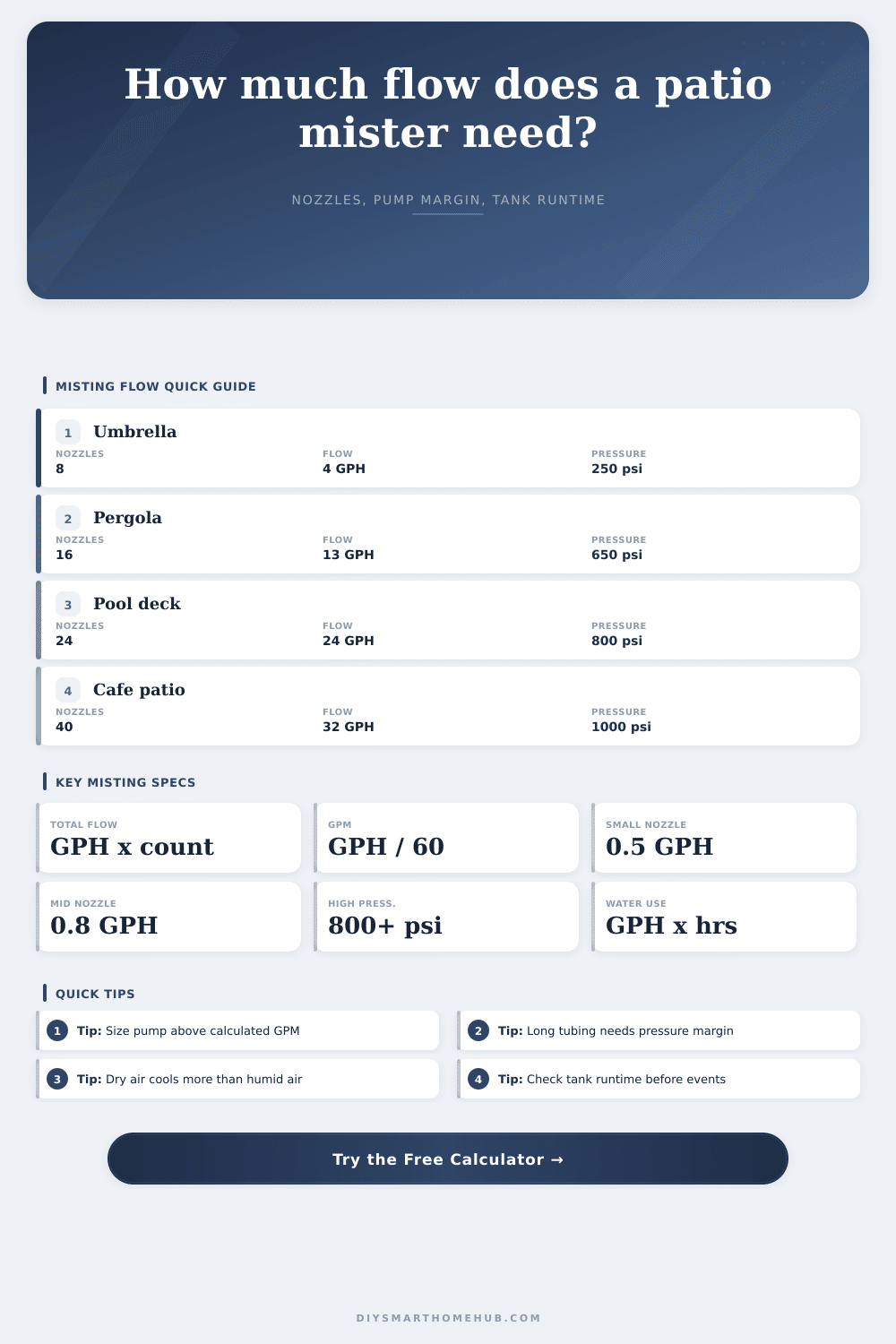
| Fine low-flow patio nozzle | 0.3 to 0.5 GPH | Small shaded seating | Nozzle GPH x nozzle count |
| Standard patio mist nozzle | 0.6 to 0.9 GPH | Pergolas and dining areas | Total GPH / 60 = GPM |
| High-output cooling nozzle | 1.0 to 1.5 GPH | Sun-exposed decks | Daily gallons = GPH x hours |
| Fan-assisted mist nozzle | 1.0 to 2.0 GPH | Airflow zones and workshops | Tank runtime = tank / GPH |
| Tubing ID | Short zones | Medium zones | Long zones |
|---|---|---|---|
| 1/4 in | Under 35 ft | Light nozzle counts only | Higher pressure loss |
| 3/8 in | 35 to 100 ft | Common patio loop | Moderate pressure loss |
| 1/2 in | Large patio feed | Good for branching | Lower pressure loss |
| 5/8 in | Large main supply | Multi-zone feed line | Lowest pressure loss |
| Humidity and exposure | Cooling tendency | Water behavior | Calculator effect |
|---|---|---|---|
| Hot dry sun | Highest evaporation | Fastest flash-off | Raises cooling estimate |
| Dry partial shade | Strong cooling | Good mist absorption | Balanced default |
| Moderate shaded patio | Medium cooling | Some drift may remain | Midrange estimate |
| Humid shaded patio | Lower cooling | Mist evaporates slowly | Reduces cooling estimate |
Are you thinking about a misting system? Good idea: you install it to get away from the heat, but then you find that your air’s as sticky as ever, and you sweat harder! Why? Because most folks worry about how misters look instead of how they’ll spray. Before you cut any tubing, use calculator above to run the numbers, and turn a guess into a plan.
The science here is that mist cools via evaporation rather than by wetting down the space. As water transitions to vapor it take up heat from its surroundings. In dry heat that’s great, but it fails in humidity. To account for weather exposure, the tool prompts you for your conditions and tweaks cooling calculation accordingly.
Why You Need a Misting Calculator
So if you’re in Arizona, mist will evaporate immediately and cool things down. If you’re in Florida, the mist will simply hover in the air making everything feel clammy. But the calculator prevents you from thinking you’ll get a desert breeze when you’re in swamp.
Mist flow is a misnomer. Everyone think more mist = cooler. But what happens when there’s too much? Puddles! Too many nozzle overwhelms the air and drowns everything in puddles.
How many gallons per hour do they put out? A regular patio nozzle puts out about half a gallon an hour. Twenty nozzles = ten gallons per hour. Your pump might not be able to push that amount at the right pressure. The mist will die by the time it gets to end of line.
What does your total demand look like? The tool lays it all out for you. Is your pump strong enough to keep the mist nice and fine, or will it drown things with big globs of water soaking into furnitures?
But length matter. How long is tubing? Many DIYers skip this. Long lengths cause water to lose pressure on the way. Tubing one-hundred feet long means that the last nozzle see far less pressure than the first one. The rest sees much less. That causes patchy wetting, it is great over here and bone-dry over there. The chart on the page describes how length affect pressure loss. A larger tube will also help but also costs more. The calculator balances all that. It tells you what pump size account for the friction in your setup.
There’s another reason it makes sense, water consumption. Twenty minutes and a small tank is gone on a big system. Who wants no water when they are eating dinner? That won’t happen if you check your tank run time.
Why? Because it makes you mindful of where that water comes from. Does it come off a municipal line? Or do you have a tank somewhere that stores the water for you? If so, how much water does that tank hold? How long will the water last? Use the tool to get those numbers and ensure the tank is sized correcty. This makes sure everything flow smoothly for your guests.
The type of nozzle also has an effect. A fine mist is cooler than a coarse spray. A coarse spray wets something down. The two usually come down to pressure and nozzle style. Higher pressure lead to finer mists. However that means you need stronger tubing and pumps. Lower pressure systems are less expensive but lead to larger droplet sizes.
With the calculator you can run through multiple scenarios. Change out nozzles for higher output ones and see what happens to flow rate. Tweak the pressure and notice the effect. This takes abstract specs and makes them into real decisions.
The best misting system is one that’s almost completely invisible. You want to feel the cool air, without seeing the water. Getting this balance between environment, pressure and flow isn’t magic; it’s physics. Understanding the numbers makes all the difference.
The discomfort goes away. The heat breaks, the air clears, and you can finally enjoy your evening. Now that’s the reward for doing the math first. You should of used the tool earlier.