Nightlight Brightness for Melatonin Calculator
Estimate delivered lumens, lux, distance falloff, dimmer percentage, and a simple CCT-weighted light index for low-lux nightlight planning.
| Light color profile | Approx CCT or color | Blue-light factor | Calculator use |
|---|---|---|---|
| Red LED | About 625 nm | 0.08 | Lowest weighted index in this tool |
| Amber LED | About 1800K | 0.18 | Very low weighted index |
| Very warm white | About 2200K | 0.25 | Warm nightlight estimate |
| Warm white | About 2700K | 0.35 | Common household warm LED |
| Soft white | About 3000K | 0.45 | Moderate weighted index |
| Neutral white | About 4000K | 0.75 | Higher weighted index |
| Daylight white | About 5000K | 0.90 | Highest weighted index in this tool |
| Target mode | Plain lux target | Weighted target | Typical calculation zone |
|---|---|---|---|
| Sleep path | 0.3 lux | 0.08 index | Floor edge, toe strip, low plug-in |
| Bedside check | 1.0 lux | 0.25 index | Bedside surface or nearby floor |
| Hallway route | 3.0 lux | 0.80 index | Hall path between rooms |
| Bathroom route | 5.0 lux | 1.50 index | Bathroom floor or vanity spill |
| Distance from light | Falloff factor | Example from 2 lux | Formula |
|---|---|---|---|
| 3 ft / 0.91 m | 1.00x | 2.00 lux | (3 / 3)^2 |
| 4 ft / 1.22 m | 0.56x | 1.13 lux | (3 / 4)^2 |
| 6 ft / 1.83 m | 0.25x | 0.50 lux | (3 / 6)^2 |
| 8 ft / 2.44 m | 0.14x | 0.28 lux | (3 / 8)^2 |
| 10 ft / 3.05 m | 0.09x | 0.18 lux | (3 / 10)^2 |
| Preset | Fixture lumens | Area | Starting brightness |
|---|---|---|---|
| Amber plug-in | 30 lm | 18 sq ft | 4% |
| Red toe strip | 45 lm | 22 sq ft | 3% |
| Warm bedside | 60 lm | 24 sq ft | 5% |
| Hall sensor path | 120 lm | 60 sq ft | 8% |
| Bathroom toe-kick | 180 lm | 45 sq ft | 10% |
| Smart bulb dimmed | 800 lm | 80 sq ft | 1% |
The solution? Understanding how light behave in a small space. When you dim the lights, you get that “heavy” sensation in your eyelids, your brain tells you it’s time for bed. It is all about the chemical switch and people have followed the sun to use it throughout history. Unfortunately, we mess with this naturaly system now using light bulbs.
Not only are moddern bedroom lights too bright; they’re the wrong kind of bright. Sure, you’ve turned off big overhead light. But you left a smart bulb on at 10 percent power or plugged in a nightlight that’s giving out blue light. This throws off your internal clock.
How to Choose Bedroom Lights for Better Sleep
And there’s the rub: If you know how light operates in a small room, the solution couldn’t be simpler. After plugging in your fixture spec, the calculator does the work for you. No more guesswork with inverse square law numbers.
And contrary to most people’s belief, a five percent-dimmed bulb isn’t benign to our slumbering brains. Even an eight-hundred-lumen smart bulb put out forty when it’s at five percent. That’s pretty bright! If that bulb happens to be shining in your face, you’re out of luck; it will overwhelm the pineal gland and prevent release of melatonin.
Instead of considering absolute light output, consider Lux, or the amount of light falling onto a surface. This helps give you a clear idea of what you are seeing as you try to sleep. Because the app considers distance from the source and room dimensions, it can estimates the delivered lux, the number you actualy see, and paint a clearer picture of what your eyes is experiencing.
The intensity is only part of it. It’s also about the color temperature. Red and warm amber light produce less aggressive suppression of melatonin then blue wavelengths do. Even dim cool white LEDs will trigger the same photoreceptors that control our wakefulness, these receptors then continue to fire alertness signals. The calculator uses a weight for the color profile you selected and displays this in a weighted index, indicating relative impact on biology. Daylight whites, even at low levels, maintain strong ability to suppress; red LEDs has no significant effect.
This means you can use red light to illuminate enough so you know where you’re going but not tell your brain that it’s morning yet. Turn on the light to go to the bathroom, locate the kid in their room, without paying the hormonal price that comes from brighter, cooler light.
We also underestimate how quickly light intensity fades as you move it further away. For instance, if you move a nightlight from six inches away to three feet away, its light will be one quarter as strong. This is known as the inverse square law. A lightbulb on the ceiling looks more gentle next to your bed than the same bulb would look when mounted low on a wall, yet both lights is providing exactly the same amount of illumination. This is actualy because of how quickly light intensity drops off with distance. The app takes this into account, enabling us to place lighting fixture well.
As an example, sometimes I’ll discover that I can increase my brightness just a bit while keeping within my desired lux limit if I push the light farther back. That makes all the difference in the way you plan out your lighting fixtures. Before, maybe you would of purchased the lowest-lumen-rated bulb possible. Now, you’ll get a normal bulb and situate it behind a shade to disperse the light, or simply further away.
Light transmission is greatly reduced by shades and diffusers. For instance, a frosted cover may pass just eighty percent of the light, providing yet another layer of protection against accidental brightness spikes. Taken together, appropriate distance + physical barrier + warm color temperature = an environment that can help natural sleep begin.
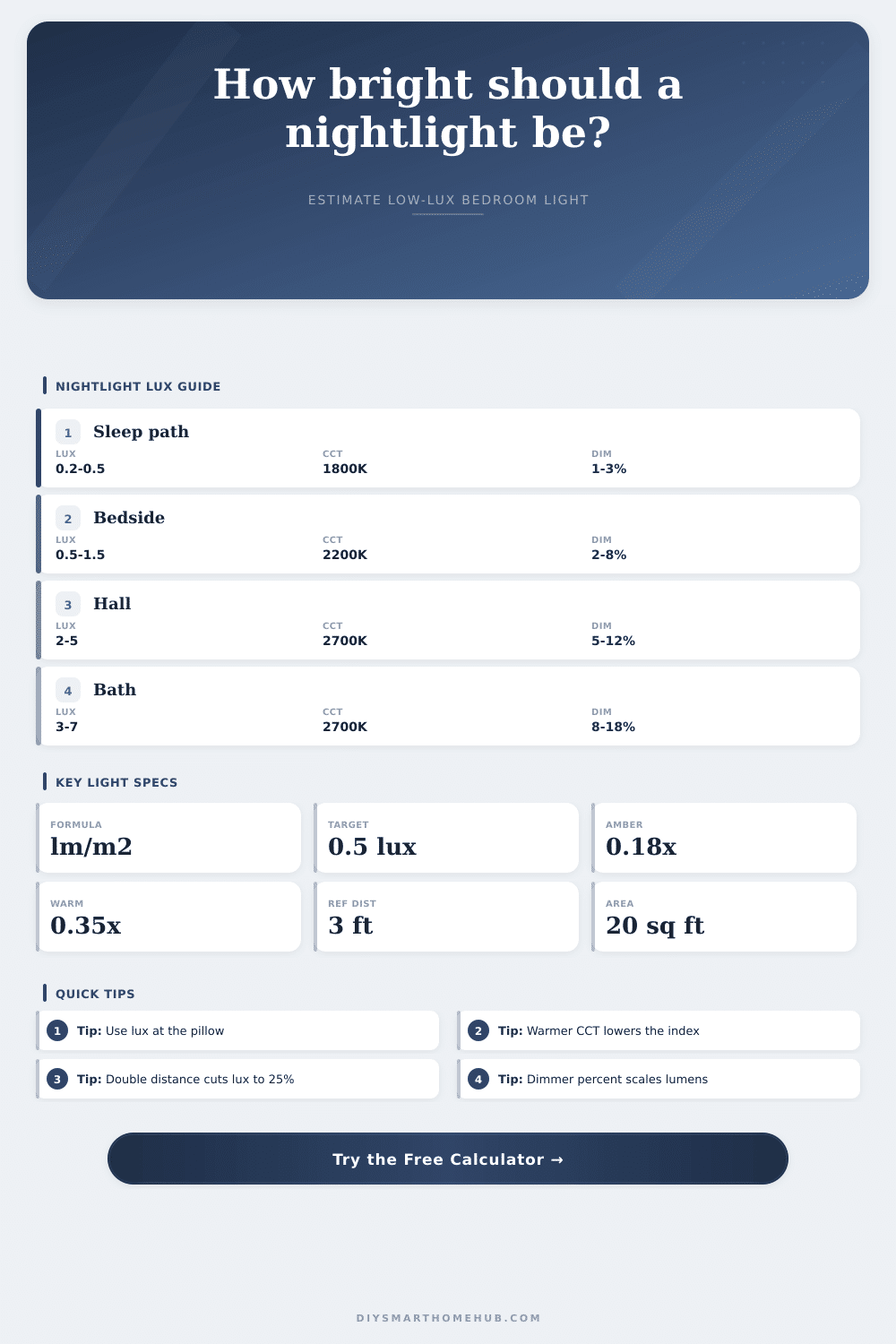
The reference table below (on the page) indicates target lux levels for various activities such as looking at a clock in bed vs. You are walking down a dark hallway. You need just enough light to avoid tripping over furnitures, but not so much that you become mentally active and start reading. This will help you design your space to be dark at night, but not necessarily black. It doesn’t matter if you can’t achieve total darkness; just eliminate bright lights and wavelengths that stimulates wakefulness.
The point is: treat your bedroom lighting like a system (not a switch), and take charge of your sleep space. Use the math as your starting point. Tweak it for your own layout. And rest assured: less light is generally better. Your body’s already wired to turn itself off, you simply have to stop shining a spotlight on its off switch.