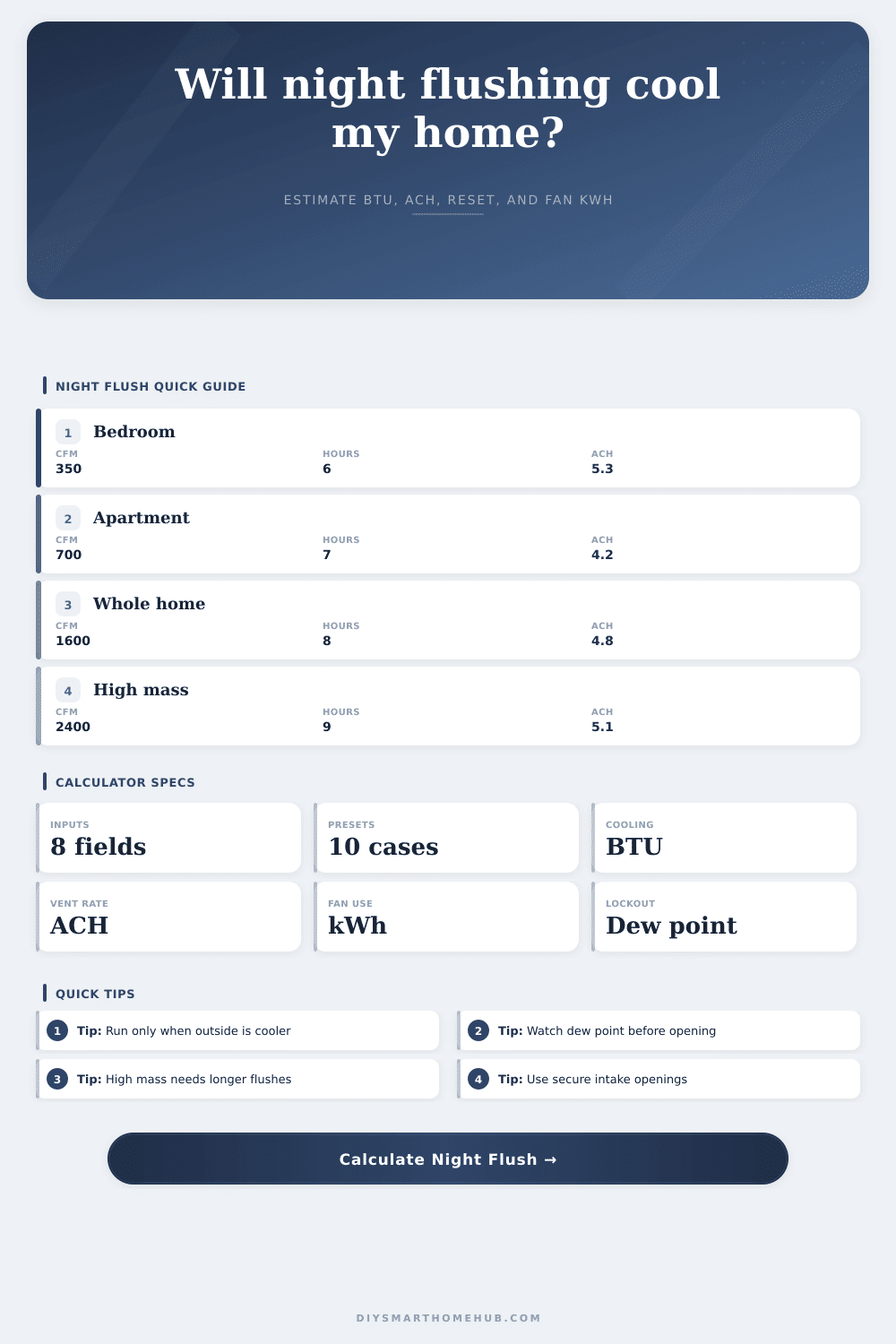
Night Flush Cooling Calculator
Estimate whether a cool night air flush can pull heat from your home, refresh the air, reset thermal mass, and stay below dew point or humidity lockout limits.
Night Flush Estimate
| Use case | Typical ACH | CFM per 10k ft³ | Result |
|---|---|---|---|
| Quiet bedroom | 3 to 5 | 500 to 830 | Gentle reset |
| Window fans | 4 to 7 | 670 to 1,170 | Good flush |
| Whole house fan | 6 to 10 | 1,000 to 1,670 | Fast purge |
| High mass home | 5 to 8 | 830 to 1,330 | Long runtime |
| Home type | Mass BTU/F | Behavior | Flush note |
|---|---|---|---|
| Light room | 20k to 60k | Fast swing | Short run |
| Wood home | 80k to 180k | Moderate | 6 to 8 hr |
| Slab home | 180k to 350k | Slow reset | 8 to 10 hr |
| Masonry | 350k+ | Very slow | Cool early |
| Condition | Good | Caution | Lockout |
|---|---|---|---|
| Temp delta | 10°F+ | 5 to 9°F | 0°F or less |
| Outdoor RH | Below 70% | 70 to 80% | Above 80% |
| Dew point | Target-6°F | Target-3°F | Near target |
| Runtime | 6 to 9 hr | 3 to 5 hr | Under 2 hr |
| Project | Volume | CFM | ACH |
|---|---|---|---|
| Bedroom | 1,500 ft³ | 350 | 14.0 |
| Apartment | 10,000 ft³ | 700 | 4.2 |
| House | 20,000 ft³ | 1,600 | 4.8 |
| Large home | 28,000 ft³ | 2,400 | 5.1 |
When you open windows, the heat doesn’t magically go away from your house. It stays in the furnitures, the drywall and most of all, the concrete slab (if you’ve got one). Some homes responds to night flush cooling; others do not.
Opening up the windows isn’t the whole story. It’s a function of airflow rate, volume and the heat capacity of whatever is holding the energy of the day. That’s where the calculator come in. It does the math for you. It converts those physical characteristics into air changes per hour and BTU’s removed. That’s the true benefit, understanding what those figures mean.
How to Use the Calculator
Before pulling the trigger, you want to be sure that this is worth the electricity required by fan.
First, what’s in the air? Fan airflow is measured as CFM. Cubic feet per minute. That’s what the tool will ask for. What most folks do is guess at the CFM based off the rating of the fan. Wrong! Airflow is killed by duct resistance and by window cracks and screens. For example, your whole house fan may be rated for three thousand CFM, yet because the intake windows are blocked by furniture or are only half-open, you’re lucky to get half that much flow. And sometimes it’s only a couple hundred CFM difference between a gentle breeze and a full purge. That’s what most people miss. They buy the big fan and wonder why the house don’t cool off. The math is right; the airflow is wrong.
The second point is thermal mass. Here’s where the calculator become fun. It wants to know your home’s thermal mass, measured in BTU/degree F. Low mass means a light wood frame. That house warm up quickly and cools off quickly. High mass means you’ve got exposed stone, brick or concrete floors. Your house is basically a battery for heat. And at night, the tool calculates how much charge that battery discharge. If your mass is high, your runtime needs to be longer. Six hours might not cut it. A table on the page spells it all out, clear as day. As it notes, you can’t rush concrete. It hangs onto warmth stubbornly. To lower the temperature by the same amount (say 5 degrees), a masonry home will need more runtime then a lighter one.
The other important element is humidity. Even with a ten-degree temperature drop, you may be miserable if the air is thick with it. The dew point lockout on the calculator helps by checking the outdoor relative humidity against your target temperature. If the dew point’s too high, the incoming air might be cooler but will still feel damp. Run the dehumidifier; keep windows shut. That’s better than inviting all that moisture inside. The tool will warn you if the outdoor conditions is probably going to make the indoor air feel heavier instead of lighter. Heed that warning. A sticky, cool night is worse then a warm, dry one.
You also need to consider fan power. Nine hours times how much does it cost to run a fan? How many kilowatt-hours does that amount to? That’s where the calculator come in. It calculates the kilowatt-hours. This will be very little in most residential homes but not free. So you’d like the cooling benefit to exceed the electrical cost.
A high mass house take more time to cool down. Its payback period is longer. By running your fan you’re spending electricity to gradually cool the home so it remains cooler later in the day. A light house has an instant cooling benefit but only briefly. The air cools but the walls doesn’t. Your bedroom feels cool first thing in the morning, then by noontime the siding gets blasted with sunlight and it all heats back up again.
The tactic? It is all about timing. When the outside is cooler than the inside, open the window. Before the outside warms up from the sun hitting the outside wall, close it. How do you know? This calculator will show you.
How much air is changing in the room? This shows how many air changes occur per night. Is it two? That’s barely breathing. Is it five? That’s a strong flush. Play around with the presets. See what would of happened if… and then change the inputs for your own home.
The point isn’t to have a lower thermostat number. The point is to make the home feel good without cranking the air conditioner during the day. THAT’S the prize. The outside air is free. All it needs is someone to unlock the door. The building is the secret. The tool will help you find the right combination. Actually, it makes it easy. You should of used this sooner. It feels naturaly better.