💡 Lux to Candela Calculator
Convert illuminance and luminous intensity using the inverse square law
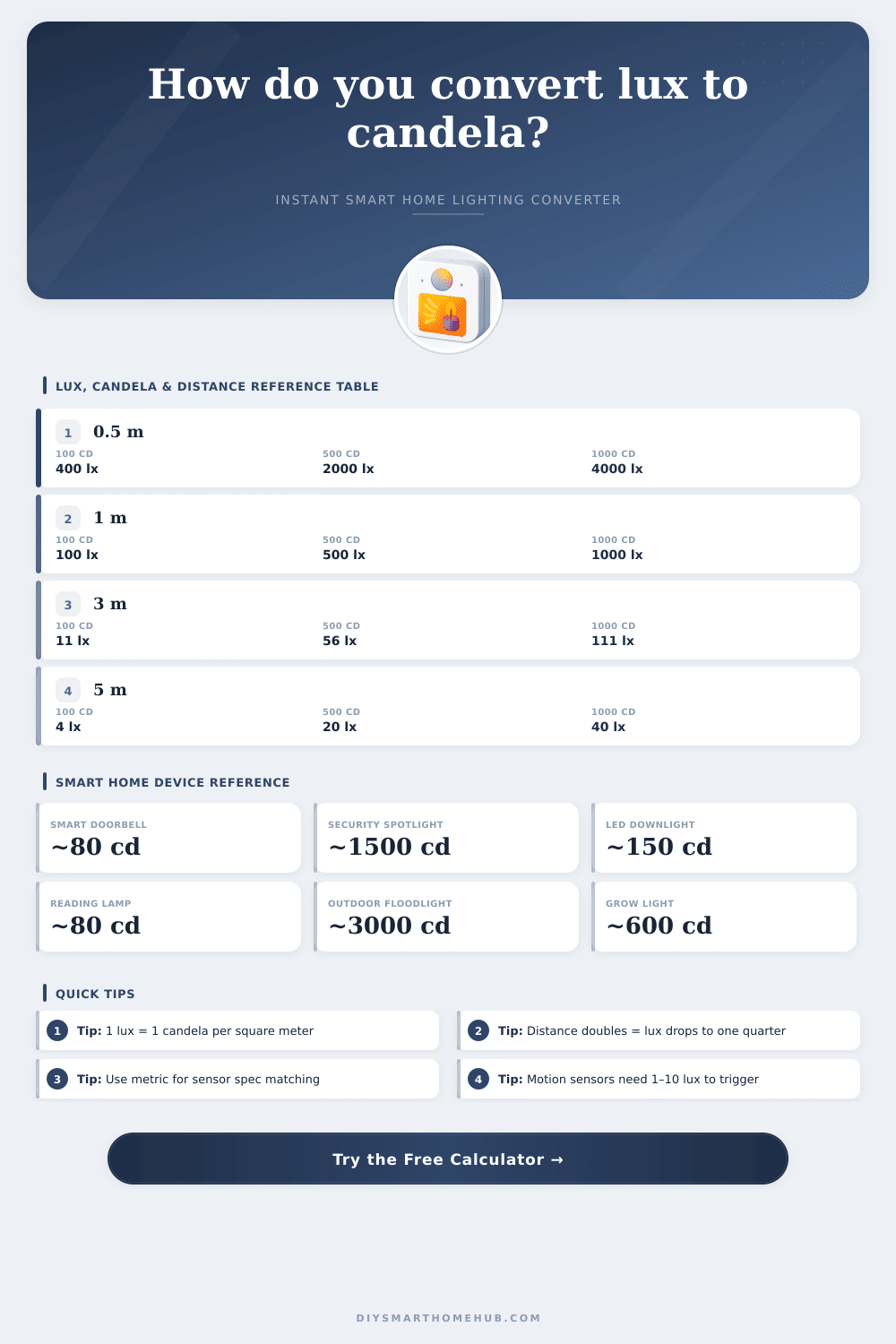
| Distance | 100 cd | 250 cd | 500 cd | 1000 cd | 3000 cd |
|---|---|---|---|---|---|
| 0.5 m | 400 lx | 1000 lx | 2000 lx | 4000 lx | 12000 lx |
| 1 m | 100 lx | 250 lx | 500 lx | 1000 lx | 3000 lx |
| 2 m | 25 lx | 62.5 lx | 125 lx | 250 lx | 750 lx |
| 3 m | 11.1 lx | 27.8 lx | 55.6 lx | 111.1 lx | 333.3 lx |
| 5 m | 4 lx | 10 lx | 20 lx | 40 lx | 120 lx |
| 7 m | 2 lx | 5.1 lx | 10.2 lx | 20.4 lx | 61.2 lx |
| 10 m | 1 lx | 2.5 lx | 5 lx | 10 lx | 30 lx |
| Device Type | Typical Candela | Lux at 1 m | Lux at 3 m | Typical Use |
|---|---|---|---|---|
| Smart Doorbell | 80 cd | 80 lx | 8.9 lx | Face illumination |
| Security Spotlight | 1500 cd | 1500 lx | 166.7 lx | Driveway, yard |
| LED Downlight | 150 cd | 150 lx | 16.7 lx | Room lighting |
| Reading Lamp | 80 cd | 80 lx | 8.9 lx | Task lighting |
| Outdoor Floodlight | 3000 cd | 3000 lx | 333.3 lx | Area security |
| Grow Light | 600 cd | 600 lx | 66.7 lx | Plant growth |
| Pathway Light | 40 cd | 40 lx | 4.4 lx | Walkway safety |
| Porch Light | 250 cd | 250 lx | 27.8 lx | Entry lighting |
| Motion Sensor Light | 500 cd | 500 lx | 55.6 lx | Triggered flood |
Light can be measured in several different ways. When you buy flashlights, car headlights or LED bulbs, it matters to understand the main three units: candela, lux and lumens. Each of them explains a particular part of how light behaves.
Candela measures the intensity of light that radiates from a source in a specific direction. An average candle has around 1 candela of luminous intensity which is where the name comes from… People called it “candle” in past times.
What Candela, Lux and Lumens Mean
Today people still use “candlepower” as a synonym for candela, especially talking about narrow beams as in powerful flashlights or spotlights.
Here it becomes interesting. A flashlight can have only few lumens, but seem however blindingly bright to your eye. Because all that light is squeezed into one narrow beam.
The reflector bowl and lens take the lumens of the bulb and focus them into candela and lux. If you put different lumen-rated bulbs in the same flashlight hosuing, you will get different amounts of usable light at your target.
Lux shows how much light actually falls on a surface. It measures the illumination at a specific distance from the source. The formula is: lux equals candela divided by distance in metres squared.
So each metre further from the light source, the lux value drops. At exactly 1 metre, candela and lux values are equal. Worth noting, lux is what your eye feels as brightness.
In photography, for instance, sunshine and flash pile their lux on the same surface… That’s why lux matters.
Lumens point to the whole amount of light that a source produces, without relation too direction or focus. It simply shows how many photons fly out. Lux is lumens spread across square metres.
If your metre shows 500 lux on 3 square metres, that matches 1500 lumens. That works best when the light spreads evenly. Mathematically, 1 lumen equals 1 candela times 1 steradian (a unit of solid angle).
The same 5-lumen source can give 10 candela, if you focus the beam tight enough. All three; lumens, lux and candela, are photometric SI units for lighting tech. The key difference though is: lumens show total output, while lux and candela consider how distance affects the real light at the target.
When you read a map, you do not need huge candela numbers. The actual standard for maximum throw distance of flashlights is when the lux at yourtarget falls to 0.25.