Lead Acid Battery Life Calculator
Estimate cycle life, service years, usable energy, runtime, and end-of-life capacity for flooded, AGM, gel, UPS, and lead-carbon battery banks.
⚡Real Backup Presets
🔋Battery Life Inputs
⚙Lead-Acid Spec Grid
📊Depth Of Discharge Cycle Reference
| Battery type | Light cycle DoD | Typical planning DoD | Estimated cycles at 50% DoD |
|---|---|---|---|
| Flooded deep-cycle | 20-30% | 50% | About 600 cycles |
| AGM deep-cycle | 20-30% | 50% | About 500 cycles |
| Gel deep-cycle | 20-30% | 50% | About 700 cycles |
| Sealed AGM UPS / SLA | 10-25% | 40-50% | About 250 cycles |
| Flooded starting battery | 5-15% | 20% or less | About 80 cycles |
| Lead-carbon AGM | 30-50% | 50-70% | About 1200 cycles |
🌡Temperature And Calendar-Life Reference
| Battery temperature | Calendar-life effect | Float behavior | Planning note |
|---|---|---|---|
| 50°F / 10°C | Slower corrosion | Needs proper voltage compensation | Capacity is lower while cold |
| 68°F / 20°C | Usually favorable | Stable float operation | Good for cabinet batteries |
| 77°F / 25°C | Most published baseline | Nameplate reference point | Default calculator temperature |
| 92°F / 33°C | Roughly half-life step | Overfloat risk increases | Ventilate sealed enclosures |
| 107°F / 42°C | Multiple half-life steps | Dry-out and grid corrosion risk | Avoid attic-style locations |
🔌Charging Voltage Reference
| 12V lead-acid setting | Typical voltage range | Purpose | Life impact |
|---|---|---|---|
| Float / standby | 13.5-13.8 V | Maintain full charge | Too high dries sealed cells |
| Absorption / cycle | 14.2-14.7 V | Complete recharge | Needed after discharge |
| Equalize flooded only | 15.0-15.8 V | Balance flooded cells | Not for AGM or gel |
| Storage open circuit | 12.6-12.8 V | Rested full battery | Recharge before sulfation |
| Low resting voltage | 12.0 V or less | Partly discharged | Do not store this way |
🏠Smart Home Backup Size Reference
| Backup scenario | Common bank | Typical load | Life planning focus |
|---|---|---|---|
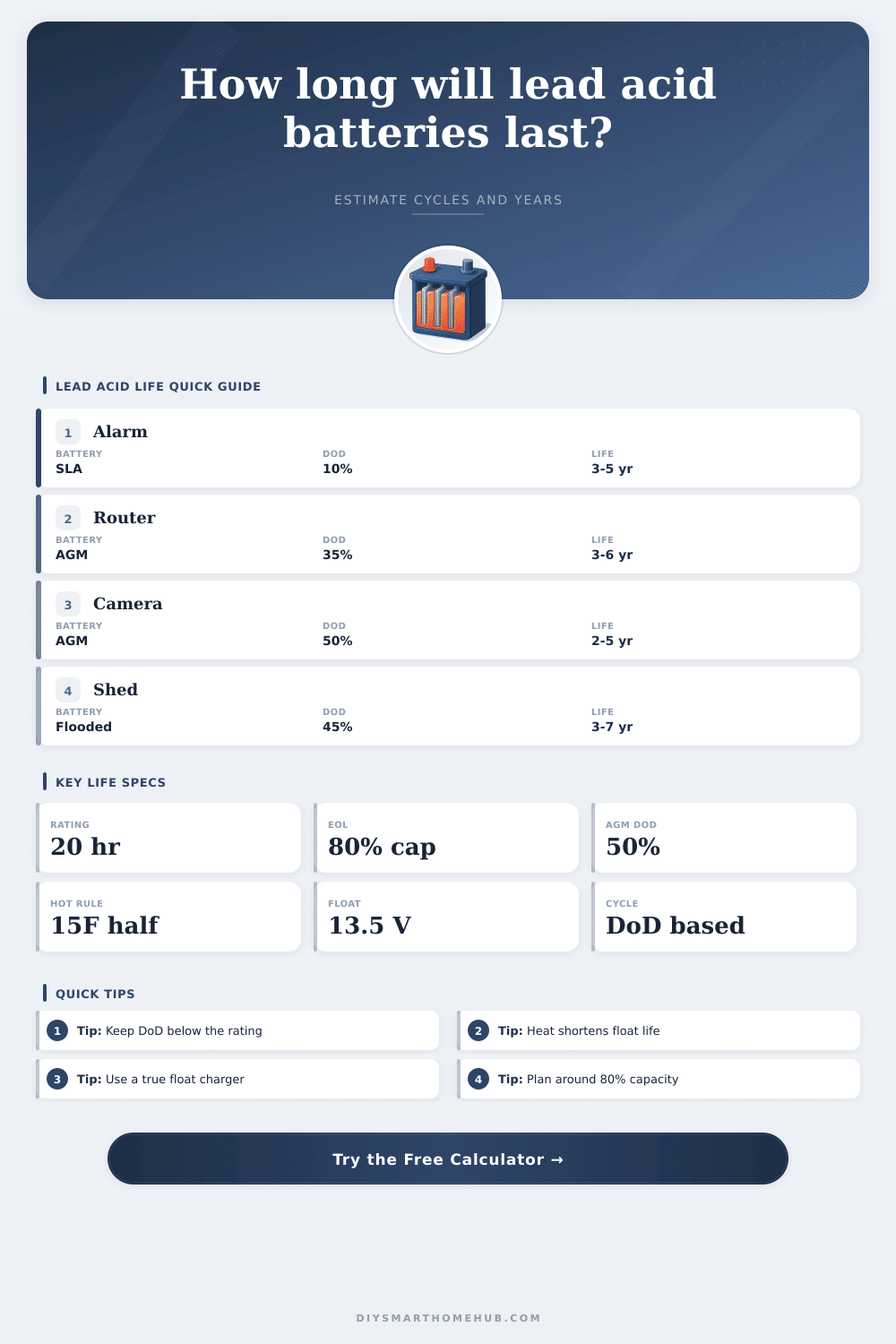
| Alarm panel sealed battery | 12V 7Ah SLA | 3-8 W | Calendar aging and float voltage |
| Router plus fiber ONT | 12V 35Ah AGM | 20-40 W | Moderate DoD and cabinet heat |
| PoE hub cabinet | 24V 100Ah AGM | 50-90 W | C-rate and recharge quality |
| Camera NVR backup | 24V 200Ah AGM | 120-180 W | Runtime depth and ventilation |
| Small shed lighting | 12V 100Ah flooded | 25-60 W | Daily cycles and water checks |
💡Calculation Notes
Lead acid batteries often fail to provide the expected amount of energy during a power outage due to the fact that the rated capacity of a lead acid battery dont always reflect the actual energy capacity of that battery. The rated energy capacity of a lead acid battery is often expressed in amp hour rating, which is the amount of energy the battery can provide over a period of twenty hours at a slow and steady rate. If a lead acid battery is required to providing that amount of energy rapidly, however, the lead acid battery becomes less efficienty in providing that energy due to the Peukert effect.
The Peukert effect is the phenomenon where a lead acid battery fails to be able to provide as much energy as it is rated to be able to provide, if it is required to provide that energy at a rapid rate. Thus, the faster that a lead acid battery is discharged, the less energy that it can provide to the device that utilize that energy from the battery. Another factor that affect the life of a lead acid battery is the concept of depth of discharge.
What Affects Lead Acid Battery Life
Depth of discharge is the measure of how deeply a lead acid battery is discharged relative to the total amount of energy that it can hold; the deeper a lead acid battery is discharged, the more energy that it has provided to the devices that utilize that energy. The depth of discharge can impact the longevity of a lead acid battery; if a lead acid battery is regularly discharged to zero percent, that deep discharge put physical stress upon the lead acid battery and causes it to fail more quickly. Thus, lead acid batteries will last fewer cycles if those batteries utilize deep discharge.
In many cases, people may purchase small and inexpensive lead acid batteries, but these small and inexpensive batteries will tend to fail quick. Thirdly, the factor of temperature of the battery affects the aging of a lead acid battery. The higher the temperature at which a lead acid battery is utilized and stored, the more rapidly the components of that battery will corrode; thus, hot environments will decrease the life of a lead acid battery.
Similarly, an increase in the temperature of the environment in which a lead acid battery is stored will shorten the life of the battery. Thus, a lead acid battery stored in a hot location will reach the end of its life more quickly than a lead acid battery stored in a cool location. Thus, the temperature of the location in which the battery is stored impact the life of that battery.
The type of charger that is used for a lead acid battery is another factor that can impact the life of that battery. Basic lead acid battery chargers tend to overcharge the batteries. Overcharging can cause the electrolyte in a sealed lead acid battery to dry out.
To avoid these issue, the use of a float charger with temperature compensation is recommended. A float charger with temperature compensation will automatically adjust the voltage that is provided to the lead acid battery based on the temperature of the air around the battery. Thus, a battery charged with a float charger with temperature compensation will not become boiling in hot weather due to overcharging, nor will it become undercharged during the winter month.
There are several different type of lead acid batteries with different lifespans. Flooded lead acid batteries require you to add distilled water to the battery to maintain the level of acid in the battery. AGM and Gel lead acid batteries is sealed and do dont require added maintenance.
Lead carbon lead acid batteries contain carbon in the lead plate of the batteries, and are able to undergo deeper discharges than other types of lead acid batteries. Lead acid batteries fail when they are unable to hold as much energy as they were manufactured to hold, usually around eighty percent of their original capacity. It is also possible to determine the cause of the failure of a lead acid battery.
The failure of a lead acid battery could be the result of calendar aging, wherein the battery simply becomes old with time, or due to cycle aging, wherein the battery has been deeply used of many cycles. In the case that cycle aging is the issue, purchasing a larger battery bank is one solution. If the lead acid batterys failure is due to calendar aging, however, moving the batteries to a cooler location in the house is another solution.
You should of checked the temperature first.