Lawn Watering Depth Calculator
Estimate catch-cup precipitation rate, target watering inches, sprinkler runtime, gallons by lawn area, and a weekly smart-controller schedule for each turf zone.
Formula breakdown
| Watering goal | Depth per week | Typical split | Runtime formula note |
|---|---|---|---|
| Cool-season maintenance | 0.25 to 0.50 in | 1 watering | Subtract useful rain before splitting the week. |
| Mild growing week | 0.50 to 0.75 in | 1 to 2 waterings | Runtime equals net target divided by measured PR. |
| Typical active lawn | 0.75 to 1.00 in | 2 waterings | Use catch-cup DU if dry spots lag behind average cups. |
| Hot or windy week | 1.00 to 1.50 in | 2 to 3 waterings | Split cycles when precipitation rate is above soil intake. |
| New sod establishment | 0.20 to 0.35 in per event | More frequent light starts | Use shallow targets until roots knit into soil. |
| Catch-cup result | Formula | Interpretation | Scheduling use |
|---|---|---|---|
| Average cup depth | Sum cup depths / cup count | Best field measure of average applied depth | Use for gross precipitation rate. |
| Catch-cup PR | Average depth / test min x 60 | Inches per hour from the real sprinkler pattern | Use for runtime by target inches. |
| Lower-quarter DU | Low-quarter avg / average depth | How well dry spots keep up with the average | Use dry-area mode for more complete watering. |
| Flow-area PR | 96.3 x GPM / sq ft | Useful cross-check when zone flow is known | Compare with catch cups for pressure or coverage issues. |
| Soil profile | Planning intake | Cycle signal | Controller note |
|---|---|---|---|
| Sand or loamy sand | 0.75 to 1.00 in/hr | Low runoff risk | Use fewer, deeper starts if roots are established. |
| Loam turf | 0.35 to 0.60 in/hr | Moderate runoff risk | Spray heads often need two cycles. |
| Clay loam turf | 0.20 to 0.35 in/hr | High runoff risk | Short cycles with soak gaps protect the target depth. |
| Clay lawn | 0.10 to 0.25 in/hr | Very high runoff risk | Use conservative cycle caps and verify with observation. |
| Slope or compacted soil | 0.08 to 0.20 in/hr | Severe runoff risk | Shorten cycles and consider lower-rate nozzles. |
| Zone example | Measured rate | Weekly target | Controller start plan |
|---|---|---|---|
| Front spray lawn | 0.75 in/hr with 76% DU | 1.00 in minus 0.20 in rain | About 32 minutes twice per week in dry-area mode. |
| Large rotor backyard | 0.45 in/hr with 80% DU | 1.20 in minus no rain | About 67 minutes twice per week, often split by soil. |
| Narrow side strip | 1.35 in/hr with 65% DU | 0.75 in minus 0.10 in rain | Short cycles, about 15 minutes three times per week. |
| Rotary nozzle retrofit | 0.55 in/hr with 82% DU | 1.00 in minus 0.25 in rain | About 28 minutes three times per week, lower runoff risk. |
May the lawn be brown in summer, patchy from recent watering? No, it is not because of soil problems or bad luck, but simply a matter of depth. Unless you gauge your sprinklers’ rate of wetting the ground, you have no clue how long it takes for half an hour to do anything but waste water. Guessing, most homeowners assumes it’s plenty to soak in for 30 minutes.
But 30 minutes is nothing, until you measure how fast each type of sprinkler head lay down the water. Sprays apply water very fast over small spots while rotors cover large areas. This disconnect, between time and real world moisture application… Are fixed by the calculator on this page. It makes you measure what your system does rather than assume it’s matching the manufacturers’ chart.
How to Water Your Lawn the Right Way
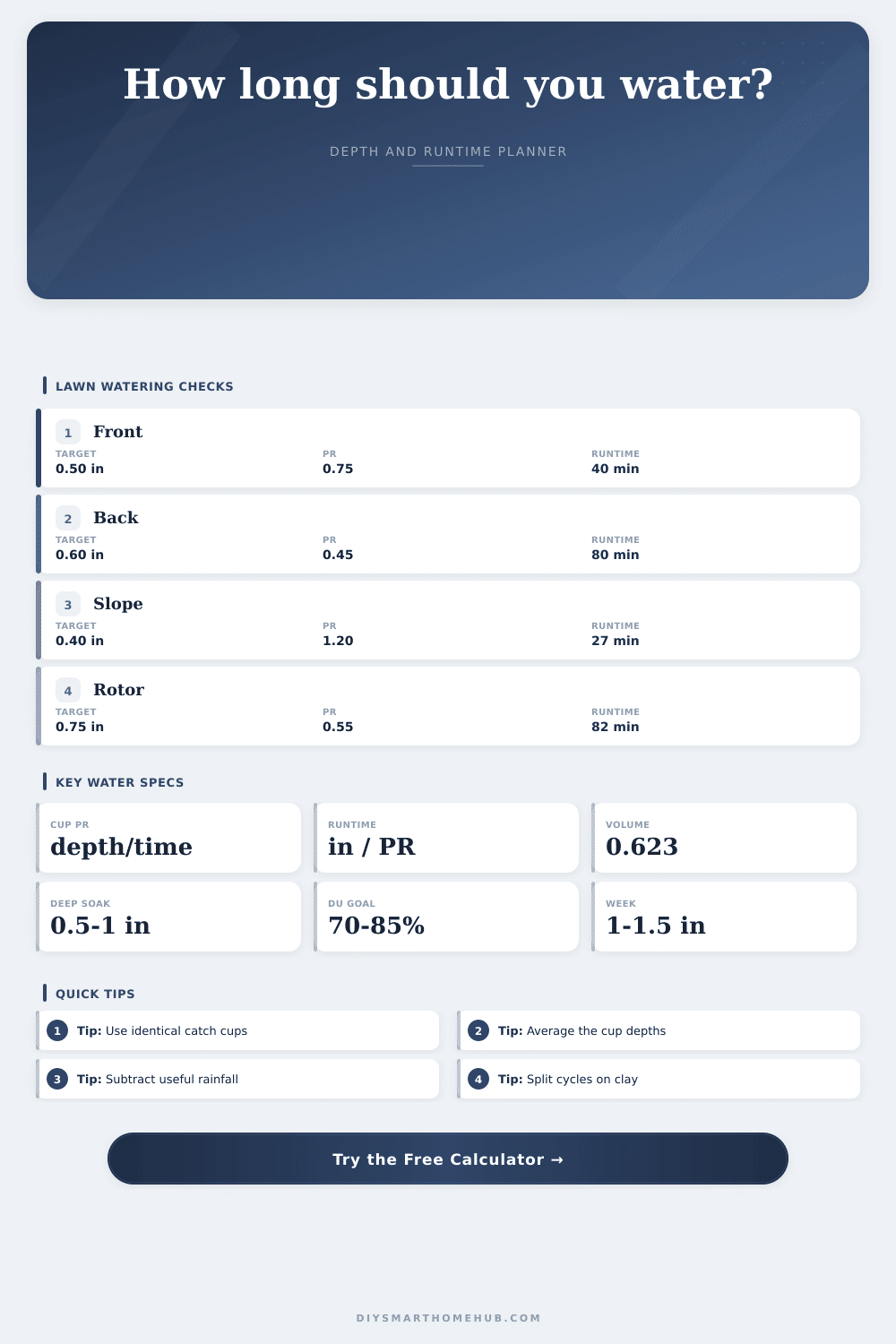
To get started: First calculate the precipitation rate, meaning number of inches of water falling per hour from your system. It is best done using audit tools such as catch cups (tuna cans). During a test, set down these devices at intervals across the zone where the sprinkler run. When the test period ends, see how deep the water was in each and average them all. Divide that average depth by duration of the run; this shows your real-world rate, which factors in any head spacing problems, pressure drops and other conditions.
So once you know that rate, the math becomes planning, how much water does my lawn require right now? Usually, lawns in high-summer requires roughly an inch a week; adjust based off weather conditions. If you got two good soaking rains last week, for instance, don’t replace that entire inch. That’s where the subtraction comes in: Use the tool to remove any useful rainfall, rain that didn’t just evaporate or run off but soaked into the soil. Divide what’s left (the net target) by your measured precipitation rate and you’ll know precisely how long to set your sprinkler on for to get the job done. No more waste on overspray, no more guesswork, it just ensures your lawn gets to the target depth.
That’s also true with the other factor: soil type. If yours is heavy clay, you don’t want to pour on an inch all at once because it won’t absorb; that inch of water will pond up and run off instead. For such soils, you must follow the soak-and-cycle approach: run the sprinklers briefly, turn them off to allow time for absorption, and then do it again. That’s when the reference tables on the page come into play, indicating that higher intake occurs on flatter then steep slopes and looser than dense soils. Sandy soil drinks fast so you can do longer sessions less often. A clay one require patience and shorter cycles.) Knowing what kind of dirt you’re working with is as important as understanding your sprinkler heads.
Another hidden variable that catches people out is that no two sprinkler zones waters uniformly. You’ll have some areas receiving twice as much water as others, and setting your timer based off the average cup-depth will leave those areas thirsting. For this reason, the calculator runs in “distribution uniformity” mode: It will add time to run the system so the driest quarter of the lawn receives enough water. (It feels like overdoing it, but isn’t; it’s adjusting for less-than-perfect equipment.)
With those numbers as your guide, you can set a schedule, making lawn care feel like maintenance rather than a chore. No more being reactive (Oh, no! The lawn’s brown!). Instead, be proactive. I’ll go out there when I’ve had 1/2 an inch of rain which should of been… By knowing exactly how much time to run each area to reach the desired depth (a half inch in springtime, or maybe an inch in high summer), you’ll save yourself some heartache. If you’re on a metered water system, it will help you keep tabs on your volume, too. The gallons-per-session figures puts things into perspective.
So in the end: If you want a healthier lawn, don’t water more… You want to water smart. That means getting the right amount of water to the root zone at the right depth (and no deeper, meaning no waste or runoff). Control the variables that count… Weather, soil and how much you actualy catch, by measuring what you get and adjusting to match.
You will have less guesswork, less stressed-out grass, deeper rooting, and probably lower water bills, too. All you have to do is start measuring with the cups instead of guessing with the clock. It’s typically as big a difference as you’ll find, and simpler than many imagine.