Automatic Feeder Kibble Hopper Days Calculator
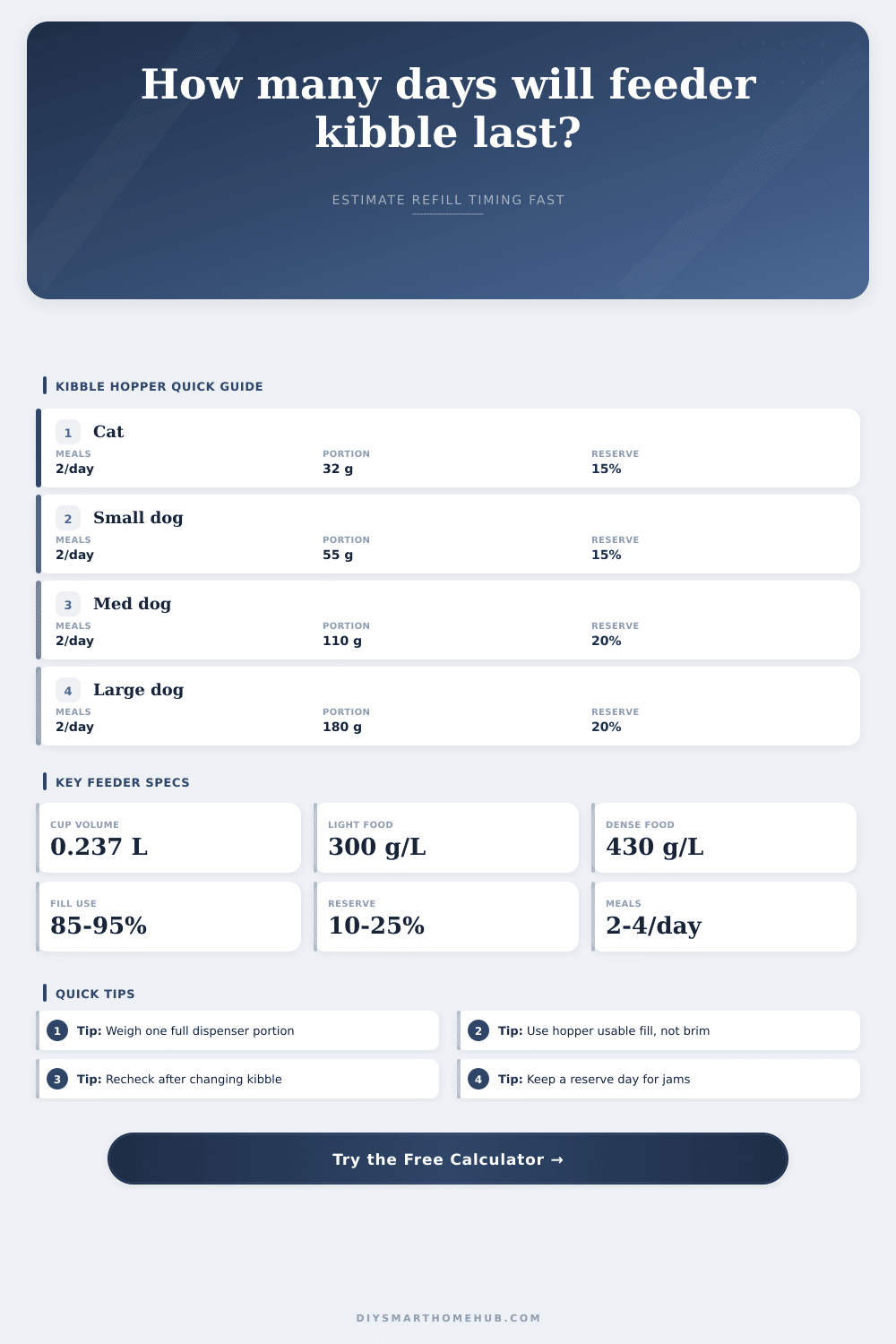
Estimate how many days a feeder hopper will last from usable hopper volume, kibble bulk density, pets, meals per day, portion grams, and reserve margin.
Formula breakdown
| Kibble type | Typical density | Approx grams per cup | Calculator note |
|---|---|---|---|
| Tiny round cat kibble | 380 to 450 g/L | 90 to 107 g/cup | Dense packing often makes hoppers last longer than app estimates. |
| Standard adult cat kibble | 330 to 410 g/L | 78 to 97 g/cup | Use 360 g/L when no measured value is available. |
| Small breed dog kibble | 320 to 400 g/L | 76 to 95 g/cup | Small pieces flow well and usually fill more evenly. |
| Medium dog kibble | 280 to 360 g/L | 66 to 85 g/cup | Large air gaps reduce grams stored per liter. |
| Large breed kibble | 240 to 330 g/L | 57 to 78 g/cup | Measure density because shape changes capacity noticeably. |
| Air-dried or light formula | 180 to 280 g/L | 43 to 66 g/cup | Low-density food can cut hopper days sharply. |
| Pet and feeding pattern | Meals per day | Portion grams | Daily grams |
|---|---|---|---|
| Indoor cat maintenance | 2 | 28 to 38 g | 56 to 76 g/day |
| Two cats sharing one feeder | 2 each | 30 to 40 g | 120 to 160 g/day |
| Toy dog measured meals | 2 | 35 to 55 g | 70 to 110 g/day |
| Small dog maintenance | 2 | 55 to 80 g | 110 to 160 g/day |
| Medium dog maintenance | 2 | 95 to 140 g | 190 to 280 g/day |
| Puppy split schedule | 4 | 35 to 65 g | 140 to 260 g/day |
| Rated hopper size | Liters | Food at 360 g/L | Best planning use |
|---|---|---|---|
| 8 cup compact feeder | 1.89 L | 680 g before fill and reserve | Single cat, short refill cadence |
| 12 cup counter feeder | 2.84 L | 1.02 kg before fill and reserve | Cat or toy dog daily feeding |
| 4 L smart feeder | 4.00 L | 1.44 kg before fill and reserve | Single pet with multi-day buffer |
| 6 L full-size feeder | 6.00 L | 2.16 kg before fill and reserve | Multiple cats or one medium dog |
| 2 gallon bin feeder | 7.57 L | 2.73 kg before fill and reserve | Large dog or longer travel reserve |
| Scenario | Usable volume | Daily food | Estimated days |
|---|---|---|---|
| 4 L hopper, one cat, 15% reserve | 3.6 L at 360 g/L | 64 g/day | About 17.2 days |
| 6 L hopper, two cats, 15% reserve | 5.4 L at 360 g/L | 140 g/day | About 11.8 days |
| 6 L hopper, medium dog, 20% reserve | 5.1 L at 320 g/L | 220 g/day | About 5.9 days |
| 2 gal hopper, large dog, 20% reserve | 6.8 L at 290 g/L | 360 g/day | About 4.4 days |
When you go on vacation and need someone to feed the cat, you don’t want to panic about whether she’ll eat fast enough that the kibble runs out. Why do you panic? Because you can’t account for how fast kibble goes through an auto-feeder.
It’s not just a matter of mechanics. I.e. This refers to the air gap around the pellets or the plastic bin. A visual “full” doesn’t mean it has enough weight for multiple days. People think they’ve filled the hopper fully and it will last a week, and instead end up with jams because mass wasn’t adequate to start. The machine is fine most of the time; we have trouble understanding volume/weight inside an odd-shaped container.
How to Fill Your Auto-Feeder Correctly
If you specify what kind of kibble you use and how big your hopper is, the calculator on the page take care of all this for you. It also shows issue of bulk density, which makes sense once you think about massive chunks versus tiny little round things. Small pellets are dense and pack tightly, filling every nook in the bin with actual food mass. Big chunks don’t fill out the bin so much; they’re stacked on each other with lots of empty air inside.
The six liter hopper could be full or half-full depending on how well packed it was, though it would appear identical no matter what. That’s a real thing and it drastically alters your refilling timetable. Don’t take it at face value, check what comes out of the feeder. Many times they’ll dispense 10-20g too much/less different than what is displayed on the app. If you assume a thirty-gram meal but the machine actualy dumps forty grams, your reserve will vanish much faster then predicted.
Weigh your meals for a few days and you’ll see what they are really consuming. Then use that figure to calculate how many “days” of reserve you has remaining (after subtracting headspace). No one fills their hopper all the way to the top, there’s always room needed for the lid and sensors. It’s common to leave 10-15% open, basically reducing your capacity by that amount even before food is eaten.
Many people is surprised at how the shape of kibbles affects the flow too. Irregular or flat shapes tend to clog the dispensing chute, creating jams that stop feeding until you clear them by hand. Having a little reserve not only prevents this but makes sure mechanical function remains reliable. Once the hopper is totally empty, static electricity and increased friction will make it hard for new loads to move through without jamming. The buffer keeps the auger working on material instead of turning on bare plastic.
Things gets complicated fast when there are multiple pet. Two cats mean double the daily draw on the same fixed volume. So you can’t just divide by two; if you have two cats you has to recalculate based off total mass available versus total mass consumed. For example: One cat may be good for two weeks on a full four-liters; two will probably reduce it to about half that time.
The key is knowing those proportions so you don’t come home from vacation to find an empty feeder and angry animals. By planning now, you’re not only taking the guessing game out of feeding logistics, but you also know exactly how far in advance to restock the food. Now it becomes just another task to check off on your calendar, no longer a potential crisis that might arise.
It’s about providing consistency for your furry friend and peace of mind for you, think of the feeder as a reservoir with a fixed amount instead of an endless well. With this knowledge in hand, you’ll be able to pack up your bags without glancing back at the kitchen counter.