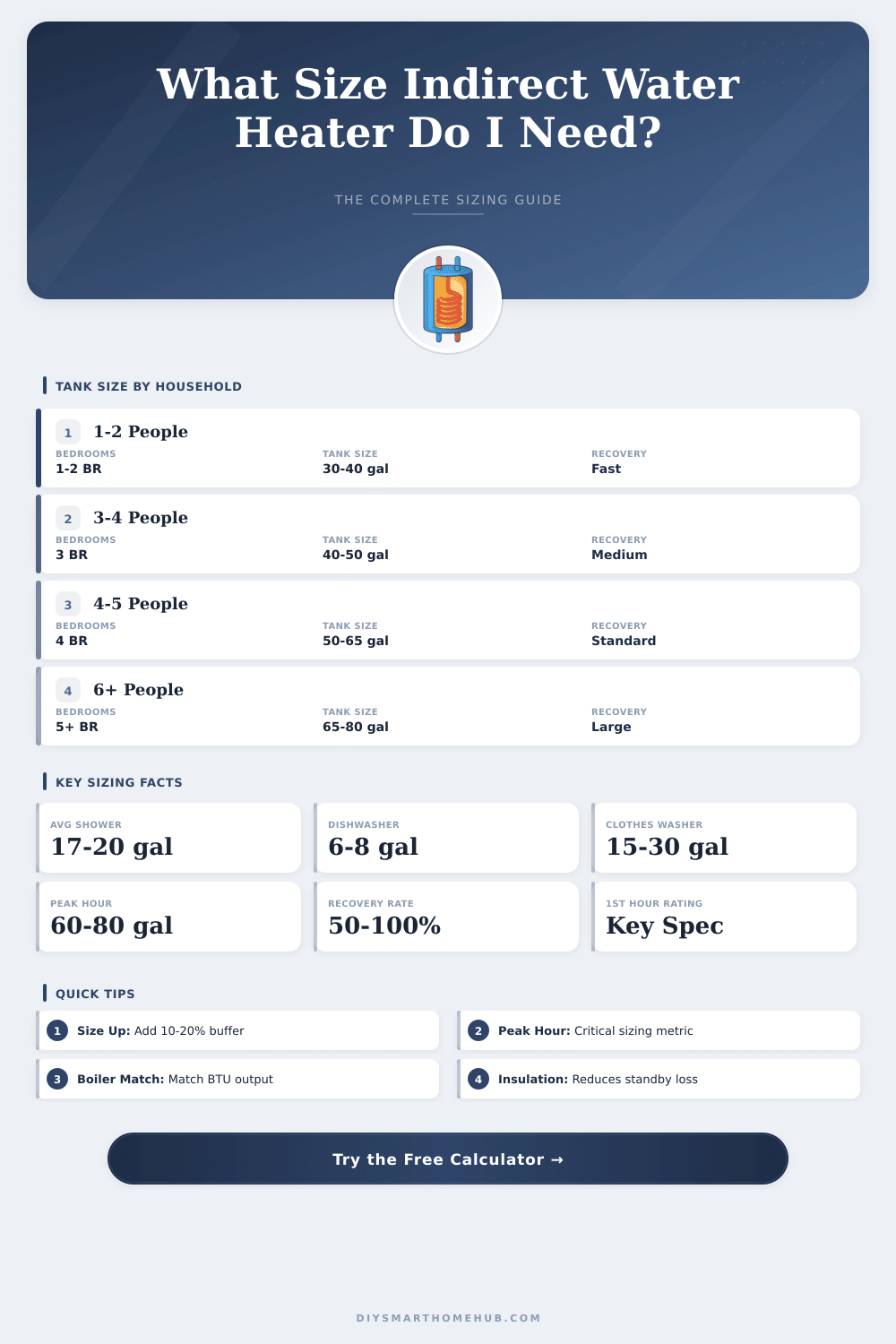
🌡️ Indirect Water Heater Sizing Calculator
Find the right tank size and first-hour rating for your home — based on occupants, usage, and boiler output.
| Fixture / Appliance | Gallons Used | Liters Used | Flow Rate (GPM) |
|---|---|---|---|
| Standard Shower (8 min) | 17–20 gal | 64–76 L | 2.0–2.5 GPM |
| Low-Flow Shower (8 min) | 12–14 gal | 45–53 L | 1.5–1.8 GPM |
| Bath (full tub) | 30–40 gal | 114–151 L | — |
| Dishwasher (cycle) | 6–8 gal | 23–30 L | — |
| Clothes Washer (hot) | 15–30 gal | 57–114 L | — |
| Kitchen Faucet (per use) | 1–3 gal | 4–11 L | 1.5–2.0 GPM |
| Bathroom Faucet (per use) | 0.5–2 gal | 2–8 L | 1.0–1.5 GPM |
| Boiler Output | Boiler Output (kW) | Recovery Rate (GPH) | Recovery Rate (L/hr) |
|---|---|---|---|
| 50,000 BTU/hr | 14.7 kW | ~44 GPH | ~167 L/hr |
| 80,000 BTU/hr | 23.4 kW | ~71 GPH | ~268 L/hr |
| 100,000 BTU/hr | 29.3 kW | ~88 GPH | ~333 L/hr |
| 120,000 BTU/hr | 35.2 kW | ~106 GPH | ~400 L/hr |
| 150,000 BTU/hr | 44.0 kW | ~132 GPH | ~500 L/hr |
| 200,000 BTU/hr | 58.6 kW | ~176 GPH | ~666 L/hr |
| Household Size | Peak Hour Demand | Min FHR (gal) | Recommended Tank |
|---|---|---|---|
| 1 Person | 20–30 gal | 24 gal | 30 gal |
| 2 People | 30–45 gal | 35 gal | 40 gal |
| 3 People | 45–60 gal | 50 gal | 50 gal |
| 4 People | 55–75 gal | 60 gal | 65 gal |
| 5 People | 70–90 gal | 74 gal | 80 gal |
| 6+ People | 85–110 gal | 90+ gal | 80+ gal |
| Tank Size | Volume (L) | Typical FHR | Best For |
|---|---|---|---|
| 30 gallon | 114 L | 40–55 gal/hr | 1–2 people |
| 40 gallon | 151 L | 55–75 gal/hr | 2–3 people |
| 50 gallon | 189 L | 70–95 gal/hr | 3–4 people |
| 65 gallon | 246 L | 85–115 gal/hr | 4–5 people |
| 80 gallon | 303 L | 100–140 gal/hr | 5–6 people |
| 119 gallon | 450 L | 150–200 gal/hr | 6+ people / commercial |
Indirect water heaters well answer for back up warm system. They help the boiler to heat the domestic water. Rather than independent devices with own burner, these tanks take heat from already existent installation.
Like this they become part of a warm net. The home heating system care about the water warming. Because of that you also call them sidearm tanks.
How Indirect Water Heaters Work with a Boiler
The boiler heats liquid in separate tank, what heats up the water for later use. So indirect tanks require an active boiler.
The way it works happen by means of heat transfer. The boiler heats liquid, usually water or antifreeze mix. This liquid circulates through wrapping of heat exchanger in the water tank.
The fired water never mixes with the water of the tank. It only passes through the wrappings of the exchanger. Like this it heats the water for home usage.
Basically the boiler performs everything, during the indirect heater only help heat transfer. Any blending of liquids happens. The water tank keep energy, what allows less often or switch the boiler.
That saves energy.
Models as the PowerStor Series Single Wall indirect water heaters operate together with boiler for reliable and efficient hot water solution. This model has one wall heat exchanger. That gives faster hot water and better heat transfer.
HTP high efficiency indirect water heaters use brilliant stainless steel. It ensures excellent warming and long life of the tank. Well installed indirect will last 20 until 30 years.
Electric water heater commonly only ten years. Burnham indirect water heaters have incredibly fast hot water recovery. They ideal for families with high hot water need.
Because the tanks keep heat like this well, users never complain about lacking water.
Widely indirect water heaters coincide with every type of boiler, regardless of fuel source. If hot water now operate well, switching to a apt indirect heater probably would give more water, no less. Current water heater has around 40,000 BTU.
Indirect water heater receive heat of the boiler, that commonly surpasses that value. The wrapping can hand over 140,000 BTU from the boiler to domestic hot water. That delivers much more of hot water in first phase than direct system.