Ice Melt Product Coverage Calculator
Estimate deicer product pounds, bag count, chloride type temperature effectiveness, seasonal storm supply, and chloride runoff load from your treated area and conditions.
❄Ice melt presets8 practical surface and storm cases
Loaded preset: Home Walkway. Adjust the product, temperature, ice thickness, label rate, bag size, storm count, and sensitive surface factor to match your site.
📏Surface and product inputsLabel rate is adjusted for real conditions
🧊Ice melt estimateAdjusted for temperature and ice thickness
📦Material snapshotUpdates with the current product
📋Product temperature referenceCommon planning values
| Product type | Practical temperature floor | Typical label rate | Runoff note |
|---|---|---|---|
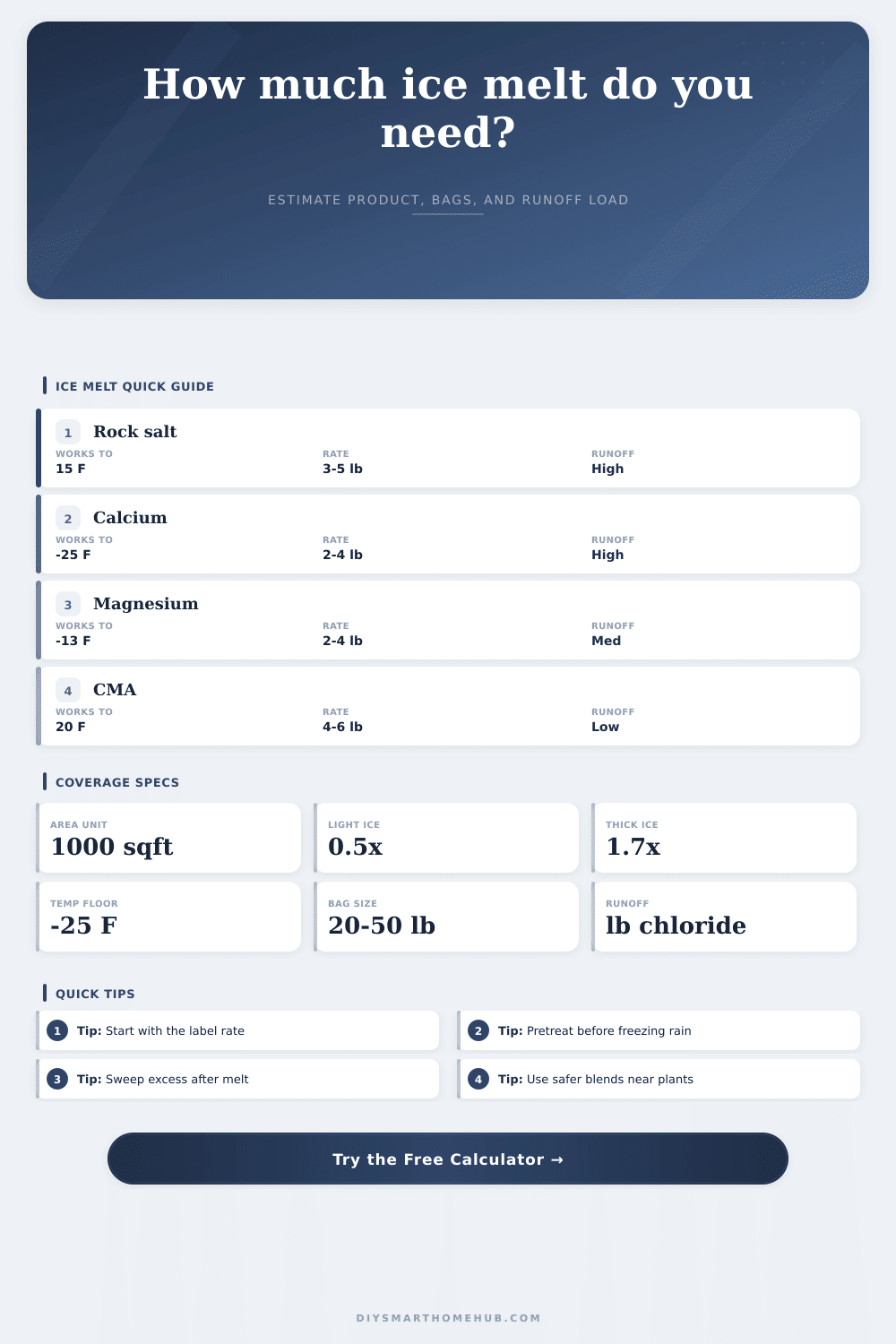
| Rock salt sodium chloride | About 15°F | 3 to 5 lb per 1,000 sq ft | High chloride fraction; use sparingly near turf and waterways. |
| Calcium chloride pellets | About -25°F | 2 to 4 lb per 1,000 sq ft | High chloride fraction but effective at colder pavement temperatures. |
| Magnesium chloride blend | About -13°F | 2 to 4 lb per 1,000 sq ft | Moderate chloride fraction with lower application rates. |
| Potassium chloride blend | About 12°F | 3 to 5 lb per 1,000 sq ft | Chloride load remains meaningful; avoid excess near plants. |
| Calcium magnesium acetate CMA | About 20°F | 4 to 6 lb per 1,000 sq ft | Low chloride option for sensitive concrete and landscaped areas. |
| Sand and salt traction mix | Depends on salt share | 8 to 15 lb per 1,000 sq ft | Provides traction; chloride load follows the salt percentage. |
📊Adjustment factor guideHow the calculator scales label rate
| Condition | Calculator factor | Formula role | Planning interpretation |
|---|---|---|---|
| Trace frost or pretreating | 0.55 to 0.80 | Thickness factor below 0.05 inches | Often enough to break bond before scraping or shoveling. |
| Light glaze | 0.80 to 1.10 | Thickness factor near 0.10 inches | Matches many bag-label coverage examples. |
| Bonded ice | 1.20 to 1.50 | Thickness factor around 0.25 to 0.50 inches | Product helps loosen bond; mechanical removal still matters. |
| Cold pavement near product floor | 1.10 to 1.60 | Temperature factor increases as effectiveness drops | Cold conditions need patience and may justify a colder-rated product. |
| Sensitive surface | 0.70 to 0.85 | Surface factor reduces the adjusted product rate | Use smaller amounts, sweep residue, and avoid repeated overapplication. |
🔍Common coverage scenariosExamples use normal pavement factor
✅Application tipsKeep the calculation practical
Always follow the product label and local winter maintenance rules. This calculator estimates material planning quantities and chloride load indicators from entered assumptions.
The formula is this: there’s an exact amount of salt that will turn ice to water, and anything more than that just wastes your concrete and your money. The calculator above do the math for you. And it transforms vague estimates into precise bag counts and pounds of de-icer. Here’s why those figures matter.
For most folks, ice melt is fertilizer, which is treated as more-is-better. That is good thinking for a tomato plant, but it does not work on pavement. Over-salting make a chemical soup that becomes too concentrated. The ice won’t freeze than, and instead stays sitting as a slushy mess. Days later it dries, leaving white crust on your boots.
Why You Should Not Use Too Much Ice Melt
The product doesn’t actually make the ice go away; it’s a thermodynamic process called ice melt in a bag. What it does do is lower the freezing point of water until the ice melts even when temperature wouldn’t normaly be low enough for it. There is a practical floor with every product; at about fifteen degrees Fahrenheit, rock salt stop performing. If pavement temperature is ten degrees, pouring additional rock salt won’t help. You’ll have some sitting on your driveway. You need something like calcium chloride, which can works down to twenty-five below zero.
In addition to taking into account the air temperature outside, the calculator will adjust its estimate based off actual pavement temperature and what product you’re using. A few shaded spots remains cold longer, and that makes the difference between a full-blown shoveling session versus a quick scrape first thing in the morning.
The other thing that folks overlook is thickness, where maybe you have to put on two pounds per thousand square feet of thin ice. Maybe you has six pounds of stubborn ice from last week’s storm that is already bonded together and compacted. In that case, the calculator adjust the application rate based on a “thickness” factor. If the ice is stubborn, it increase your rate. You don’t want to make mistake of putting a light rate on top of bonded ice. You’ll spread it out and wait a couple of minutes then say the product didn’t work. You just under-dosed it for the condition.
The active ingredient in rock salt is chloride. That doesn’t go anywhere when ice goes away; it simply gets washed down the hill (and then into the sewer system from there, which explains why this calculator calculate how much of your chloride load is headed where). Consider using a calcium magnesium acetate mix if you are concerned about runoff reaching a storm drain or have plant bordering the walkway. This mix has a lower chloride threat, but it also has a higher temperature floor and costs more by weight. You sacrifice performance for protection; that’s a valid trade if your landscaping is older than your driveway.
“Planning involves bag size and storm count. You might use five pounds in one storm. Thirty pounds will be used in six storms. That equates to one 50 pound bag, or three 10 pound bags. This may sound easy; however folks purchase too much for an event or too much for the entire season. Using the preset scenarios helps visualize this. A warehouse dock is not like a home walkway. The math is different than the area but the rule remains.
The secret weapon is pretreating. By putting down some salt before the snow falls, it breaks the bond of ice to concrete. Now you need only half as much to maintain it clear. The calculator notes this: thinner thickness factor for trace frost. Not just do you melt the ice, but you prevent its sticking in the first place.
When you know that ice melt is a management tool, not a deletion spell, you stop fighting the weather. Instead you work with the chemistry and keep the dosage right. Sweep up leftovers, respect the temperature floor, and your concrete will thank you. Your boots will be cleaner, too.