Geothermal Well Depth Calculator
Estimate total active bore length, recommended well count, actual depth per well, grout quantity, loop fluid volume, and wellfield fit for a vertical ground loop. Switch between imperial and metric units, compare geology and grout combinations, and see how spacing, EWT targets, and loop selection change the first-pass design.
Each preset loads a realistic well-depth starting point for a vertical loop. They are intended for sanity checks only and should still be reconciled against local geology, drilling practice, and the selected heat pump data.
These are first-pass geothermal well-depth estimates only. Final vertical loop design should still verify geology, grout spec, casing needs, pump head, flow balance, and the exact heat pump entering water limits.
Ground conductivity and moisture drive the biggest depth swings. Strong grout can help, but the geology assumption still matters more than the grout package alone.
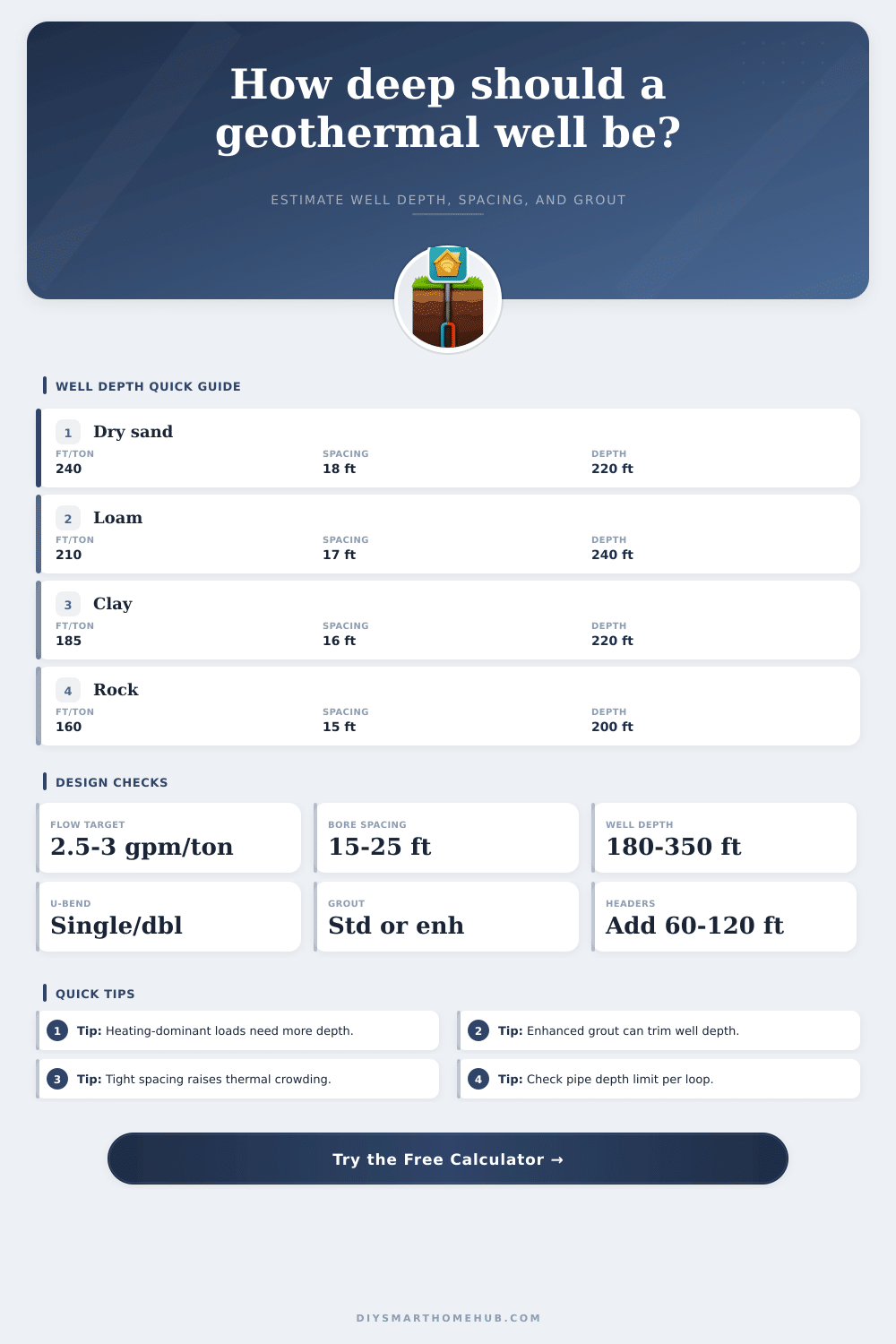
| Ground profile | Conductivity | Typical ft/ton | Spacing | BTU/h-ft | When it fits best |
|---|
| Configuration | Legs | Max depth | Flow band | Fluid volume | Best use |
|---|
| Project | Load | Typical bore plan | Spacing | Design note |
|---|
A deeper well can reduce well count, but only if pipe configuration, grout, and pumping strategy still support the depth you want to drill. The best layout is balanced across all three.
Driveways, setbacks, underground utilities, and rig maneuvering space often shrink the true drillable footprint more than owners expect, especially on retrofit urban sites.
The depth of geothermal well can a lot diversify. It depends of the geology for boreholes in BGHE systems. Those commonly have 150 until 200 feet of depth do not exist one right depth for geothermal hejtsistemo.
Best are talk with local professional instalisto of geothermal systems. Such expert personality knows as design the system according to the local soil.
How Deep Are Geothermal Wells
The whole depth estimates the kind of system the celuso of the well and grundaj provisions. Vertical wells usually reach 300 feet or more in rock. Horizontal systems operate otherwise because one installs them only 5 until 6 feet under the surface.
Minimal depth for horizontal terŝlosiloj are 6 feet but 8 feet more bonegas. These usually go 5 until 6 feet deeply. Note that slices more than 5 feet can danĝri because of gluado of walls.
Different targets require different depth. For farming or commercial heating one bears mezprofundajn wells of 400 until 1500 feet. Electrical product requires deep boring for reach warm water.
These go of 1500 until 10000 feet or more. Some drafts work in 3 until 5 kilometers. Vertical wells were the earliest in geotermio similarly to naftoindustrio and it stays efficient because of cost.
Maximum accustoms 10000 feet. Some geothermal wells also extend horizontally long distance.
Engineers count depth for geothermal boreholes. That helps to set as far as deeply go for best impact. In closed geothermal system water circulates through underground key.
It absorbs heat vintre and give it somere in stable depth. Matter to bury the tubes quite a lot deeply against cold. That operates because underground temperatures do not adjust although outside are varme or freezingly.
Under 20 feet the surface changes quickly delay.