Geothermal Payback Calculator
Compare a ground-source heat pump against your current heating and cooling setup using conditioned area, climate, loop type, geothermal performance, incentives, and monthly break-even tracking in one model.
📌Preset Scenarios
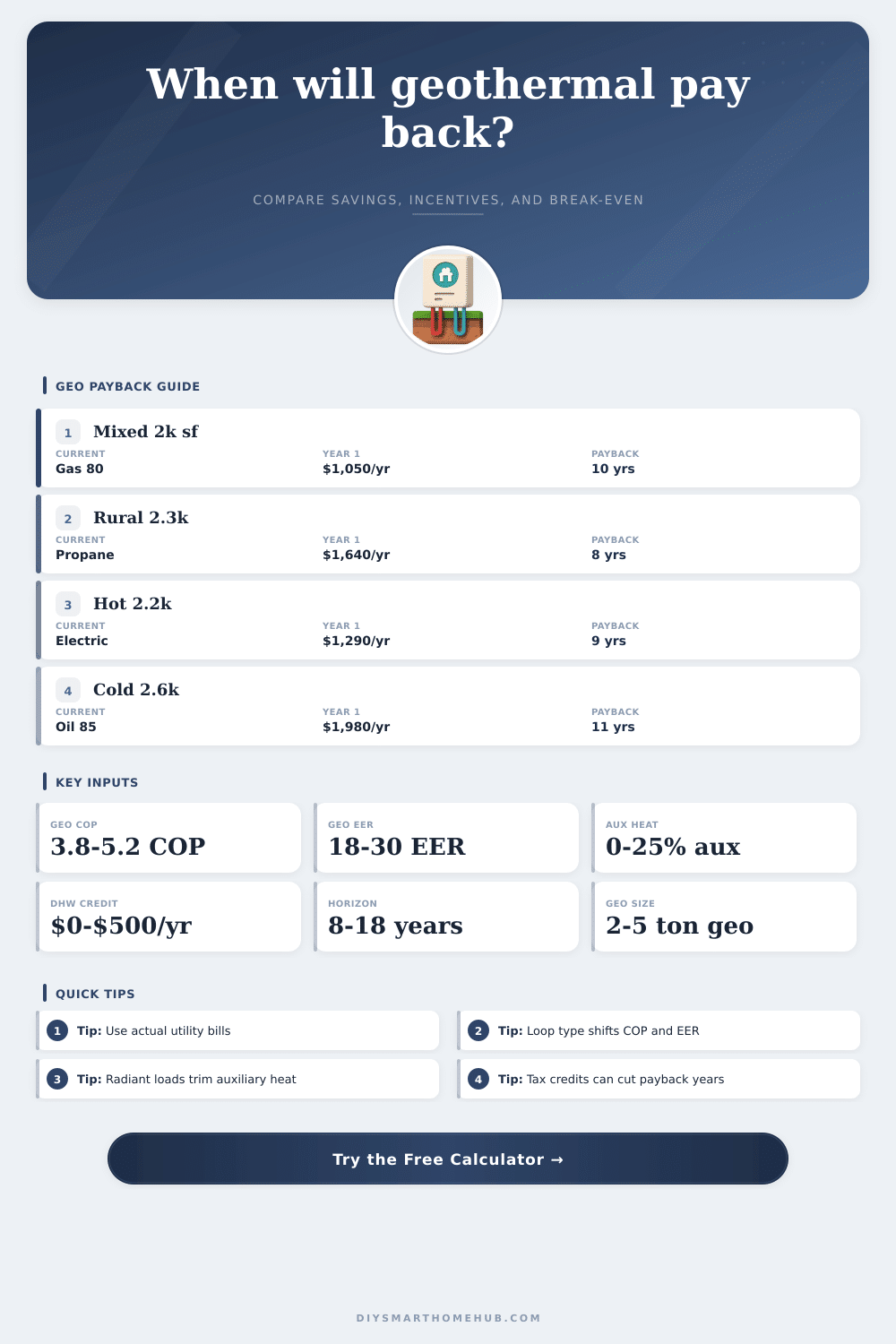
Loaded preset: Mixed-climate gas furnace replacement with attic ducts, 13 SEER cooling, and a 3-ton variable-speed geothermal system on a vertical loop.
⚙Home and Payback Inputs
The model estimates annual heating and cooling energy for the current equipment, then compares that with geothermal compressor power, pumping power, auxiliary heat, maintenance, desuperheater credit, and incentives.
📈Estimated Payback Results
💡Geothermal Profiles
These reference cards summarize common geothermal equipment classes used in the payback model. Each one stores nominal size, seasonal efficiency, pump watts, and delivery assumptions.
📊Reference Tables
Use the tables below to compare climate defaults, loop assumptions, current-system baselines, and modeled preset outcomes before adjusting the economics to match your home.
| Climate | HDD | CDD | Design F |
|---|
| Loop | EWT Heat | EWT Cool | Note |
|---|
| Current System | Heating | Fuel | Delivery |
|---|
| Preset | Current | Geo | Year 1 |
|---|
📝Project Notes
Utility history beats guesswork
Annual fuel and electric bills are the best reality check. If the modeled current operating cost is far from your recent totals, tune rates, shell profile, duct losses, and degree days before trusting the payback output.
Loop design changes economics
Vertical bores often cost more upfront but can hold steadier winter entering water temperatures, while pond or open-loop systems may boost efficiency enough to materially shorten the break-even window.
Geothermal technology helps to save money daily. It does not need to work so strong for heating or cooling the house, because it benefits from the stable temperature underground. Like this it operates more effectively and can give up to 80 % of savings compared with an old system.
Some folks even can heat or cool his home for less than the price of a cup of coffee at a coffee shop. The yearly expense for heating and cooling could reach only 365 dollars. By means of a Waterless DX geothermal unit you can receive even free warm water thus save more.
How Geothermal Can Save You Money
A calculator show, as far as you save on energy bills, if replace the current heating and cooling system by means of a WaterFurnace geothermal system. Free calculator compares it with traditional HVAC during 10, 20 or 30 years. It takes in reflection energy savings, upkeep and finances.
So you can estimate the whole cost over time. Some utilities even point, that geothermal cost 22. 28 % less each term for heating.
For exactly estimate the return of investment, you need know the yearly savings on energy. You must know also the cost difference between a geothermal system and other heater or central air conditioner. The payback period in years calculates divideable: savings shared by cost.
A geothermal heat pump with 20,000 dollars of raw install price and 30-percent tax credit costs initially only 14,000 dollars. At 1,400 dollars of yearly savings it will pay itself in 10 years. Federal tax credits shorten the period to 5…
10 years. Various federal, state and local incentives help offset installation and increase the return.
During life cycle cost analysis matter to estimate the expecting age of the ground loop machines. Consider, whether residual value you includes and how long is the period. Major gear would can replace after 25 years.
Payback figures count for well installed systems. A geothermal cost estimator operate by means of input of home size and place. An ROI calculator helps to estimate the payback against your present HVAC system.