Generator Runtime Calculator
Estimate how many hours your generator can support a measured load, including fuel reserve, altitude derating, starting surge, fuel type, and low-load fuel waste.
🔌Real-World Presets
⚙Generator And Load Inputs
Runtime Estimate
📊Generator Class Spec Grid
⛽Fuel Energy And Runtime Assumptions
| Fuel type | Energy basis | Typical electric efficiency used | Best runtime range |
|---|---|---|---|
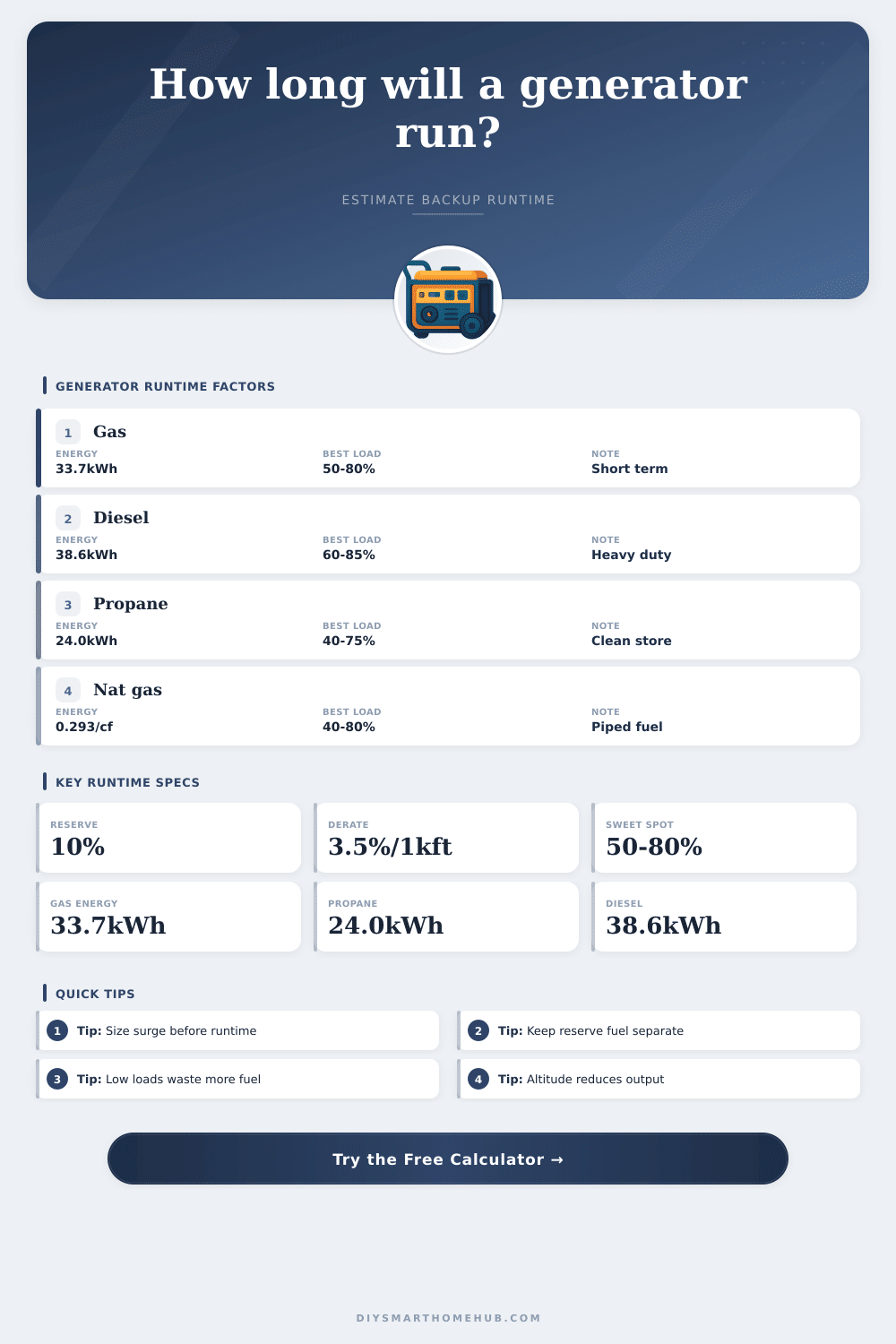
| Gasoline | 33.7 kWh per gallon lower heating value | 18 percent at half load, 22 percent near full load | Portable generators, short outage fuel storage |
| Diesel | 38.6 kWh per gallon lower heating value | 24 percent at half load, 30 percent near full load | Heavy-duty or long-duration backup loads |
| Propane | 24.0 kWh per gallon liquid propane | 16 percent at half load, 20 percent near full load | Stored standby fuel with cleaner long-term storage |
| Natural gas | 0.293 kWh per cubic foot, approximate utility gas | 16 percent at half load, 20 percent near full load | Piped standby systems where fuel volume is planned |
Fuel data uses common lower heating value references and practical small-generator efficiency bands. Actual runtime changes with engine tune, temperature, load cycling, fuel quality, and generator design.
🔧Load Tier Reference Table
| Load on generator | Runtime behavior | Fuel planning note | Calculator treatment |
|---|---|---|---|
| Under 25 percent | Usually quiet but inefficient per delivered kWh | Consider a smaller inverter generator for light electronics | Applies a low-load efficiency penalty |
| 25 to 50 percent | Good runtime for refrigerators, internet gear, and chargers | Eco throttle can help if loads are steady | Interpolates toward half-load efficiency |
| 50 to 80 percent | Strong operating range for many portable generators | Leave surge margin for pumps and compressors | Uses the main efficiency curve |
| Over 80 percent | Runtime falls and voltage recovery can be weaker | Reduce load or use a larger generator for long outages | Flags high load in the result status |
🔋Common Backup Load Examples
| Backup load | Typical running watts | Extra starting watts | Runtime impact |
|---|---|---|---|
| Full-size refrigerator | 120 to 250 W cycling average | 600 to 1,200 W extra startup | Low average load, but surge must be allowed |
| 1/3 hp sump pump | 800 to 1,000 W while pumping | 1,300 to 2,000 W extra startup | Runtime depends on duty cycle during storms |
| Window or portable AC | 900 to 1,500 W running | 1,200 to 2,500 W extra startup | Raises fuel burn because duty cycles can be long |
| WiFi, router, ONT, laptop chargers | 60 to 250 W combined | Usually minimal surge | Very low load may be inefficient on large generators |
| 1/2 hp well pump | 1,000 to 1,500 W running | 2,000 to 3,500 W extra startup | Needs surge headroom more than average watts |
📝Generator Type Comparison
| Generator type | Typical capacity | Runtime strength | Best calculation use |
|---|---|---|---|
| Small inverter portable | 1,000 to 2,500 running watts | Efficient for electronics and refrigerator cycling | Light loads where eco throttle matters |
| Open-frame portable | 3,000 to 9,500 running watts | Flexible fuel cans and extension load planning | Outage essentials and temporary transfer-switch loads |
| Dual-fuel or tri-fuel portable | 3,500 to 12,000 running watts | Runtime changes sharply between gasoline and propane | Compare fuel types with the same load profile |
| Liquid-cooled diesel | 8,000 W and higher | Better efficiency under sustained heavy load | Long backup periods with high average demand |
| Home standby natural gas | 10,000 to 26,000 running watts | Fuel supply is continuous if utility gas is available | Load percentage, surge headroom, and gas volume planning |
🏠Common Project Size Runtime Table
| Scenario | Average load | Typical generator | Fuel planning focus |
|---|---|---|---|
| Router, lights, fridge | 500 to 900 W | 2,000 to 3,500 W inverter | Avoid oversizing too far above load |
| Storm essentials with sump | 1,200 to 2,200 W | 3,500 to 5,500 W portable | Startup margin for pump cycles |
| Room cooling backup | 1,800 to 3,000 W | 5,000 to 7,500 W portable | Long AC duty cycles increase fuel burn |
| Whole-house essentials | 4,000 to 7,000 W | 8,000 to 14,000 W transfer system | Keep sustained load below 80 percent |
💡Runtime Planning Tips
When there is a power outage, it is possible that you will not know for how long your generator will run on the amount of fuel that are in the tank. Most peoples will assume that the generator will run for a certain length of time on a tank that is filled with fuel, but the amount of fuel that the generator consumes is not constant. Instead, the generator consume fuel based off the amount of electrical loads that is connected to the generator.
If heavy electrical appliances are connected to the generator, the generator will use the fuel more quick than if there are only light electrical appliances that are connected to the generator. The load that is placed on the generator has an impact upon the efficiency of the generator. Most generators are most efficient if they are running at a moderate load; this is typically between fifty percent and eighty percent of the load capacity of the generator.
What Affects How Long a Generator Runs
If the generator is running at a low load, the generator will be less efficient; the engine of the generator will still require the use of fuel to move the internal part of the generator. Thus, it is important for the generator to be maintained within this specified range so that the generator provide as much electrical energy as possible for each gallon of fuel that the generator consumes. It is important to understand the difference between running watts and starting watts for the appliances that the generator is to operate.
Running watts are the units of power that are required for the appliances to continue to run, but starting watts are the additional power units that appliances that contain motors require to start the motor. For instance, water pump require running watts to maintain the function of the pump, but they require higher starting watts to start the motor. If the starting watts for an appliance are beyond the capacity of the generator, the generator will stall.
Thus, it is important to account for starting watts for appliances to ensure that the generator can start those appliance. The altitude at which you use the generator will impact the amount of power that the generator creates. At higher altitudes, the air contains less oxygen.
Since the generator’s engine require oxygen to burn the fuel that runs the generator, the engine will create less power at higher altitudes. Thus, it is important to understand that the wattage units that are represented on the generator may not be the same than the amount of power that is created at high altitude. The type of fuel that is used for the generator will impact the way in which the generator burns that fuel and for how long that fuel will last.
Gasoline is one fuel that can be used with the generator, but gasoline can degrade over time and potentially damage the carburetor of the generator. Propane is a fuel that will not degrade over time, but contains less energy per gallon than gasoline. Diesel fuel is another fuel that is efficient with heavy load.
Finally, natural gas can be used with generators that are connected to the utility line. Each of these fuel will burn at a different rate with the generator. It is not recommended that you plan for fuel based upon using every drop of fuel that is contained within the generators fuel tank.
It is recommended that a fuel reserve of ten to twenty percent of the total fuel tank be maintained. If you turn off the generator, sediment that has settled at the bottom of the fuel tank can enter the generator’s engine. Thus, fuel is burned to ensure that there is fuel to run for longer periods into the future, should the outage last longer than originally planned.
Additionally, fuel can be saved to allow time to locate more fuel for the generator. The best way to extend the amount of time that a generator will run is to manage the load of the generator. If the fuel levels of the generator are low, it is recommended to turn off some of the electrical appliances that are connected to the generator.
Appliances like air conditioners and washing machines can be turned off to extend the life of the generator’s fuel supply. By reducing the load that is placed upon the generator, the generator will be able to remain efficient and avoid using fuel at a rapid rate. Thus, if the load, the altitude, and the fuel type are understood, it will be possible to calculate for how long the generator will run on the fuel that is contained within the tank.