Generator Load Calculator
Estimate running watts, starting surge, generator kW, reserve margin, load percentage, 120 V amperage, and 240 V amperage for a home backup plan.
Load Breakdown
| Appliance or circuit | Typical running watts | Starting watts | Why it matters |
|---|---|---|---|
| Refrigerator/freezer | 500 to 800 W | 1500 to 2200 W | Compressor surge sets startup headroom |
| 1/2 hp sump pump | 900 to 1100 W | 2900 to 3200 W | High surge during storm outages |
| 1 hp well pump | 1800 to 2200 W | 5500 to 6000 W | Often requires 240 V output |
| Gas furnace blower | 600 to 900 W | 1800 to 2350 W | Motor load changes by blower size |
| Window A/C 10k BTU | 1000 to 1300 W | 3000 to 3600 W | Compressor startup dominates sizing |
| Router, modem, cameras | 35 to 120 W | Same as running | Usually small but always-on |
| Generator class | Rated output range | Best load pattern | Planning note |
|---|---|---|---|
| Portable inverter | 2 to 7.5 kW | Electronics, fridge, lights | Clean waveform for smart devices |
| Open-frame portable | 3.5 to 12 kW | Mixed emergency circuits | Check noise and THD specs |
| Dual-fuel portable | 4 to 13 kW | Flexible fuel storage | Propane rating is often lower |
| Home standby | 10 to 26 kW | Automatic panel backup | Natural gas output varies by model |
| Battery inverter | 1.8 to 10 kW | Short quiet backup | Energy capacity limits runtime |
| Home scenario | Running load | Surge load | Suggested generator |
|---|---|---|---|
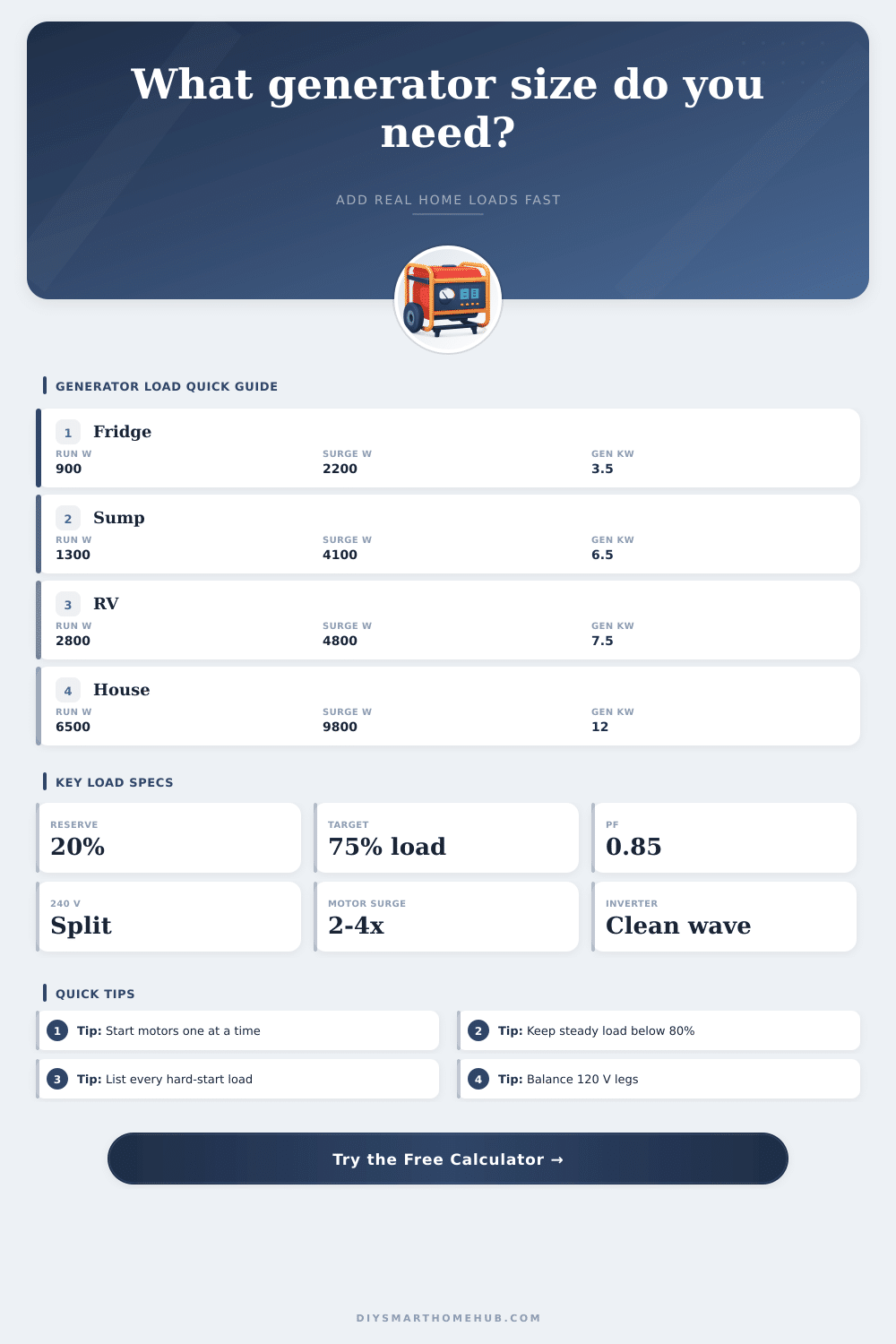
| Refrigerator, router, LED lights | 1035 W | 2535 W | 3.5 kW inverter |
| Sump pump storm backup | 2385 W | 4535 W | 6.5 kW portable |
| Gas furnace winter essentials | 2085 W | 3635 W | 5.5 kW portable |
| RV with air conditioner | 3835 W | 6235 W | 7.5 kW inverter |
| Well pump whole-home essentials | 6385 W | 10385 W | 12 kW 240 V unit |
| Electrical check | Formula | Example | Use in sizing |
|---|---|---|---|
| Running kW | Watts / 1000 | 5200 W = 5.2 kW | Minimum steady supply |
| Apparent kVA | Watts / PF / 1000 | 5200 W at 0.85 = 6.1 kVA | Alternator loading check |
| 120 V current | Watts / 120 | 1800 W = 15 A | Branch-circuit awareness |
| 240 V current | Watts / 240 | 7200 W = 30 A | Transfer inlet sizing context |
| Reserve watts | Load x margin | 5000 W x 20% = 1000 W | Prevents running at limit |
When you are attempting to size a generator for your home, you must gain an understanding of the differences between running watt and starting watt. Running watt are the power that an appliance use while it is operating. Starting watt are the massive bursts of energy that an appliance’s motor require in order to start the motor from a standstill to the motor beginning to spin.
Appliances that contain motor, such as refrigerators or sump pumps, require a significant amount of starting watts. If your generator dont have enough starting watts to supply these motor, then the motor will not start and the circuit breaker on the generator will trip. Thus, you cannot size a generator by simply adding up the running watts of all the appliances in your home.
How to Size a Home Generator
You must also consider how many motors in your home will start at the same time. While it is possible that all motors in your home do start at the same time, it is more likely that they do not. You can size your generator to account for the starting wattage of the largest motor in your home and the running watts of the other appliance in your home.
Alternatively, you can size your generator to account for the possibility of two large motor in your home starting at the same time. If your generator is too small for the needs of your home, it will continually trip it’s circuit breakers. If your generator is too large for the needs of your home, you will have to purchase a generator that costs more money than you need to purchase.
Another factor to consider when sizing your generator is the power factor of the appliances in your home. Appliances that has heating elements, such as toasters, are highly efficient in that they will not waste any of the electricity provided by your generator. However, appliances that have motor, such as refrigerators, are less efficient because motors create magnetic field, which wastes some of the power provided by the generator.
When you select a power factor for your generator, such as 0.85, you are accounting for the inefficiency of motors. By ignoring the power factor of the appliances in your home, the generator may run hotter or more loud than it should. The quality of the electricity that your generator provides is another factor to consider.
The electrical power most generators provide is not of the quality required by sensitive electronics. Sensitive electronics, such as computers or internet routers, require a clean sine wave of electricity. Inverter generators emit a clean sine wave and are therefore better for protecting sensitive electronics.
While inverter generators are safer for sensitive electronics, they often cost more money than standard portable generator. Another consideration is providing a reserve margin for the generator. This means that you should never operate your generator at 100% of its total capacity.
You should aim to operate your generator at only 70% or 80% of its total capacity. By reserving some of the power of your generator, you will prevent the voltage from sagging if you add another appliance to the generator. Furthermore, providing a reserve margin ensure that the generator can handle additional loads that you may have failed to account for when purchasing the generator.
If you are using a 240-volt split-phase system, you should balance the load that is distributed to the two 120-volt legs of the generator. Generators have two 120-volt power legs through which power is distributed. If all of your heavy appliances are placed on one of these 120-volt legs, that leg will be overloaded even if the total wattage of the appliances is within the limit of the generator.
Thus, to ensure that each leg of the 240-volt split-phase generator is balanced, you should distribute even the heavy 120-volt loads between both legs. Finally, you should list every essential appliance that you would like to have power during a power outage. Appliances such as refrigerators, especially older refrigerators, will require more starting watts than newer refrigerators.
Every home is different and there will be some essential appliance and some appliances that you are willing to sacrifice for power. By removing luxury appliances from the list, you can purchase a generator that is smaller than if you had selected the appliances in your home in order to run at the lowest cost. By considering each of these factors, you can ensure that your generator will provide you with steady power during a power outage.