Condensation Point Calculator
Check indoor dew point, measured surface margin, cold-wall bridge risk, and the surface temperature needed to stay clear of condensation.
1Room And Surface Presets
2Condensation Inputs
Condensation Point Results
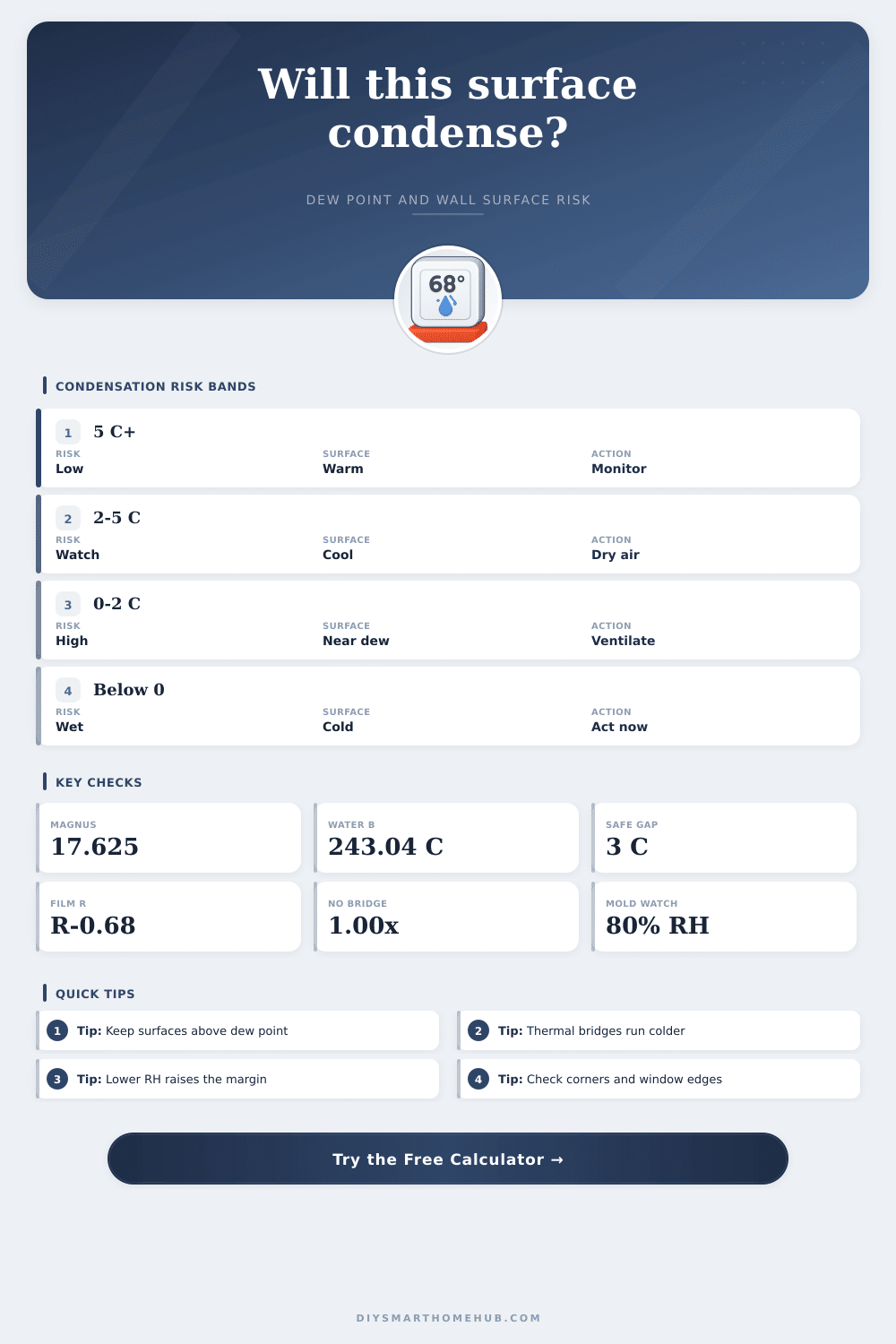
Magnus dew point is compared with the measured surface and an estimated bridged wall surface.
3Material And Surface Spec Grid
4Reference Tables
| Margin after safety | Risk band | Surface RH clue | Calculator reading |
|---|---|---|---|
| More than 9°F / 5°C | Low | Usually below 75% | Surface is comfortably warmer than dew point |
| 4 to 9°F / 2 to 5°C | Watch | Often 75% to 85% | Small humidity or temperature shifts can matter |
| 0 to 4°F / 0 to 2°C | High | Near 90% to 100% | Condensation is close under normal variation |
| Below 0°F / 0°C margin | Condensing | At or above 100% | Surface is at or below the safe threshold |
| Indoor condition | Dew point | Surface watch point | Typical caution area |
|---|---|---|---|
| 68°F at 35% RH | 39°F / 4°C | 44°F / 7°C with margin | Cold metal frames |
| 70°F at 50% RH | 50°F / 10°C | 55°F / 13°C with margin | Window edges and corners |
| 72°F at 60% RH | 57°F / 14°C | 62°F / 17°C with margin | Closets and exterior walls |
| 75°F at 70% RH | 65°F / 18°C | 70°F / 21°C with margin | Bathrooms and basements |
| Assembly example | Nominal R | Bridge factor | Surface behavior |
|---|---|---|---|
| Insulated 2x4 wall | R-13 / RSI 2.29 | 1.20 to 1.45x | Stud lines can run cooler than cavities |
| Insulated 2x6 wall | R-19 / RSI 3.35 | 1.15 to 1.35x | Better margin except at framing clusters |
| Continuous exterior insulation | R-5 added / RSI 0.88 | 1.00 to 1.15x | Warms sheathing-side and room-side surfaces |
| Metal frame or lintel path | Varies | 2.00 to 4.00x | Can be much colder than nearby drywall |
| Surface material | Thermal response | Moisture sign | Best reading location |
|---|---|---|---|
| Painted drywall | Moderate response | Darkening or soft spots | Exterior corners and behind furniture |
| Window glass | Fast response | Fogging or droplets | Lower edge and spacer line |
| Metal frame or duct | Very fast response | Beads or sweating | Thin edge, screw line, or seam |
| Concrete or masonry | Slow response | Damp patches | Coldest lower wall zone |
5Condensation Tips
Why does the bathroom mirror fog up during the winter? The water vapor change back into liquid once it hit something cold enough to prevent it from staying a gas. That’s the dew point… And knowing its location around your house will help you avoid growing mold in your walls.
This tool (on this page) helps you see where the dew point is, so you can prevent moisture from building up on your surfaces before it starts.
How to Prevent Condensation and Mold
If you’re like most folks, you think about indoor temperatures; but not about relative humidity. But that’s the wrong thing to look at, since warm air contain more moisture than cold air. If your house has warm, moist air, and there’s something cold; like an uninsulated corner, or perhaps a window pane, you’ll find that the warm moist air touches the cold object and cools down immediately. And when it cools down its ability to contain water decreases dramatically. Eventually the air reaches a temperature called the dew point. At this point, the air can no longer hold the excess water; the water falls onto whatever surface it touches.
No need to be a physicist: Just understand that condensation adheres to rigid thermodynamic rules… And once you have the correct numbers, you can predict where it will happen.
Once you know what’s going on in your room, plugging numbers into the calculator at the top of this article will do the math for you, and save you from having to guess where the danger line realy is. It uses your current indoor humidity level and air temperature to calculate exactly what your dew point is. From there, it contrasts that with temperature of the surface you’re concerned about. What if it is cooler than the dew point? It is a problem. Because weather changes quickly and sensors differ, the tool includes a safety margin. A five degree buffer tends to be wise. That’s enough to account for those unexpected cold snaps (or people showering without flipping on the fan).
For example: Thermal bridges makes it easier for heat to escape through that point different than through the surrounding wall. A thermal bridge can be anything from a concrete corner, to a metal frame around a window, or even a stud that’s tightly adjacent to the outside sheathing. Those thermal bridges mean the interior surface cools down way more then the average surface area throughout the room. Maybe you’re not feeling cold while standing on the middle of the floor. But then you stand in the corner next to the window and; whoa! That’s cold!
The calculator gives you an option to account for the bridge factor. It estimates how much colder that specific path gets compared to a well-insulated cavity. Why does this matter? Condensation doesn’t form on a warm wall’s center. It forms at its weakest point.
The second factor is material. Certain materials conducts heat faster than others. Things that conduct heat quickly include glass and metal. They’ll be very near outside temperatures until well-insulated. Materials that retain heat. Such as wood and drywall, will have their surfaces warmer for longer. This is why when it’s cold outside, your leather car seats won’t be as cold as your windows, but they’re in the exact same air!
The tables on the page makes this clear. They show you how each type of material will react to the same amount of humidity. If you know what kind of material you’re working with (fast responding, e.g. Metal? slow responding, e.g. If you know if a material responds fast like metal or slow like concrete, you will be able to judge urgency more accurately.
The best part is ventilation, but it has to happen. For just five minutes, opening a window will trade moist indoor air for drier outdoor air; you won’t cool anything off this way, but it’ll instantly lower the relative humidity a few points. This moves the dew point temperature farther from those cold surfaces. Your goal is to maintain that separation.
When you notice drops starting to form, don’t wipe them off like a chore, think airflow instead. Water wants to be somewhere else? It’s telling you that your building exterior is losing its thermal war in that area. You should of moved the furnitures back from the cold wall, seal the leak, and insulate. Dry air and a warm surface mean no mold.