Coffee Bean Consumption Calculator
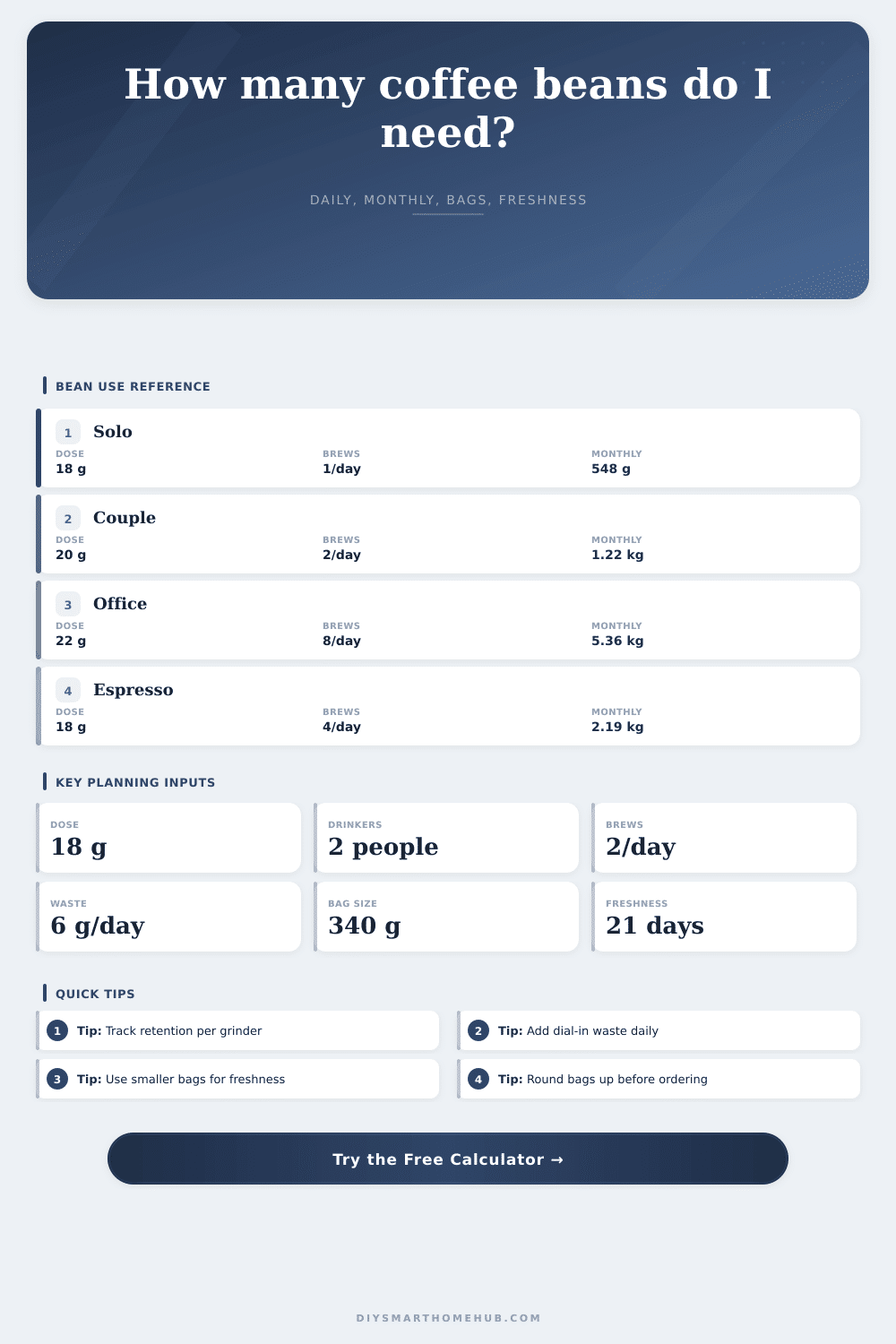
Estimate whole bean use from coffee dose, drinkers, brews per day, grinder retention, dialing-in waste, bag size, and freshness window.
Finish time appears after the first calculation.
Finish time appears after the first calculation.
Finish time appears after the first calculation.
Finish time appears after the first calculation.
Many single-cup pour over and drip servings land in this dose range.
A common double basket range before accounting for purge or dialing waste.
Low-retention grinders use less buffer; hopper grinders can need more.
Many homes plan opened bags inside a two-to-four-week window.
| Brew style | Typical dose | Common daily pattern | Planning note |
|---|---|---|---|
| Single drip mug | 15 to 20 g | 1 to 2 brews per drinker | Bean use is mostly dose driven; waste is usually small. |
| Pour over | 16 to 24 g | 1 to 3 brews per drinker | Manual brewing may add a little dialing waste when changing grind. |
| Double espresso | 18 to 21 g | 1 to 4 baskets per drinker | Daily purge and dial-in waste can materially increase beans used. |
| French press | 30 to 70 g | Shared batch brewing | Use dose per full press rather than per cup when planning. |
| Cold brew | 60 to 125 g | Batch every few days | Average the batch dose across the days it serves. |
| Office carafe | 55 to 120 g | 1 to 3 pots per day | Multiply by pots per day, then add grinder and purge waste. |
For batch brewers, enter the dose per full batch as one brew. For espresso, enter the dose per basket or shot pair you count as one brew.
| Planning span | Bean grams | Exact bags | Rounded bags |
|---|---|---|---|
| 7 days | 286 g | 0.84 | 1 |
| Waste scenario | Daily waste | Monthly waste | Impact |
|---|---|---|---|
| Current settings | 5 g | 152 g | Included in results. |
| Freshness target | Max useful bag | Selected bag fit | Bean planning cue |
|---|---|---|---|
| 14 days | 571 g | Fits | Finish before target. |
Instead of guessing, use a tool. A coffee calculator can help you figure out exactly how much coffee you need based off how much you drink. It calculates amount by taking into account that whole bean coffee has a very short shelf life; after several weeks of being roasted, it will lose its flavor.
Unlike rice and pasta, it’s not something you can stock up on; instead, enter your consumption habits into the calculator and let it do the math for you.
How to Use a Coffee Calculator
The one thing to pay attention to first is how much coffee you drink in each cup. Do you grind enough beans for a big ol’ mug or are you estimating and using eighteen grams a day? If you’re incorrect on this front, your supply will be gone before you know it.
To avoid this situation, many folks estimate how much they use based off the number of cups rather than weight. Underbuying follows. Establish your proper dose by weighing your coffee at least once. Tell the tool exactly how many grams you want to brew.
It will account for any coffee left in the grinder. This refers to the amount of coffee left inside machine after brewing. This loss is not made up; it becomes real when you start keeping track over the course of a month.
There’s another unseen cost here: the adjustment of your espresso. Every time you adjust your espresso (whether due to habit or changing beans), you discard a few more gram of coffee to get it flowing right. If you’re dialing in your espresso, you can lose ten to fifteen grams of coffee just to get the settings right. There’s a space to note how much you throw away each day on the calculator.
It isn’t about what’s inside your cup, it’s about what’s on your counter. What are you buying?
Size of bag is far more important than most would imagine: A one kilo bag sounds like an economic purchase, yet if you’re drinking only 300g monthly, that bag is wide open, sitting in your pantry for weeks on end. At that point, the coffee is past its prime, just three weeks old and already starting to lose it’s peak flavor.
While smaller bags are pricier by-the-gram, at least you can be sure you’re getting fresh product. Do you value flavor (aka, being able to taste what you’re supposed to) over monetary savings? If so, order based on your preferred freshness window; here’s a reference table outlining which size bags works for you.
If you burn through beans, get the big one. If you sip slowly, stick with those half pounders. These various scenario can be visualized by presets.
One person drinking solo drip is different than someone who’s going to make a French press for company every Sunday in their home. While the frequency may go down, the dose per brew goes up which changes the math. With this approach, you’re front-loading your consumption. If you don’t plan for this variability you’ll get caught empty-handed mid-month and panic. You should of planned ahead.
Automated deliveries are possible when you understand how much you use them in a month. No more running out, no more having stale bags. Supply management becomes a background process. You spend time on the ritual of making coffee instead of the logistics of buying it.
How does it work? Since you know how much you need in 30 days, ordering become a simple math problem. You have fresh coffee at the end of the day without any last minute stress. That’s what good planning gets you: the balance between quality and convenience.