Carbon Monoxide Detector Count Calculator
Estimate how many CO detectors to plan from bedrooms, sleeping zones, levels, fuel-burning appliances, attached garage exposure, square footage, spacing radius, and redundancy preference.
Count, Coverage, and Risk Breakdown
| Detector Type | Power / Alert Pattern | Planning Strength | Count Calculator Treatment |
|---|---|---|---|
| Battery-only CO alarm | Local sounder with replaceable or sealed battery | Flexible placement near sleeping zones and fuel sources | Counts as one zone detector when within spacing radius. |
| Plug-in CO alarm | Outlet powered, often with backup battery | Simple for halls, dens, and mechanical-adjacent rooms | Works best where outlet location still matches the zone plan. |
| Hardwired CO alarm | Branch circuit power with battery backup | Strong for new work or interconnected alarm networks | Does not reduce count; it improves notification reliability. |
| Combination smoke and CO alarm | Dual sensor housing with shared notification | Useful at level landings and bedroom hallway ceilings | Count only if the CO placement is suitable for that room. |
| Smart CO detector | Local sounder plus app or hub notification | Helpful for remote alerts and multi-level awareness | Still counted by level, sleeping zone, and source zone. |
| Low-level CO monitor | Displays lower concentration trends and alarms sooner | Supplement for sensitive occupants or fuel-heavy homes | Added as a supplement; not used to subtract baseline alarms. |
| Placement Zone | Common Count Rule | Calculator Formula | Why It Matters |
|---|---|---|---|
| Occupied levels | At least one CO alarm on each occupied level | Level baseline = occupied levels | CO can enter living areas from equipment, garage, or shared air paths. |
| Sleeping zones | Place near sleeping areas so alarms can wake occupants | Sleep baseline = separate sleeping zones | Bedroom wings and basement suites often need separate coverage. |
| Fuel appliances | Add detectors near separated combustion zones | Source zones = ceiling(fuel appliances / 2) | Grouped appliances can share a nearby detector; separated sources cannot. |
| Attached garage | Add a nearby interior detector for garage exposure | Garage factor = 0, 1, or 2 zones | Vehicle exhaust and attached spaces increase CO risk paths. |
| Finished basement | Protect finished or mechanical basement areas | Basement factor = 0, 1, or 2 zones | Boilers, water heaters, and sleep spaces can be remote from main halls. |
| Home Scenario | Typical Inputs | Detector Count Range | Secondary Check |
|---|---|---|---|
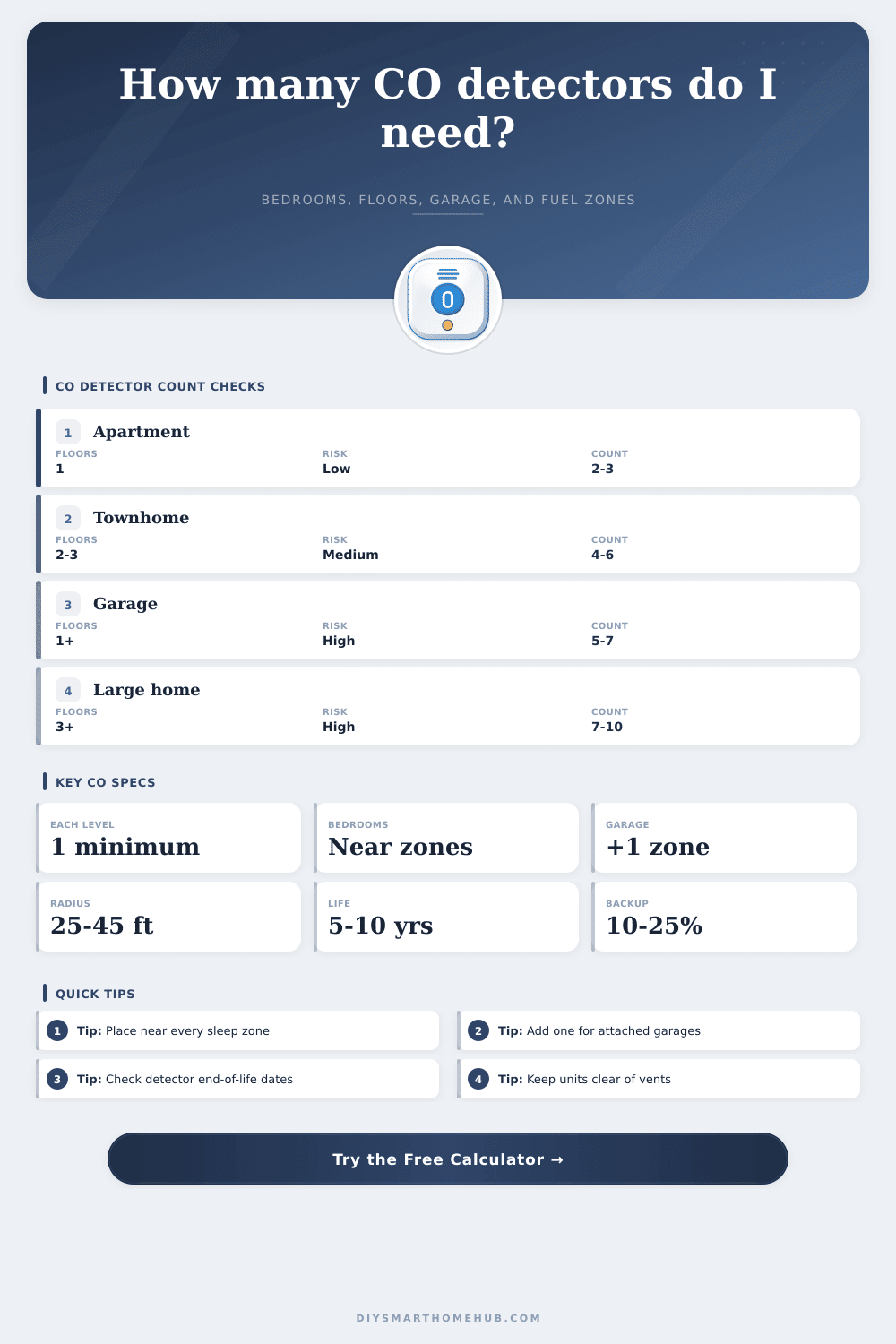
| Small apartment | 1 level, 1 sleep zone, limited fuel equipment | 2 to 3 detectors | One near sleeping area and one near source or main hall. |
| Two-story townhome | 2 to 3 levels, attached garage, gas appliances | 4 to 6 detectors | Check garage-adjacent hall and bedroom level separately. |
| Detached family house | 2 levels, 3 bedrooms, furnace, water heater | 5 to 7 detectors | Compare sleeping zones with level and source count. |
| Basement boiler home | 2 to 3 levels, remote mechanical room | 6 to 8 detectors | Basement detector should not be skipped because main floor has one. |
| Large multi-wing home | 3+ levels, multiple sleeping zones, garage | 8 to 12 detectors | Spacing radius and bedroom wing count often dominate. |
| Planning Radius | Coverage Area | Best Use | Calculator Effect |
|---|---|---|---|
| 25 ft / 7.6 m | About 1,960 ft² geometric circle | Closed plans, long halls, or sensitive occupants | Raises coverage count quickly in large homes. |
| 30 ft / 9.1 m | About 2,830 ft² geometric circle | Typical hallway and bedroom-zone planning | Moderate conservative default for separated rooms. |
| 35 ft / 10.7 m | About 3,850 ft² geometric circle | Balanced whole-home estimate | Often lets zone rules dominate over raw area. |
| 45 ft / 13.7 m | About 6,360 ft² geometric circle | Open-plan spaces with strong alarm audibility | Area count decreases, but level and sleep rules remain. |
| Risk Driver | Low Score Pattern | High Score Pattern | What the Formula Adds |
|---|---|---|---|
| Fuel appliance density | 0 to 1 fuel appliance | 4+ combustion appliances | Up to 30 risk points and extra source zones. |
| Garage exposure | No attached garage | Living space over garage | 0, 12, or 20 risk points and zone count. |
| Sleep separation | Single compact sleep hall | Split wings, basement room, or ADU | Separate sleeping zone count becomes a hard floor. |
| Compartmentalized layout | Open plan | Closed doors and remote rooms | Coverage efficiency drops, raising area-based count. |
The source doesn’t say that the chances of being hurt or killed by fire are small; it focuses on how carbon monoxide is a dangerous invisible killer that require proper detection and placement to keep your family safe.
Smoke alarms. You probably have one: above your kitchen door. Every month or two, the battery dies and it chirps at you for a bit, until you run to the hardware store, buy another battery, and forget about it. Carbon monoxide alarms are different. They address an invisible killer that act nothing like fire. Fire travels through heat and flame. Unlike fire, carbon monoxide travels through ducts, along cracks in foundation walls, or in the same air as connected garage.
Why You Need More Than One Carbon Monoxide Alarm
It isn’t necessarily even about whether or not you have a CO detector; rather it’s all about where those detectors is located relative to your sleeping locations, and where your fuel-burning appliances are. This is typically the difference between having a safe home versus leaving some coverage gaps.
After plugging in all your floor plan details into the calculator above, it does the math for you, no need to guess at conversion factors and coefficients. Basic metrics includes the number of levels in the home (occupied), separate sleeping zones, and whether there’s a source of fuel such as a water heater or furnace. Then, it tells you what the recommended count should of be, and also gives a risk score based off how dense those combustion appliances are throughout your space. A compact apartment will require fewer units different than a sprawling two-story house with an attached garage, even though both might have a similar overall area. That’s why the tool makes you think about layout, beyond just square footage.
Carbon monoxide exposure cause drowsiness before it causes panic. The device has not done its job if you can’t hear the alarm while asleep. Separately sleeping zone are most important for that reason. Common sense tells most folks they only need one detector per level. Not true. Usually not. By definition, different zones (like a basement suite or other sleeping wing) is considered separate areas needing separate protection. Separate bedrooms with long hallways may lack sufficient warning time for both rooms. Protecting each area where someone’s head touches the pillow. That’s what the calculator assumes. For split levels and townhomes, the number of required detectors jump into the 4-6 range, as explained on the page’s reference table.
This doesn’t even factor in the garage risk. This adds another problem: vehicle exhaust fumes can leaks into common areas through garage doors and shared walls. This is a dangerous issue that most homeowners forget about until it’s too late. Another practical consideration that people overlook is battery life. Electrochemical sensors has a shelf-life of five to ten years before they degrade. While hardwired units with battery backups offer better reliability for notification, both contribute towards your required number of zone instead of replacing them.
Some people try to cut costs by using smart detectors that send alerts to their phones. These can be nice additions to provide awareness. However, they cannot substitute for a physical unit installed in the room or hallway. A local unit ensures it will actualy wake you up if something goes off, even if you don’t hear your phone buzzing three rooms away.
What’s missing here? Typically, people place their detectors near a potential fuel source or too near a vent. A little science lesson: carbon monoxide is a bit lighter than air, so it won’t linger too high up. It also rapidly disperses into the surrounding air temperature. Most manufacturers suggest mounting them on walls at breathing height rather than on ceilings like smoke alarms. That seemingly tiny adjustment make a big difference; detector location directly influences response speed.
To help you picture the areas, this calculator allows for “redundancy” buffer zones, taking into account dead spots caused by weird home shapes and/or many small rooms. Closed doors and long hallways separating home wings? You’re probably going to want to add that percentage just to cover all bases.
The rubber meets the road in maintenance. If you’ve got a detector from the last century sitting on the wall that’s been there since the previous owner moved out in two thousand and eight, then it’s no good. Read the manufacturing date off the back of each unit. Swap them out before they expire, not after. Run tests once a month as with smoke alarms, but watch for low-battery indications well ahead of time instead of waiting until you’re jolted awake by an irritating chirp at three a.m. Counting zones carefully, locating units properly, and swapping them out according to schedule. This is proper planning. It’s the kind of discipline that ensures your family’s safety when the air goes silent.