Blind Tilt Privacy Angle Calculator
Estimate the slat angle that blocks an outside line of sight while showing daylight opening, target view height, direct sun opening, and slat geometry limits.
Detailed privacy breakdown
| Blind or louver type | Typical slat width | Typical center spacing | Front closure angle |
|---|---|---|---|
| Micro office blind | 0.5 in / 13 mm | 0.42 in / 11 mm | About 57 degrees |
| Aluminum mini blind | 1.0 in / 25 mm | 0.82 in / 21 mm | About 55 degrees |
| Faux wood blind | 2.0 in / 51 mm | 1.75 in / 44 mm | About 61 degrees |
| Wide wood blind | 2.5 in / 64 mm | 2.20 in / 56 mm | About 62 degrees |
| Shutter louver | 3.5 in / 89 mm | 3.00 in / 76 mm | About 59 degrees |
| Outside viewer setup | Height difference | Distance from glass | Sightline altitude |
|---|---|---|---|
| Standing viewer, seated target | -18 in / -46 cm | 8 ft / 2.4 m | About -11 degrees |
| Porch viewer, desk target | -6 in / -15 cm | 5 ft / 1.5 m | About -6 degrees |
| Sidewalk below raised room | 24 in / 61 cm | 10 ft / 3 m | About 11 degrees |
| Neighbor window slightly above | -30 in / -76 cm | 20 ft / 6.1 m | About -7 degrees |
| Sun altitude | Common time feel | Privacy interaction | Slat response |
|---|---|---|---|
| 0 to 15 degrees | Low horizon sun | Similar to a standing viewer through the window | Needs steeper closure or shade help |
| 20 to 35 degrees | Morning or afternoon sun | Often conflicts with preserving outward view | Use privacy angle, then check direct sun opening |
| 40 to 60 degrees | Higher daytime sun | Top-down rays may pass if slats are tilted the wrong way | Flip tilt direction if glare remains high |
| 65 degrees and above | High summer sun | Interior glare depends strongly on window orientation | Open area can stay moderate while sun is cut |
| Opening ratio | Privacy meaning | Daylight meaning | Best use |
|---|---|---|---|
| 0% to 2% | Strong line-of-sight privacy | Most directional view is blocked | Bedrooms, bathrooms, nighttime rooms |
| 3% to 10% | Mostly private with tiny view leaks | Filtered daylight remains | Offices, street rooms, apartment corridors |
| 11% to 35% | Partial privacy only | Useful daylight and some outward view | Daytime living spaces |
| 36% and above | Not reliable privacy | Brightest and most open setting | Upper floors or private yard views |
That’s the basic conflict: I need light. But I don’t want it broadcast. If only I could put my coffee mug down, step into the kitchen, survey the view out my window; the neighbor’s house. And figure out exactaly what works.
Most of us believe that when we close our blinds, they’re shut. Shut like a shutter. It is a convenient fiction because measuring for sight lines are tedious. The reality is geometric and less forgiving to intuition. How closed your blinds are (and whether they’re tilted up or down) depends on the width of your slat and the tightness of its stack. Where the blind-viewer positions herself relative to your window determine privacy. After entering your blind geometry and where the viewer will stand, the calculator do all the trigonometry for you.
How Blinds Really Work
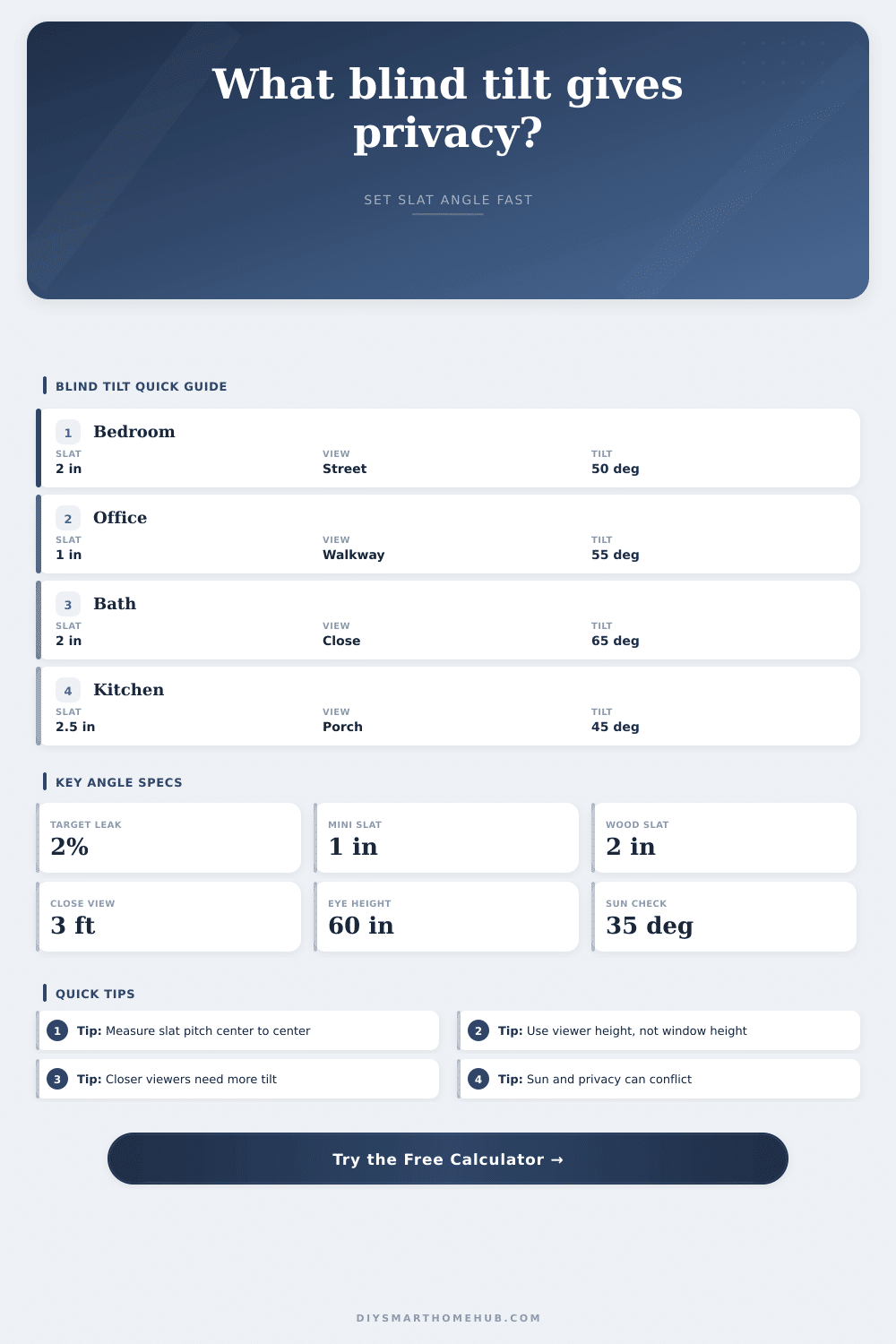
No more guesswork: Does my blind block the sidewalk next door at a forty-five degree tilt? (You’d think so; after all, if I have blinds closed nobody can see in.) But light travels in straight lines. And with only a quarter inch space between slats when they’re tilted, somebody standing nearby can still peek in. That’s why the tool requests both eye height and viewer distance. Someone on one side of the street has a different line of sight than someone who walks up onto your porch. The closer they get, the steeper is the needed angle to obscure whatever you’re doing.
This is a tiny detail, but it is also very important to how secure something actualy feels, as opposed to how private we think it is. But what about slat width? Many people choose their blinds solely on the basis of style, and that means many people select wide faux wood for moddern appearance. Sure, those wide slats feel substantial, but there is usually more space between them then there is with narrower aluminum mini-blinds. While a wider slat admits more daylight (standard spacing), it must be tilted at a sharper angle to block light as effectively as a narrow one-inch slat would. The chart on the page explain it nicely. It plots a comparison among different materials, showing how sharply they need to be tilted to maintain the same front closure angles.
Don’t assume all blinds are equally effective as shields: You have to consider the physical pitch or distance between the centers of adjacent slats. And then there’s the sun. When we adjust the privacy settings in the morning, glare is rarely on our mind. But by afternoon, the sun’s hitting the window at harsh angles. Tilt your blind to prevent a peeping Tom across the way, and suddenly that bright screen of your television is reflecting sunlight like a mirror. To check this, the tool compares your preferred tilt angle to the angle of the sun. That’s frequently where comfort falls apart.
You can optimize for privacy (no one can see inside from the street), but now you need shades in the house. Finding the balance between these two needs mean not just focusing on one result, but looking at both at once. The other error people often commit is targeting the incorrect height on the inside. They try to hide their laptop screen by measuring height from the floor. Instead, we need to know the height from the top of your desk, or the height of your seat in relation to your eyes while sitting there. That way the calculator knows exactly how high it has to be in order to block somebody’s line of sight from above, which would of mean going through the space between the slats and striking that spot. It’s blocking something visually at that exact elevation you care about.
But more broadly speaking: privacy isn’t an on-off switch. It’s about occlusion and view and light, a negotiation. What sort of leakage can you stand? Two percent may seem like nothing, but it can feel like just enough to see someone moving around in there. Know the geometry, and you’ll know what your expectations should be. When you know how far away someone has to be to even see into your space, you’re no longer guessing, you’re actualy able to plan your window treatment with purpose. Coffee tastes better when you’re not wondering if anyone’s watching.