Battery Series and Parallel Connection Calculator
Plan a battery bank topology from target voltage, target amp-hours or watt-hours, battery voltage, battery Ah, reserve margin, and load current.
🔋Series-parallel connection presets
⚙Topology inputs
Calculation breakdown
🧮Wiring topology/spec grid
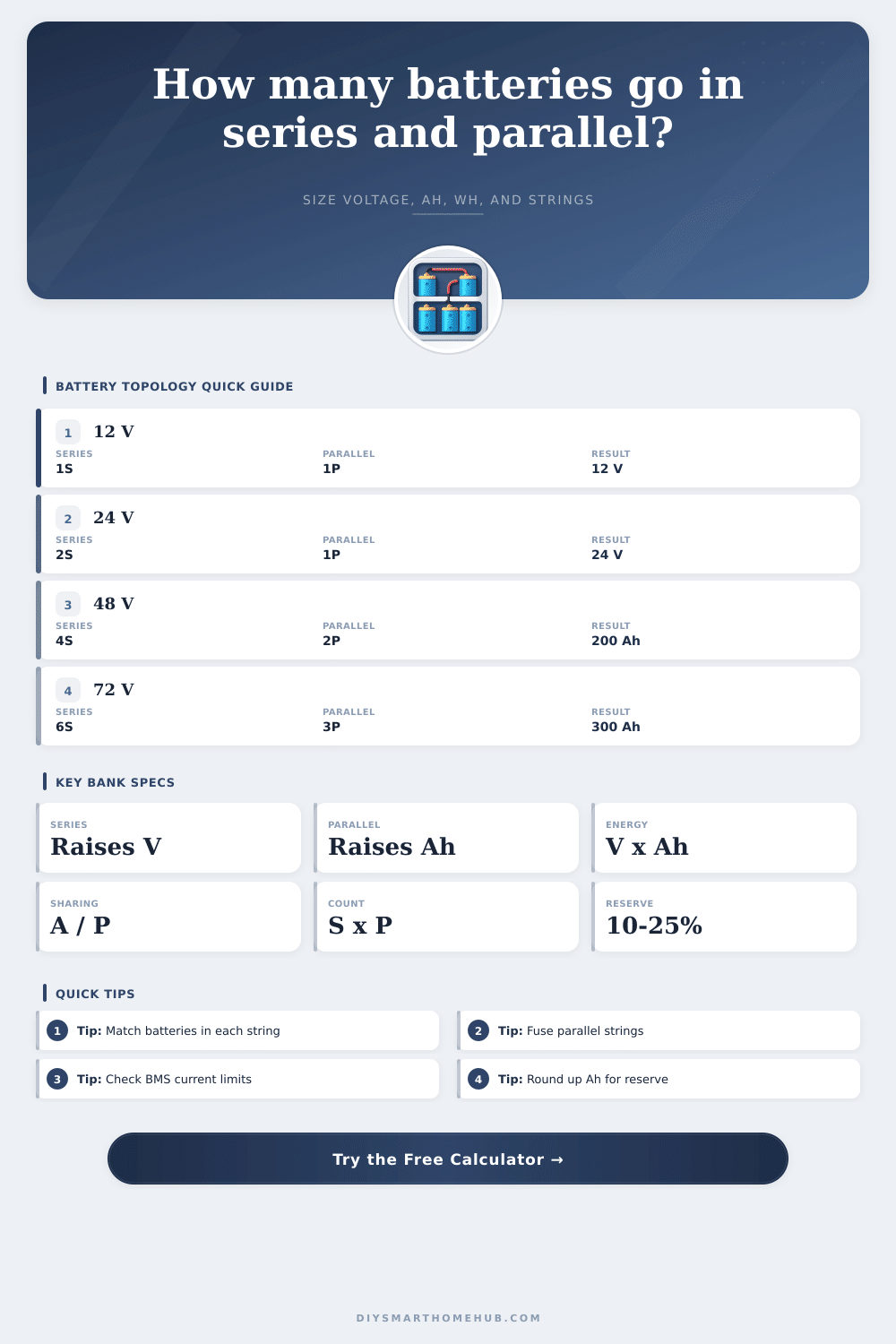
Raises voltage while Ah stays the same inside one string.
Raises Ah and current capacity while voltage stays the same.
Total batteries equal the series count multiplied by parallel strings.
Ideal branch current is bank load current divided by parallel strings.
📊Common battery voltage targets
| Target bank | Typical units | Series math | Common use |
|---|---|---|---|
| 12 V nominal | 1 x 12 V or 4 x 3.2 V cells | 12 V / unit V | Small DC loads, compact backup |
| 24 V nominal | 2 x 12 V or 8 x 3.2 V cells | 24 V / unit V | Cameras, lighting, small inverters |
| 36 V nominal | 3 x 12 V or 12 x 3.2 V cells | 36 V / unit V | Carts, motors, specialty DC buses |
| 48 V nominal | 4 x 12 V or 16 x 3.2 V cells | 48 V / unit V | Solar storage, UPS racks, home backup |
| 72 V nominal | 6 x 12 V or 24 x 3.2 V cells | 72 V / unit V | Higher-power DC equipment |
🔗Topology comparison table
| Connection type | Example | What changes | Design check |
|---|---|---|---|
| Series only | 4S1P 12 V 100 Ah | Voltage rises to 48 V, Ah remains 100 Ah | Every battery carries the same current |
| Parallel only | 1S3P 12 V 100 Ah | Voltage stays 12 V, Ah rises to 300 Ah | Each branch should share current evenly |
| Series-parallel | 4S2P 12 V 100 Ah | Voltage and Ah both rise | Use identical string length and fuse each string |
| Cell-level pack | 16S2P 3.2 V 50 Ah | Builds battery voltage from individual cells | BMS channel count must match series count |
| Single module | 1S1P 48 V 100 Ah | Module handles voltage and current internally | Confirm BMS current and charger voltage |
⚡Current sharing reference
| Parallel strings | Bank load current | Ideal current per string | Use this reading |
|---|---|---|---|
| 1P | 80 A | 80 A | All current flows through one series string |
| 2P | 80 A | 40 A | Good balance can halve current stress |
| 3P | 90 A | 30 A | String fusing and equal cable lengths matter more |
| 4P | 120 A | 30 A | Monitor branch current if strings age differently |
| 6P | 180 A | 30 A | Large banks need disciplined busbar layout |
📋Preset topology examples
| Preset | Target | Battery unit | Expected topology |
|---|---|---|---|
| Preset examples load when the calculator starts. | |||
✅Battery topology tips
When you look at a stack of lithium batteries, all you see is voltage, which, in accounting terms, is how you measure it. Adding in parallel increase the area available for current flow. Series adds pressure. Parallel/series mixes things up so that any single weak link can take down entire bank.
The idea seems straightforward enough, but without a calculator it’s guesswork. Do I need this coefficient? How do I convert this? That’s why we built the calculator (above). Enter capacity and voltage and let it do the math. No guessing on conversions or coefficients required.
How To Build A Battery Bank
You tell it what you want; it tells you how to physically lay out battery bank and get there. The system voltage is determined by the series string, which tell you what class of charger and what compatible inverter to use. To achieve a certain voltage, like forty eight volts, simply stack up modules (or cells) until you get there. Then you can run multiple parallel string to increase the capacity but not the voltage.
That’s important because your runtime depends on amp-hours and you need a compatible voltage range for your inverter. Many folks has confused these two goals. They want more power so they put their batteries in series. Series increases voltage, rather than capacity. The tool separates those issues, so you don’t end up with high voltage system that doesn’t hold much juice.
Practical considerations come into play at high currents. Theoretically, parallel strings shares the load equally. Each string carries fifty amps if both feed total of a hundred amps. But life isn’t theoretical. One string will have slightly more resistance than another due to different ages of batteries, or maybe longer cables. That string gets the short end of the stick. Its companion string must pull heavier weight. Over time, that puts stress on weak link, and it may fail too soon.
The calculator provides an option for balance factor to compensate. Ninety percent is a reasonable number to set for slight differences in cable length or battery age. It is a tiny adjustment. It makes a difference during long periods of heavy load. A reserve margin gives you some protection over time. When batteries age they deteriorate, and when it’s cold outside, they lose some effective capacity. For example, if you want your system to provide rated performance for one year after being cycled, choosing a 15, 20% reserve would of do just that. It’ll also give you a bit of peace of mind in case your loads are greater than expected or something goes wrong.
If you don’t have any reserve, then you’re running right up to your usable window. The tool allows you to set the percentage based off the importance of your application. You may require more reserve for a solar storage bank versus a weekend camping rig.
The other huge factor is the type of battery used… The chemistry profile. Cells made with lead acid are different than those using lithium iron phosphate for instance. The latter has better cycle life and depth of discharge. A lead-acid will last longer if discharged shallower while you can often drain lithium much deeper without penalty. The tool adjusts the capacity based off the type of chemistry you choose. This ensures that you don’t think you have more usable capacity out of a lead-acid bank than what is actualy possible.
People make mistake of thinking all batteries are created equal when they aren’t. The chemicals used in each battery dictate the safe limits for operating them. Physical limitations like wire gauge and fusing can’t be bypassed by software. To keep voltage drop low when paralleling high current strings, use heavy cable; if not, it will form a bottleneck that negates the benefit of multiple batteries. You must fuse each parallel string individually to protect against faults in any single branch.
The calculator tells you how many strings to add, but only your wiring diagram reveal whether all strings are sharing the load equally. For long-term reliability, cable lengths and gauges must be symmetrical. Designing a battery bank is about balancing voltage needs with current demands. Set the stage for series. Add capacity in parallel. Make sure everything is wired correctly. Then let the show begin.
Choose a target, do the math, and then build precisely. Buy according to math, wire to last. Begin with voltage requirement, allow the tool to determine topology, and always have equal paths for current sharing.