DIYSmartHomeHub aquarium planning tool
Aquarium Volume Calculator
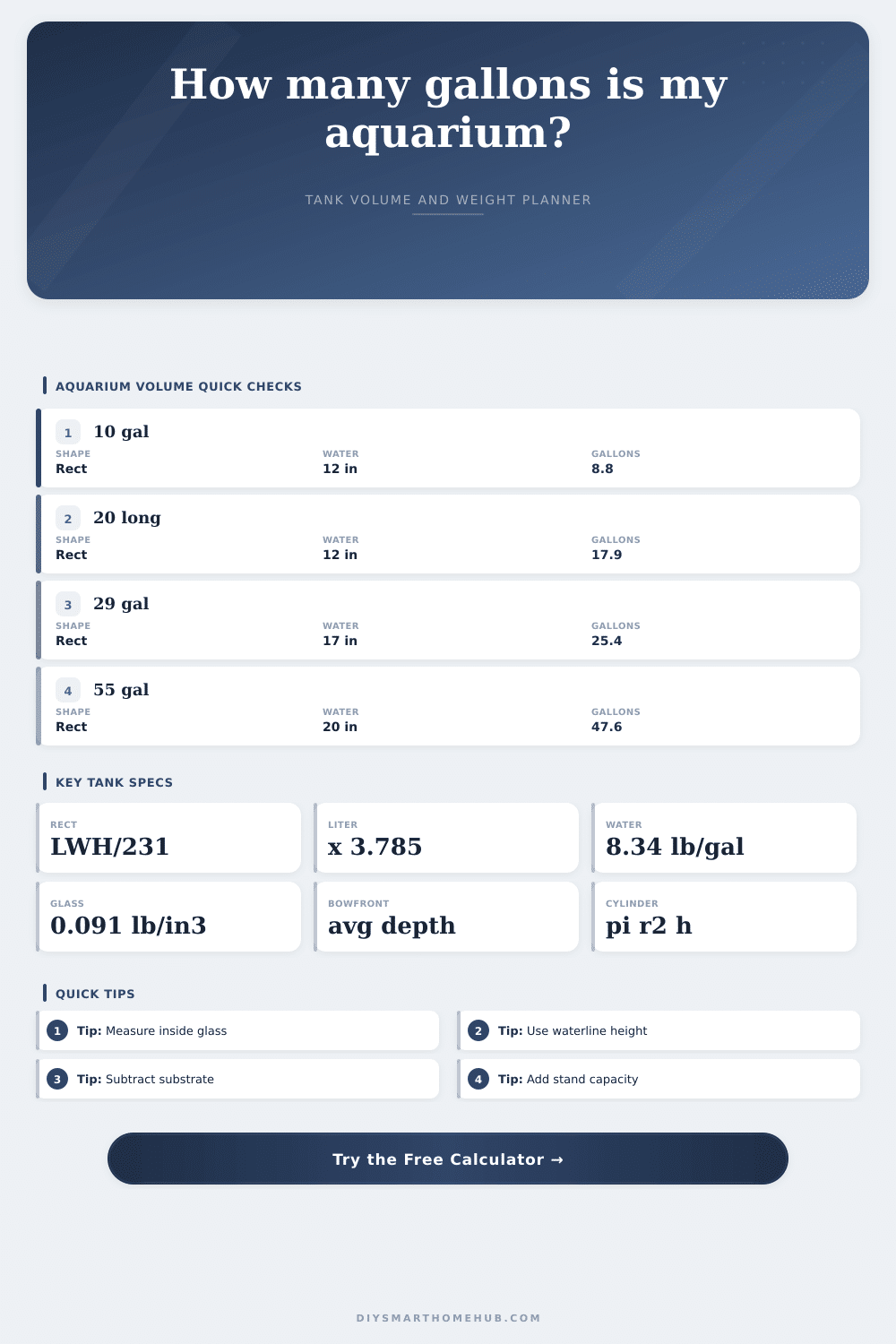
Estimate net aquarium gallons, liters, substrate displacement, filled water height, glass weight, substrate weight, and total loaded tank weight.
Uses inside inches and the actual filled water height instead of outside tank height.
Column tanks use diameter to calculate radius, then cylindrical water volume.
Freshwater is estimated with 8.34 pounds per US gallon before glass and substrate are added.
Glass weight is approximated from panel area, average thickness, and glass density.
Rectangular
Most standard rimmed and rimless aquariums. Use inside length, width, and actual waterline height for the cleanest result.
L x W x H / 231Bowfront
The curved front adds water beyond the back depth. The calculator treats the bulge as about two thirds filled plan depth.
L x (W + .67B) x H / 231Cylinder
Round column aquariums need only inside diameter and filled height. Small diameter errors change volume quickly.
pi x r² x H / 231Net water
Final usable water subtracts substrate displacement and any entered decor, rock, overflow, or equipment displacement.
Gross - deductions| Aquarium Size | Inside Dimensions | Filled Height Used | Approx Net Water |
|---|---|---|---|
| 10 gallon rectangle | 20 x 10 x 12 in | 12 in with 1.5 in sand | About 8 to 9 gallons after deductions. |
| 20 long planted | 30 x 12 x 12 in | 12 in with 2 in substrate | About 17 to 18 gallons after substrate. |
| 40 breeder reef | 36 x 18 x 16 in | 15.5 in with 1 in sand | About 39 to 41 gallons before sump volume. |
| 55 gallon tall | 48 x 13 x 20 in | 20 in with 1.5 in gravel | About 47 to 49 gallons after deductions. |
| 75 gallon reef | 48 x 18 x 21 in | 20.5 in with 1 in sand | About 72 to 74 display gallons. |
| Substrate Type | Bulk Weight Used | Water Displacement | Best Planning Note |
|---|---|---|---|
| No substrate | 0 lb per gallon of bed | 0 percent | Useful for bare-bottom quarantine and breeding tanks. |
| Aquarium sand | 12.5 lb per gallon of bed | 70 percent | Fine grains leave less open water between particles. |
| Rounded gravel | 11 lb per gallon of bed | 55 percent | Coarser gravel contains more water-filled pore space. |
| Planted aquarium soil | 7 lb per gallon of bed | 50 percent | Lighter porous soil often displaces less water by weight. |
| Crushed coral | 10.5 lb per gallon of bed | 60 percent | Useful for hardwater setups and marine buffering estimates. |
| Net Water Volume | Water Weight | With 15 lb Substrate | With 35 lb Substrate |
|---|---|---|---|
| 10 gallons | 83 lb | 98 lb plus glass | 118 lb plus glass |
| 20 gallons | 167 lb | 182 lb plus glass | 202 lb plus glass |
| 40 gallons | 334 lb | 349 lb plus glass | 369 lb plus glass |
| 75 gallons | 626 lb | 641 lb plus glass | 661 lb plus glass |
| 125 gallons | 1043 lb | 1058 lb plus glass | 1078 lb plus glass |
| Deduction Type | How Calculator Handles It | Typical Range | Why It Matters |
|---|---|---|---|
| Substrate bed | Footprint x substrate depth x material displacement | 0.5 to 4 gallons | Substrate can remove meaningful swimming water in small tanks. |
| Large rocks | User-entered decor displacement | 0.5 to 15 gallons | Dense hardscape reduces actual dosing and water-change volume. |
| Overflow boxes | User-entered equipment displacement | 0.2 to 3 gallons | Built-in boxes replace display water inside the tank footprint. |
| Freeboard | Use filled water height instead of tank wall height | 0.5 to 2 inches | Waterline height is often lower than the advertised tank height. |
If you’re like me, your first aquarium was purchased because of name printed across the package, twenty gallons. Therefore, you thought you got twenty gallons of swimming space. Wrong! That’s where many beginning fish keepers slips.
Twenty gallons isn’t a hydrological fact; rather, it’s a marketing label. How much water you end up with in there depend entirely on its level and its contents. Knowing this distinction will save you from under- or over-dosing medications. It will also prevent you from placing a heavy tank on furniture unable to support it.
Why Your Tank Is Not What It Says
If you don’t want to remember all of this, no problem! All the geometry has been handled by the calculator (above). All you need to know are dimension of the tank interior and how much water you actualy keep in there. The latter matters because water doesn’t always reach the top of the tank, nor does the glass take up zero space.
You input those values into the calculator. Then you input your desired substrate depth. The calculator will deduct that displacement from your volume. This is where folks go awry. They assume that sand/gravel/etc. Is all solid weight, but they’re really just air and water between grains.
Different materials displace different amount of water; so there is a displacement factor. Gravel displaces less water then sand because it’s coarser and doesn’t pack as tightly. So for the same amount of “physical” depth, you’ll end up with less usable water volume. It is a small detail but an important one that changes your dosing calculations significantly.
There’s also weight to consider, which is really important when planning an aquarium. Water weighs a lot. In fact, it weigh roughly eight point three four pounds per each gallon. So don’t think that your fifty-five gallons is “no big deal” until you put the rocks, the substrate, the water, and the glass into the tank.
This tool factors in both bulk weight of whatever substrate you use as well as density of the glass itself to estimate the total weight of the loaded tank. Consider this figure an absolute maximum. Don’t rely on hope or chance: if you have a one-hundred pound rated stand and the tool gives you three hundred and ten, don’t go there. If you suspect your tank has particularly thick walls, increase the glass thickness input or just go with the worst case scenario.
There’s another factor, shape. Standard rectangle tanks is easy. Cylinders and bowfronts break standard formulas. Bowfronts appear to be deeper than they are. The outward curve increases the volume which a simple width x height equation cannot capture. To approximate that, it add a fraction of the depth of the curve to the average width. It’s still an approximation but at least it’s a lot better than guessing.
Then there are cylinder tanks. Their size increase with the square of the radius, meaning a tiny difference in your measured diameter results in a big difference in gallons. For accurate measurements, you have no option other than to measure within the glass.
The other factor is weight, which is also affected by the type of substrate. For example, crushed coral is dense whereas planted soil isn’t. The density tables on this page break it all down for you. What they tell you is that just two inches of heavy rock substrate can be heavier than the water in your small tank. That’s one reason why many reef keepers minimize their substrate or use a lighter sand. It provides water volume yet keeps an overall manageable load.
You must know your numbers because dosing is a precise thing. Overdose by 20% on something and it can kill fish. Don’t assume you have x gallons of water. Subtract your sand, rock, and filter box. Now you know what you’re working with. Treat based off the net water volume you have to swim in. That’s the true output.
Treatments, pH adjusters, salt mixes, etc… Use the gross weight figure for your furniture and floor joists.
When you’re setting up something new, have this tool on hand. It makes it data instead of guesswork. What you’ll discover is that nothing weighs as much as advertised, but even worse, very little holds the volume stated on the label. Knowing this allows you to plan for keeping your floors intact and your fish out of harm’s way.
You should of checked the weight first.