DIYSmartHomeHub aquarium planning tool
Aquarium Filter Turnover Calculator
Estimate effective filter flow after media, head height, and plumbing losses, then compare hourly turnover with the target range for your aquarium type.
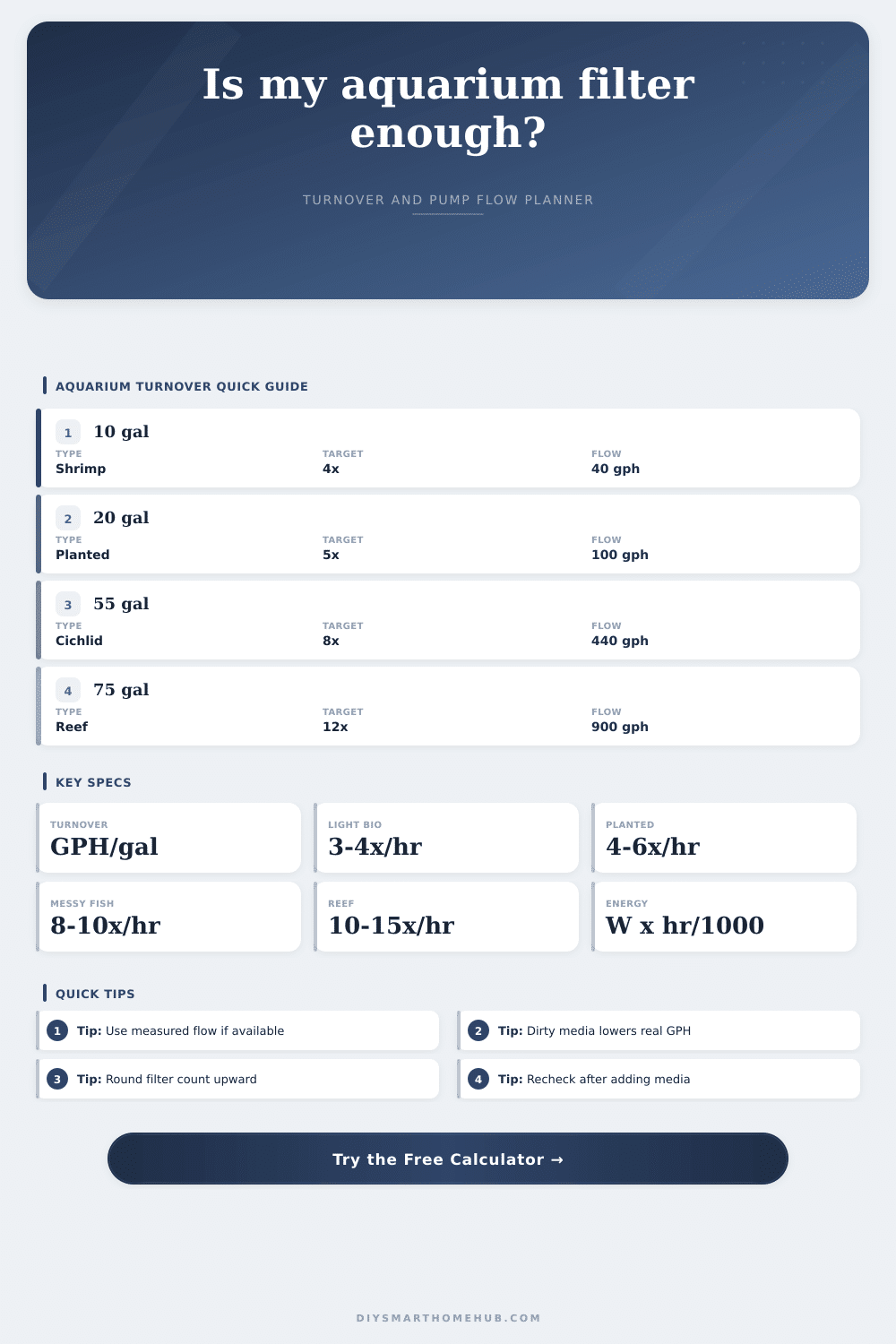
Hourly turnover equals effective gallons per hour divided by actual tank gallons.
Rated flow is reduced by media loading, plumbing restriction, and head height factors.
Target effective GPH equals tank gallons multiplied by the selected turnover target.
Daily kWh equals total pump watts multiplied by runtime hours, divided by 1000.
Low-flow fish
Betta, long-fin fish, and gentle blackwater layouts usually need filtration without strong current.
3-4x/hrPlanted community
Most stocked freshwater displays balance biological filtering with comfortable swimming zones.
5-6x/hrMessy freshwater
Goldfish, cichlids, turtles, and heavy feeding plans need more real water movement through media.
8-10x/hrReef sump return
Return-pump turnover is separate from wave pumps, but still needs enough flow through filtration.
10-15x/hrTarget turnover by aquarium type
| Tank type | Typical target | Flow note | Use when |
|---|---|---|---|
| Betta or low-flow fish | 3-4x/hr | Gentle output | Long fins, small tanks, calm-water species |
| Shrimp or fry tank | 4x/hr | Prefiltered intake | Small livestock that need intake protection |
| Planted community | 4-6x/hr | Even circulation | Moderate stock with plants and decor |
| Community freshwater | 5-7x/hr | General use | Tetras, livebearers, gourami, small catfish |
| Goldfish or cichlid | 8-10x/hr | High solids load | Messier fish and heavier feeding |
| Reef sump return | 10-15x/hr | Sump flow only | Return pump sizing before in-tank flow pumps |
Loss factor examples
| Restriction | Light loss | Moderate loss | Heavy loss |
|---|---|---|---|
| Clean biological media | 5-10% | 15-25% | 30%+ |
| Fine sponge or pad | 10-15% | 20-35% | 40%+ |
| Prefilter sponge | 5-12% | 15-25% | 30%+ |
| Spray bar or elbows | 3-8% | 10-18% | 20%+ |
| Canister hoses | 5-10% | 12-22% | 25%+ |
| Sump return lift | 4-8%/ft | 8-12%/ft | 12%+/ft |
Common tank quick checks
| Tank size | 5x target | 8x target | 12x target |
|---|---|---|---|
| 10 gal / 38 L | 50 GPH | 80 GPH | 120 GPH |
| 20 gal / 76 L | 100 GPH | 160 GPH | 240 GPH |
| 29 gal / 110 L | 145 GPH | 232 GPH | 348 GPH |
| 40 gal / 151 L | 200 GPH | 320 GPH | 480 GPH |
| 55 gal / 208 L | 275 GPH | 440 GPH | 660 GPH |
| 75 gal / 284 L | 375 GPH | 600 GPH | 900 GPH |
Filter style planning notes
| Filter style | Common loss | Strength | Watch item |
|---|---|---|---|
| Sponge filter | Air and sponge limit | Gentle biological filtration | Air pump output and lift tube flow |
| Hang-on-back | Cartridge and intake | Simple turnover on small tanks | Rated flow can drop as pads clog |
| Internal pump | Media cage and nozzle | Short path, compact layout | Outlet blast in small tanks |
| Canister | Hoses, media, spray bar | Large media volume | Head height and packed baskets |
| Sump return | Vertical lift and elbows | Flexible filtration volume | Pump curve at actual head |
| Power filter pair | Shared total losses | Redundancy and coverage | Uneven flow between sides |
What happens? You buy a filter rated for your tank size, install it, and then observe your fish fighting the powerful flow. The current feels more like a fire hose than a gentle stream. Other times, there’s no water movement at all in certain spots because it doesn’t move far enough.
Pump’s not typically the issue. Typically the issue is reality vs. What manufacturer labels. Pumps are tested in empty buckets. Yours contains filter media, plants, and rocks.
Why Your Filter Flow Is Wrong
Turnover is how many times per hour the water turns over. If it turns over 5 times, that’s 5 times the filter filters all the water in an hour. Why is this important? You want bacteria to have some amount of time to eat up the waste.
So the calculator takes all your loss factors and tank size into account and figures out the real flow rate for you.
First, consider head height. Pressure drops as water rises. For every foot of rise, there’s less pressure. Sharp turns and long tubes make this problem worse. With a low pump, your water doesn’t have pressure by the time it reaches media. The calculator accounts for lift. It tells you how many gallons per hour are actualy flowing. This little tweak prevents cloudy water.
The second variable is media loading. How do manufacturers test? With zero or very little media. They will use rings and sponges to fill filter. That’s going to cause some resistance. Depending on how full your filter gets it could drop your flow 20-40%. This will make your filter run slower than rated so if you don’t account for this, you may end up with a smaller filter then you need. In the tool, I have a place where you enter a % for this loss. You might discover your filter only running at half rated speed. Many people just take what is on the sticker for granted.
What’s the right flow rate? Low for bettas. It is high for tetras and others. Why? Because strong current stresses betta fin and hurts them. Ammonia is low in well turned over water.
What is a good number? The page table provides suggestions. For example, it says delicate setups should of have three turnovers. It recommends 12 or more for reefs. These are starting places. Modify based off what you have.
Another consideration is energy consumption. Pumps consumes electricity. The more watts, the higher the cost. And they’re on all day. The calculator calculates how much electricity is being used per month and each day. What’s the runtime? What are the watts of the pump? How does that compare with the cost of sick fish versus a better pump? It is an easy calculation.
Balance, That’s what filtration is all about. There must be enough flow to get water clean. The flow should not be so high that it harms the fish.
The tool gives you numbers. The eyes give you the truth. Too much flow and stuff floats on the surface and there’s no movement. You need more flow. Do you need less flow because decorations are rattling and the fish are hiding?
Math provides a framework. Observation provides the final answer. Use the numbers as a start. Adjust the flow till the tank looks right.