Laser Engraver Exhaust Calculator
Estimate enclosure air changes, required exhaust CFM, duct velocity, smoke capture velocity, static pressure derate, and purge time for a diode, CO2, or fiber laser enclosure.
🔧Laser Exhaust Presets
⚙Exhaust Inputs
📊Live Planning Grid
📐Reference Tables
| Material profile | Smoke factor | Typical ACH | Capture velocity target |
|---|---|---|---|
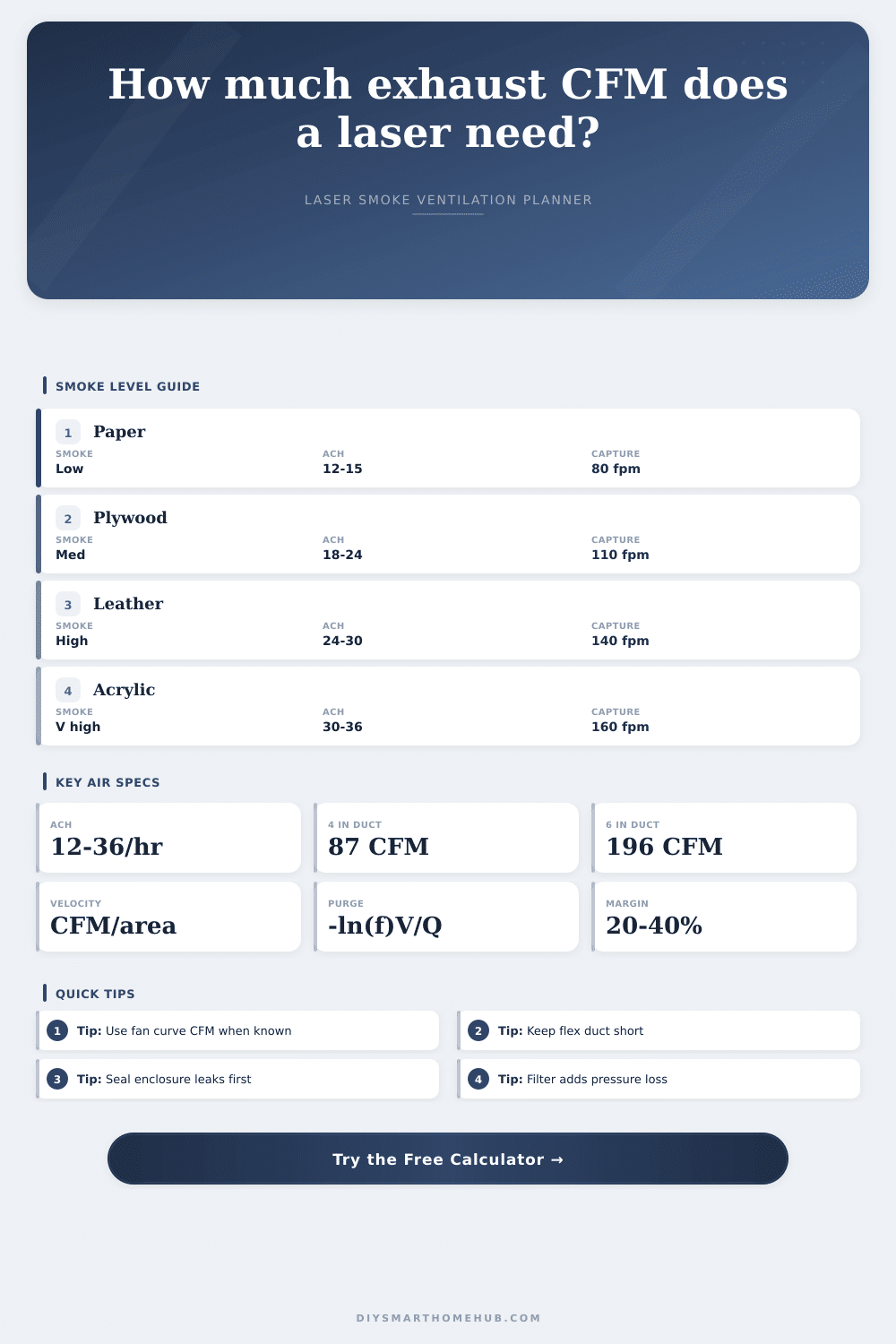
| Paper and cardstock | 0.90 low smoke | 12 to 15 ACH | 80 to 100 fpm at the inlet path |
| Plywood or MDF | 1.15 medium smoke | 18 to 24 ACH | 100 to 130 fpm for normal enclosures |
| Hardwood engraving | 1.25 medium-high smoke | 20 to 28 ACH | 110 to 140 fpm with visible plume control |
| Leather cutting | 1.45 high smoke | 24 to 30 ACH | 130 to 160 fpm for stronger capture |
| Acrylic cutting | 1.55 high odor | 30 to 36 ACH | 140 to 180 fpm and direct outside exhaust |
| Duct diameter | Duct area | Velocity at 150 CFM | Velocity at 250 CFM |
|---|---|---|---|
| 3 in round | 0.049 ft² | 3056 fpm | 5093 fpm |
| 4 in round | 0.087 ft² | 1719 fpm | 2865 fpm |
| 5 in round | 0.136 ft² | 1100 fpm | 1833 fpm |
| 6 in round | 0.196 ft² | 764 fpm | 1273 fpm |
| 8 in round | 0.349 ft² | 430 fpm | 716 fpm |
🌡Pressure And Purge Guidance
| Exhaust restriction | Model allowance | What it means | Calculator effect |
|---|---|---|---|
| Straight smooth duct | 1 ft per actual ft | Baseline run resistance | Raises equivalent length and pressure |
| 90 degree elbow | 7 ft each | Direction change and turbulence | Derates delivered fan CFM |
| Activated carbon | 2.0 in wg | Common odor filter restriction | Reduces fan flow more than open venting |
| HEPA plus carbon | 3.5 in wg | High restriction stack | Needs a fan curve or extra margin |
| Purge target | Formula multiplier | Example at 100 CFM, 20 ft³ | Use case |
|---|---|---|---|
| 10% remaining | 2.30 x V / CFM | 0.46 min | Fast smoke clear after light engraving |
| 5% remaining | 3.00 x V / CFM | 0.60 min | Normal lid-open delay planning |
| 2% remaining | 3.91 x V / CFM | 0.78 min | Smoky wood or leather jobs |
| 1% remaining | 4.61 x V / CFM | 0.92 min | Odor-sensitive acrylic clearing |
🏠Common Laser Setups
| Setup | Typical enclosure | Fan and duct range | Planning note |
|---|---|---|---|
| Compact diode enclosure | 10 to 20 ft³ | 120 to 220 CFM through 4 in duct | ACH requirement is small; capture and filter derate often dominate. |
| K40 or small CO2 laser | 15 to 30 ft³ | 200 to 300 CFM through 4 or 5 in duct | Acrylic jobs usually need more flow and better outside discharge. |
| Large CO2 cabinet | 35 to 70 ft³ | 350 to 650 CFM through 6 in duct | Long runs and elbows can reduce delivered fan CFM sharply. |
| Filtered indoor recirculation | Any size | Fan sized from filter static pressure | Use the fan curve at the filter pressure, not just free-air CFM. |
💡Laser Exhaust Sizing Tips
Mount the laser into a box Fire up the laser and make first cut which looks perfect The second cut smells bad.
Laser fumes is more than just an odor issue. They are a chemical and particulate hazard that hangs around long after work is done.
How to Choose the Right Laser Exhaust
Exhaust systems are about more than just moving air. They’re about moving correct amount of air fast enough. They’re about moving the correct amount of air fast enough. Once you know the duct layout and your volume, this calculator will do all the math for you. That eliminates having to figure out conversions and coefficients and saves you some guesswork.
What’s next? You’ll want to find out size of enclosure. Do not look at footprint of cart that holds it, but at actual interior air volume. Fifteen cubic feet might fit inside a small diode box. Fifty or more could be found in a large CO2 cabinet. Once you have the volume, you know how often you must change air inside the enclosure to prevent pooling of smoke.
Less smoke producing materials like paper and cardstock is simple. They don’t emit much and thus require less frequent air changes. Acrylic emits large amounts of heavy fumes which require higher ventilation rates. Your material profile selection set the baseline requirement. Pick the incorrect profile and you’ll either end up with an overbuilt system or find yourself with watery eyes for every cut.
Laser ventilation requires a capture velocity. You might have a huge fan capable of moving five-hundred CFM. But if the air enters the inlet too slowly, the smoke plume will escape out the top before the fan gets hold of it. So you want air coming in fast at the location where the smoke is being created. The calculator will help you balance amount of airflow (total) with how fast that air is moving into the box from your slot or lid. If the air moves too slowly, you are just working the fan hard without much result.
Ducting creates resistance. Each elbow and each foot of pipe take away performance from your fan. A straight ten-foot run is not equal to a forty-two inch run with three sharp turns. As air rubs against the duct walls it loses pressure. Don’t expect to get the free-air CFM rating printed on the fan box. That assumes there is zero resistance. Resistance is real life. To model that loss in the tool, we turn filters and elbows into equivalent length runs of straight duct. Then we lower the fan’s output to reflect what you’ll actualy get.
Why does it matter? We’ve heard too many stories of people buying fans based off their peak rating only to be disappointed. But what about filters? Filters make it complicated. They use an activated carbon block or HEPA stack to stop both the particles and the smell. But they choke the airflow, too. How much? This can reduce effective CFM by as much as thirty percent or more. That’s why you want a fan capable of pushing into the pressure. The calculator takes care of this by adjusting the delivered flow according to the type of filter chosen.
This derate matters most when you’re recirculating indoor air. When you’re venting right outside, the loss is negligible. But either way, the math says whether you’ve got enough going or need something more powerful.
The final test is the purge time. How many minutes should you blast that fan once the laser shuts off? What level of purged air are we looking for? Most people say “five percent” is uncertain. If it’s something touchy, like a school project, then 10 percent will get you into dangerous territory. That’s where the tool guesses at the number of minutes required to achieve your desired level of clean. It uses an estimate based on a logarithmic decay model. In other words, the initial minutes is doing all the heavy lifting. The last bit of smoke takes disproportionately longer to remove. A minute after that and you’re down by another factor of two. (So, if you only have a little engraving to do, don’t sit there waiting an hour.)
The laser exhaust setup involves a choice between clean air, cost, and noise. More expensive filters = cleaner air. Longer Duct = less air lost but fewer places to vent. Larger fan = more air moved but louder fan. A shorter duct means less air is lost, but there are fewer places to vent the air. Smaller fan = quieter but not as much air.
You could of had everything for free. You want enough pressure to push against the filter and duct. You want enough airflow to get rid of air in the box. And you want enough capture velocity to suck up the smoke.
Start at the beginning. Seal all leaks. Determine the size. Select the correct profile for material. Let the numbers determine what hardware suits. It’s worth it for clean air.