Workshop Dust Collection CFM Calculator
Estimate the dust collector airflow needed for one open tool, then check duct transport velocity, equivalent run loss, filter static pressure, and collector margin.
🔧Workshop Presets
⚙Airflow Inputs
📊Live Design Grid
🧮Tool And Duct Reference Tables
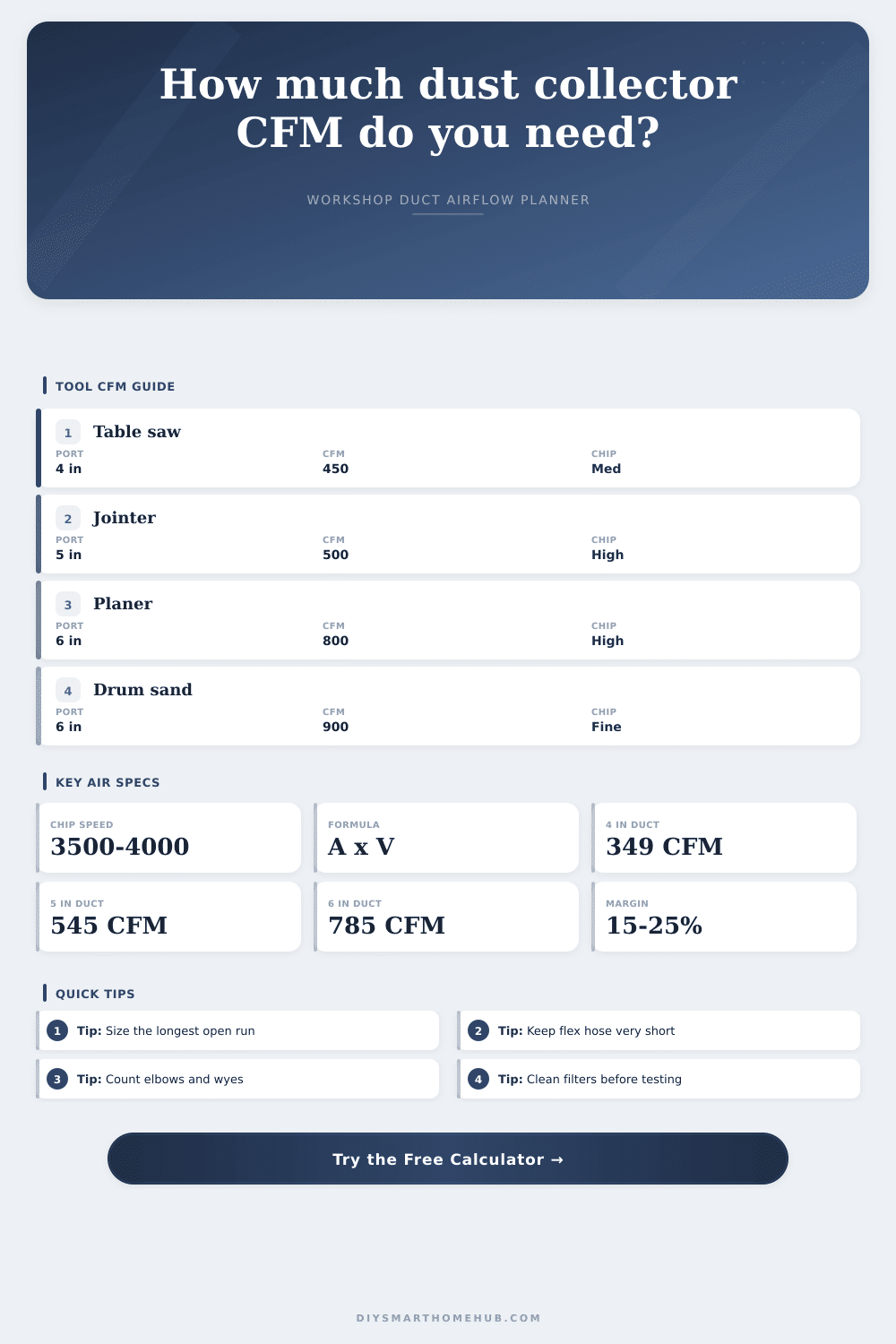
| Tool or hood | Typical port | Capture CFM | Chip load |
|---|---|---|---|
| Table saw | 4 in | 400 to 450 | Medium chips and fines |
| Cabinet table saw | 4 to 5 in | 500 to 650 | Enclosed base plus blade guard pickup |
| Jointer | 5 in | 450 to 600 | High chip load at the cutterhead |
| Planer | 5 to 6 in | 700 to 900 | Heavy chips and fast cutterhead output |
| Drum sander | 4 to 6 in | 700 to 1000 | Fine dust demands strong capture |
| Round duct | Area | CFM at 3500 | CFM at 4000 |
|---|---|---|---|
| 3 in | 0.049 ft2 | 172 cfm | 196 cfm |
| 4 in | 0.087 ft2 | 305 cfm | 349 cfm |
| 5 in | 0.136 ft2 | 477 cfm | 545 cfm |
| 6 in | 0.196 ft2 | 687 cfm | 785 cfm |
| 8 in | 0.349 ft2 | 1222 cfm | 1396 cfm |
📏Pressure And Fitting Tables
| Component | Equivalent length | SP role | Planning cue |
|---|---|---|---|
| Smooth main duct | Actual length | Base friction path | Keep the longest open run short and direct |
| Flexible hose | 2.5x actual length | High friction allowance | Use only at the machine connection when possible |
| 90 degree elbow | 7 ft each | Turbulence and direction change | Use long-radius elbows for lower real loss |
| 45 degree bend | 3 ft each | Moderate bend loss | Two gentle bends can beat one tight elbow |
| Wye or blast gate | 5 ft each | Branch and gate disturbance | Close unused gates to preserve velocity |
| Static pressure | System reading | Collector effect | Design response |
|---|---|---|---|
| Under 5 in wg | Low restriction | Many collectors hold flow well | Good target for compact shops |
| 5 to 7 in wg | Normal ducted shop | Fan curve matters | Check rated CFM at pressure |
| 7 to 9 in wg | Restrictive path | Airflow may drop hard | Shorten flex and open diameter |
| Over 9 in wg | High resistance | Small collectors struggle | Review fittings, filter, and fan curve |
🏠Common Shop Setups
| Setup | Typical duct | CFM target | Static pressure note |
|---|---|---|---|
| Mobile collector to one tool | 4 in hose under 10 ft | 350 to 500 cfm | Flex hose and tool port usually dominate loss |
| Wall-mounted collector with trunk | 5 in main to 4 in drops | 500 to 700 cfm | Watch elbows at each branch and blast gate |
| Planer or jointer station | 6 in main preferred | 700 to 900 cfm | Heavy chips need both CFM and velocity |
| Cyclone with cartridge filter | 6 to 8 in main | 800 to 1200 cfm | Filter loading can add several inches of pressure |
💡Dust Collection Sizing Tips
The problem isn’t typically something broken in your machine; it’s that the air just doesn’t move fast enough to take the chips off into the distance before they can fall out and ruin your project (and your lungs). You know it when the collector starts humming as you’re sanding on a board and there’s a slight haze over table. It is a quiet failure that ruins lung and projects alike.
We tend to believe that dust collection is pretty straightforward: more horsepower = better system. But that’s not true. Dust collection is fluid dynamics. That’s why we created the calculator above… To run the math for you. Understanding how those numbers work makes all the difference between a clean shop and a messy one.
How to Get Good Air Flow in Your Shop
What you want is to move air so quickly that it carries chips up into the hood and holds them suspended. But a small duct moving fast air might starve your table saw of capture power; and if there’s too much resistance, it can suck the life out of your fan. And if there’s not enough air movement, then whatever you throw at it has time to settle back to Earth. The key is to find the sweet spot. Typicaly, that’s in the range of 3,500 to 4,000 fpm (feet per minute).
This means cubic feet per minute, which is amount of air being moved. And then there’s velocity, or how fast the air is moving. Those are two different metrics. To understand the difference, consider that slow-moving, big ducts is bad. Small ducts with high velocity = bad. You want to have just the right mix, typicaly somewhere around 3,500 to 4,000 fpm. That way the air blows fast enough to suspend the chips as they’re carried up into the hood.
Duct size is a double-edged sword. On one hand, large ducts reduce friction, which is nice. On the other, they’re harder to move air through at high enough speeds for transporting. So if you have a 6-inch main feeding a 450 CFM tool, amount of airflow through that line could be as slow as 2,000 fpm. That is too slow.
Use the calculator to see what the actual duct velocity will be given the duct diameter and desired flow you’ve selected. If it’s low, you either need a larger fan or a smaller duct. It’s a physics thing, and there’s no arguing with it.
This is static pressure. Each foot of flexible hose, each elbow, each blast gate represent resistance. And the culprit here is the flexible hose which has a crimped surface that grabs at the air. Ten feet of flexible hose equals as much drag than thirty feet of smooth pipe. Add it all up; all the resistance from your entire run, and then the resistance of the filter within the collector, and you’ve got the total load of static pressure. That means reduced fan output.
Collectors is rated at maximum airflow, assuming zero resistance; but in reality, most shops has large resistance. By taking into account the filter load and adding an equivalent length of hose for every fitting, the tool give you a realistic view of what your fan will really provide.
Take a look at the reference table on the page: this shows typical CFM requirements for common woodworking tools. Generally speaking, if you’re throwing huge chips like a planer does, you need serious volume (sometimes 800 CFM or more). If you’re dealing with fine dust like in a router table, you need strong capture at the source but not necessarily huge volumes downstream. They aren’t hard-and-fast rules, but they’re starting points.
A planer is the biggest source of debris (don’t skimp on that one). Also, the filter maintenance makes all the difference in the world. A new and clean cartridge filter might add only two inches of water gauge to your static pressure. An old and clogged filter could be adding four or five. That difference can cut your actual airflow in half. Adjusting the filter condition on the calculator shows what neglect does to performance. It is a small thing, but it is important.
Lastly add a little fudge factor. Filters gets dirty, ducts leak, fans degrade. You calculate that you need 600 CFM? Add a 700 CFM collector. You’re walking a tight rope with a 600 CFM collector. One dirty filter, one extra elbow and you’re back to breathing sawdust.
Plan for the worst case, not the best case. Keep the air moving and your finish quality and your lungs will thank you.