Stair Lighting Step Count Calculator
Estimate how many stair lights to use from step count, tread width and depth, target lux, fixture output, wattage, spacing pattern, transformer voltage, wire length, and wire gauge.
Stair lighting result
| Wire gauge | Voltage drop | Drop percent | Planning note |
|---|---|---|---|
| Calculate to compare wire sizes. | |||
| Spacing pattern | Fixture count formula | Good fit | Tradeoff |
|---|---|---|---|
| Every step | steps / 1 | Short or showpiece stairs | Most even, highest load |
| Every 2nd step | ceil(steps / 2) | Typical interior stair | Balanced coverage |
| Every 3rd step | ceil(steps / 3) | Accent or wall wash | Needs brighter fixtures |
| Every 4th step | ceil(steps / 4) | Long exterior runs | More shadow between lights |
| Top/bottom plus every 4th | ceil(steps / 4) + 1 | Entry stairs and landings | Emphasizes ends |
| Top, middle, bottom | 2 or 3 fixtures | Low output accent lighting | Spacing drives result |
| Target lux | Use case | Fixture style | Check |
|---|---|---|---|
| 20-30 lx | Soft accent | Low output marker | Trip visibility |
| 30-50 lx | Interior stair | Recessed step light | Even spacing |
| 50-80 lx | Entry or deck | Shielded brighter light | Glare control |
| 80-120 lx | Task-like stair | Higher lumen fixture | Transformer load |
| Example stair | Steps | Pattern | Typical result |
|---|---|---|---|
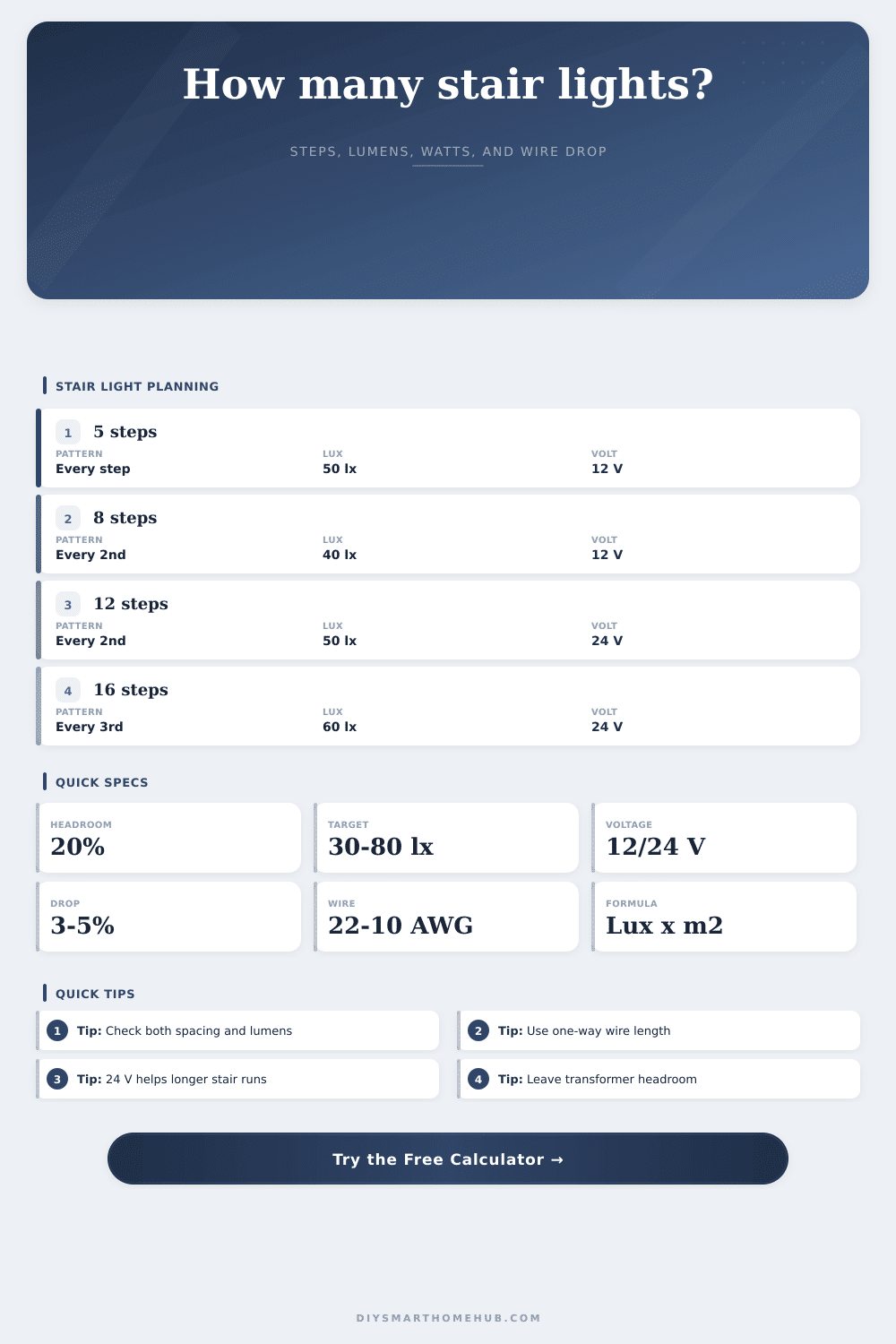
| Short hall | 5 | Every step | 5 fixtures |
| Split level | 8 | Every 2nd | 4 fixtures |
| Basement flight | 12 | Every 2nd | 6 fixtures |
| Townhouse flight | 16 | Every 3rd | 6 fixtures |
| Long deck run | 18 | Ends plus 4th | 6 fixtures |
| Formula | Expression | Uses | Output |
|---|---|---|---|
| Run | steps x tread depth | Lit stair length | ft or m |
| Lumens | width x run x lux | Area light target | lumens |
| Power | fixtures x watts | LED load | watts |
| Transformer | watts x 1.20 | Headroom sizing | watts or VA |
| Voltage drop | 2 x K x A x ft / cmil | Copper circuit | volts |
The voltage drop calculation treats the wire length as one-way distance from transformer to the farthest fixture and uses copper conductors with K = 12.9 ohm-cmil per foot.
Lighting stairs make them safer and easier to see. Without glare, which blinds your nighttime vision, you must be able to clearly see each step’s outer edge.
Low-voltage light is not intuitive; use math instead. Underpowering or ill-placed five lights might not cut it. The calculator handles the complex relationships between electrical physics, brightness, and step count. It request stair measurements (since the size of space affects how far light should travel). A wide staircase require more distance for light to distribute evenly to keep it bright enough. It then translates these numbers into what’s called a “lux target,” or the amount of light that hits floor. Ideally, you want to have anywhere from thirty to eighty lux of lighting across your tread for safety reasons. Any less and you can’t see where you’re going; any more and it will be too glaring.
How to Plan Stair Lighting
The following choice is about the number of fixtures per step, i.e., their density. While all steps with a light are ideal (perfectly covered), this result in a lot of wire plus a heavy transformer. As a compromise between illumination and cost, most users opt for every second step. This table of references reveal the number of fixtures needed depending on pattern. Based off these figures, the tool verifies whether provided fixtures light up sufficiently. Fewer lights can be bright; lots of lights may be dim. To ensure safety, stairs must meet the greater demand.
Low-voltage systems rely on avoiding voltage drop. Voltage will be reduced when electricity passes down a wire. If your transformer is very far from your fixtures, by the time current reach the final light, it might not have enough voltage to shine brighty. The calculator takes distance and wire gauge into account for this loss. You can spend more initially on thicker wire, which pays off with no dimmer fixture later. You’ll avoid replacing cable because lights are weak.
The last thing is transformer. Don’t purchase a transformer with the same amount of watts as your lights. There is a 20% buffer built into tool so that the transformer doesn’t run hot and fail. That also means you can add more light in the future without having to upgrade the system. A lot of homeowners skip this step, this overloads their transformer, and they notice the lights start to dim after a few month.
The tool has some presets that are helpful as a starting point. A long outdoor deck run is handled different than a short hall stair. And an outdoor run will have wider spacing and thicker wire because the aesthetic is different. No need for reading light on your deck steps. Just light to keep from tripping. Stairs inside demand more precision, the difference is small but matters.
Lighting stairs is all about control. It controls your foot and guides your eye, taking away the anxiety of being in dark. The calculator removes the fear of failing at the task. What was once a guess now becomes a plan. Yes, you will see floor when walking down the steps. You would of no longer fumble around or see confused shadows. It is simply clear light. That is why it’s worth the time it takes to put in those numbers.