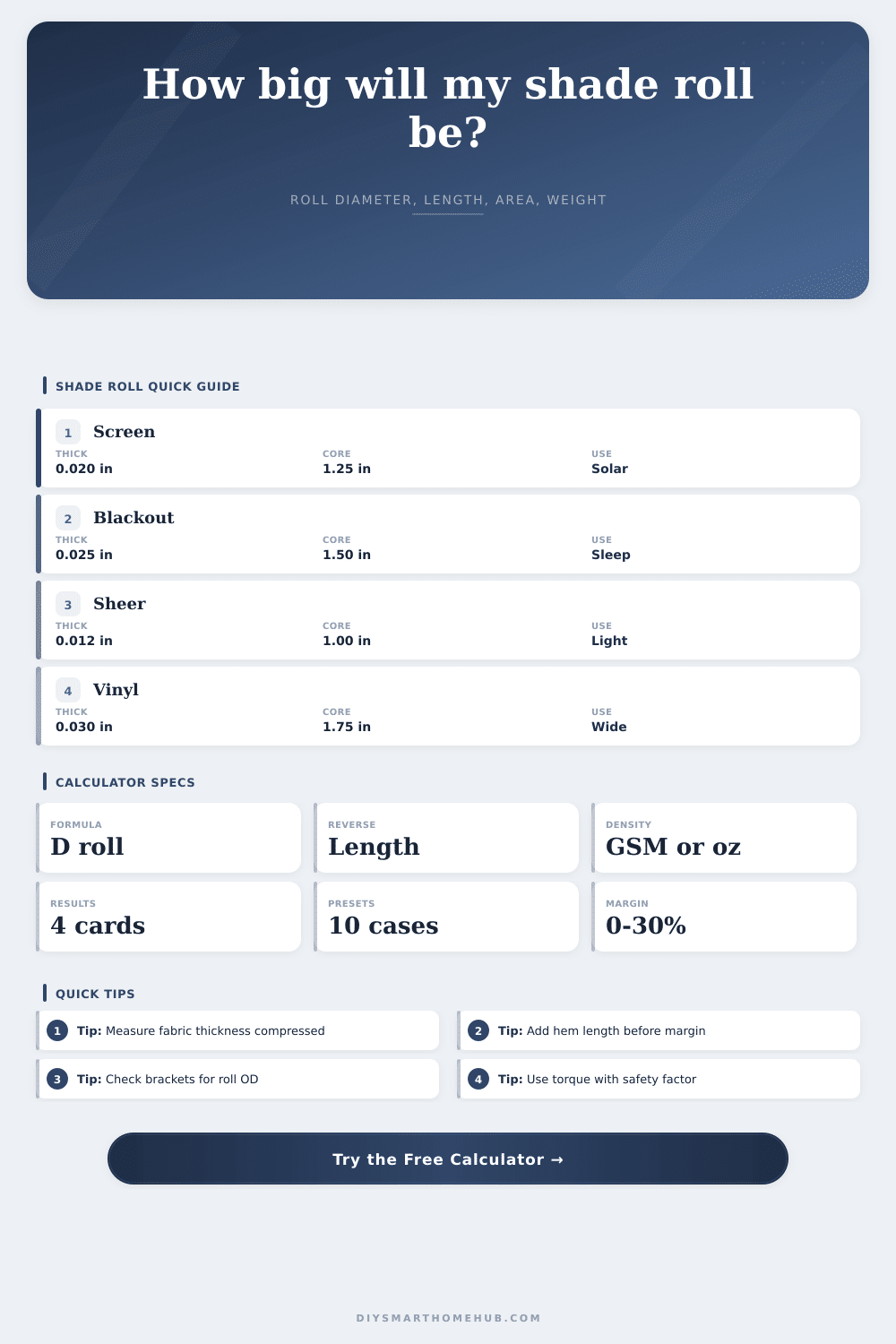
Shade Fabric Roll Diameter Calculator
Estimate finished roll outside diameter from fabric thickness, shade length, width, tube size, material density, hem allowance, shade count, and safety margin. Use the inverse diameter check to estimate fabric length already on a roll.
Shade Fabric Roll Results
| Fabric type | Typical thickness | Typical density | Best calculator use |
|---|---|---|---|
| Solar screen 5% | 0.018-0.022 in / 0.46-0.56 mm | 340-430 gsm | Everyday glare and heat control roller shades. |
| Solar screen 3% | 0.020-0.024 in / 0.51-0.61 mm | 390-500 gsm | Tighter weave screen fabric with less view-through. |
| Blackout polyester | 0.022-0.028 in / 0.56-0.71 mm | 420-620 gsm | Bedroom or media room shades where opacity matters. |
| Sheer light filtering | 0.010-0.016 in / 0.25-0.41 mm | 140-260 gsm | Small diameter rolls with low fabric weight. |
| Vinyl coated shade | 0.026-0.034 in / 0.66-0.86 mm | 520-760 gsm | Heavier roll where clearance and torque deserve a margin. |
| Exterior solar mesh | 0.026-0.040 in / 0.66-1.02 mm | 560-850 gsm | Outdoor or exposed shades with larger tube hardware. |
| Core tube OD | Roll OD check | Length at 0.020 in fabric | Hardware note |
|---|---|---|---|
| 1.00 in / 25 mm | 2.00 in / 51 mm | 9.8 ft / 3.0 m | Slim roller hardware and light fabric. |
| 1.25 in / 32 mm | 2.50 in / 64 mm | 18.4 ft / 5.6 m | Common small to medium shade tube. |
| 1.50 in / 38 mm | 3.00 in / 76 mm | 26.5 ft / 8.1 m | Useful for taller drops or thicker fabric. |
| 1.75 in / 44 mm | 3.50 in / 89 mm | 36.1 ft / 11.0 m | More room for wide shades and heavier cloth. |
| 2.00 in / 51 mm | 4.00 in / 102 mm | 47.1 ft / 14.4 m | Large tube with more bracket clearance needed. |
| 2.50 in / 64 mm | 4.50 in / 114 mm | 55.0 ft / 16.8 m | High-capacity roller assemblies. |
| Scenario | Fabric and core | Adjusted fabric | Approx roll OD | Torque note |
|---|---|---|---|---|
| Kitchen window | 0.020 in screen, 1.25 in core | 36 in x 92 in | 1.96 in / 50 mm | Light motor load. |
| Bedroom blackout | 0.025 in blackout, 1.50 in core | 48 in x 110 in | 2.30 in / 58 mm | Moderate margin. |
| Patio door | 0.030 in vinyl, 1.75 in core | 84 in x 96 in | 2.66 in / 68 mm | Check bracket depth. |
| Sheer office | 0.012 in sheer, 1.00 in core | 42 in x 84 in | 1.55 in / 39 mm | Low roll inertia. |
| Exterior solar | 0.035 in mesh, 2.00 in core | 96 in x 116 in | 3.06 in / 78 mm | Use a higher margin. |
| Bay window trio | 0.018 in screen, 1.25 in core | 30 in x 80 in each | 1.78 in / 45 mm | Total area triples. |
Before cutting out the fabric, measure the window casing. If finished cylinder is just a fraction of an inch too big, it won’t fit in brackets or fascia box. An extra wide cylinder (from an even slightly oversized fascia box or bracket) makes all beauty of fabric useless.
While math here is simple, it also tricks a lot of DIYers into thinking that adding length only increases the cylinder by a small amount. It’s not linear! The diameter vs length relationship is actualy a square root curve, meaning that the first few feet of fabric don’t contributes much to the overall size. The final few feet can be just enough to exceed your clearance limits. Know geometry and you’ll have a nice looking install.
How to Measure and Cut Fabric for Window Shades
It all starts with core of the tube. Bumping up to a bigger diameter core doesn’t simply make the tube thicker but change how layers of material wrap around that core. Picture coins stacked onto a spindle. With a smaller core you have more room for fabric to wind up before hitting outer limit. This will give you much greater total length then a larger one (see table of references).
Cut only after you’ve measured whatever brackets/hardware you’re going to use. Remember that when retrofitting, the tube might be rusty or worn through, but bracket depth remains unchanged. It’s a no-negotiation item called architecture.
The second assumption that fails is thickness of fabric. People often look at openness factor or price tag and assume they know the gauge, but they do not. It may seem like a small amount, but a sheer light filtering fabric might be barely thicker than a piece of paper, while a blackout polyester could be almost double the thickness. Even though they are both made by same company. That tiny increment is multiplied by number of wraps around the tube.
On a small shade it’s inconsequential. On a seven-foot drop it’s a quarter-inch loss of clearance. Once you measure actual thickness (using the ruler trick), you just pop it into calculator and let it do the math. No more guessing how many layers compound on each other in your head. Always measure fabric squished between two adult-sized sofa. Measuring dry will get you false hope.
The mechanics is more critical than the weight, though weight does matter. A big roll with a heavy shade will generate massive amounts of torque. That has to be countered by manual spring or motor. On the first trip down, mass of shade generates inertia which must be over come. Ignore this and your motor may burn up or your shade sag on the next trip. Remember: adding a safety factor doesn’t mean you’re being pessimistic. It’s engineering. You account for the way real world isn’t perfect. You account for side channels, friction and so forth.
The last trap is hem allowance. You measure your window, you cut your fabric, you go to sew your hem, and oh yeah… you forgot to account for adding extra length at top and bottom of fabric for the hem. That fabric still gets wrapped around the tube. It still contributes to the diameter. Add your hem length BEFORE calculating what size roll you want, and you’ll have a true answer. Add it afterwards and you’re in for a surprise.
It makes geometry of what was once guesswork. No hoping it fits. Proving it fits. If you get how the core establishes the baseline and the thickness create the curve, there isn’t much to it beyond input and output. The math spits out exact size of roll as you need. No bigger. No smaller.
Measure. Calculate. Cut. Shade fits. Satisfying. In a basic-physic’s kind of way. Next time you gaze upon window, you’ll see more than just light. You’ll see clearances and layers and cores.