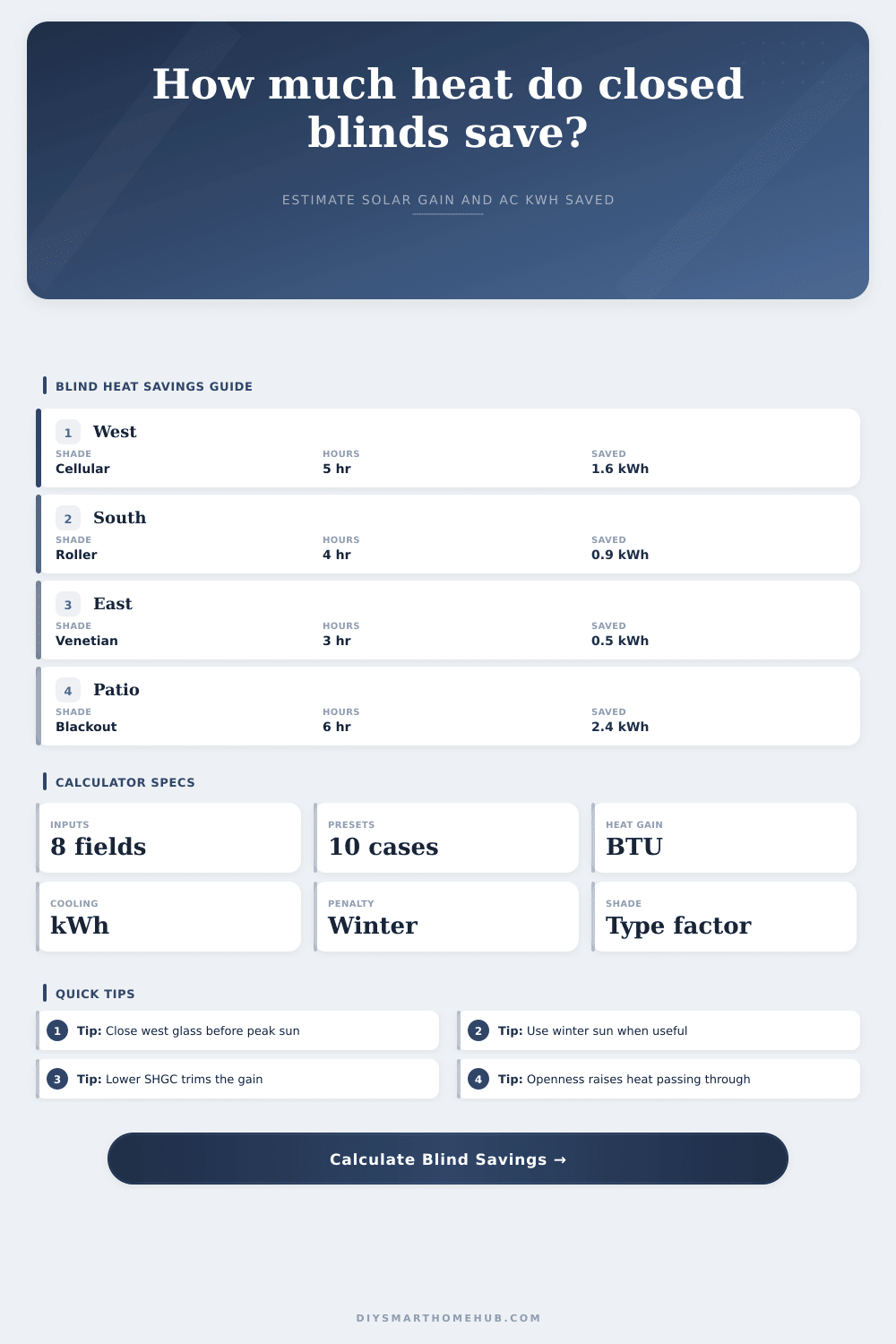
Blind Closure Heat Savings Calculator
Estimate solar heat gain through a window, the BTU blocked by closing blinds, cooling kWh saved from AC load reduction, and the winter penalty when useful sun is blocked.
Blind Closure Heat Savings Results
| Shade type | Base reduction | Openness effect | Best calculator use |
|---|---|---|---|
| Blackout roller | 78% | Closed fabric | Strong daytime heat blocking and room darkening. |
| Cellular shade | 62% | Low openness | Balanced solar control with air-pocket insulation. |
| Solar screen 3% | 66% | 3% open | Good glare control while preserving outside view. |
| Solar screen 5% | 58% | 5% open | Moderate heat reduction with more daylight. |
| Venetian blinds | 50% | Slat angle | Useful when slats are tilted to reflect sun upward. |
| Sheer shade | 28% | Open weave | Light filtering where comfort gains are modest. |
| Orientation | Typical input | Factor used | Calculation note |
|---|---|---|---|
| West | 175-240 BTU/hr-sq ft | 1.00 | Often highest cooling value during late afternoon. |
| South | 140-220 BTU/hr-sq ft | 0.92 | Strong midday exposure, especially with limited overhangs. |
| East | 110-190 BTU/hr-sq ft | 0.78 | Morning loads may matter less if AC load is low. |
| Southwest | 170-250 BTU/hr-sq ft | 1.08 | High peak-load value on hot clear days. |
| North or shaded | 35-90 BTU/hr-sq ft | 0.35 | Mostly diffuse gain, so closure savings are small. |
| Skylight | 190-290 BTU/hr-sq ft | 1.15 | Roof glass can receive intense sun for long periods. |
| Scenario | Area | Shade | Sun hours | Approx kWh saved |
|---|---|---|---|---|
| West living room | 72 sq ft | Cellular | 5 hr | 1.59 kWh |
| South patio door | 48 sq ft | Solar 5% | 4 hr | 0.80 kWh |
| East bedroom | 28 sq ft | Venetian | 3 hr | 0.30 kWh |
| Skylight room | 18 sq ft | Blackout | 6 hr | 0.74 kWh |
| Apartment glass wall | 120 sq ft | Solar 3% | 5.5 hr | 3.13 kWh |
| North office | 36 sq ft | Sheer | 4 hr | 0.09 kWh |
In this scenario, it’s 3 o’clock in the afternoon; sunlight is flooding into your living room from west wall. You can feel the heat radiating from that wall based off the doorway. You’re standing by the door feeling its warmth. Your AC is straining, humming harder as it battles to offset the solar gain blasting through glass. This is when interior window treatments transition from just decoration to actual component of your building envelope.
Most of us view blinds as decorative elements, something used to filter out hard light or provide some privacy. Not many of us envision them as dynamic insulation that modify the amount of thermal load placed upon our HVAC system.
How Blinds Help Save Energy
Enter the calculator above. Plug in your window specs and let it crunch the numbers for you. You will no longer have to guess how much afternoon heat escapes around glass.
This is the heart of it: The physics are straightforward. Energy (measured in BTUs) from sunlight strike the window and travels through the glass. That energy becomes heat within space. Closing the shade interrupts that flow of energy before it reaches mass of the room. How much heat you block depends greatly on how the shade is constructed and what kind of fabric it’s made of.
For example, a sheer shade dims the light somewhat but allows majority of the heat to pass through. Cellular shades trap air in honeycomb pockets, forming a thermal barrier that drastically reduces heat from sun. Knowing this makes all the difference: Do you want to reduce glare? Try a solar screen; it may do the trick but won’t save nearly as much energy then. Do you want to stop the heat? You’ll need an opaque or very low openness fabric.
The second factor is orientation, which is hugely important to the payoff you recieve from closed blinds. For example, west-facing windows is known for their late-afternoon heat spike. Indoor temps increase most rapidly during that period, with AC compressors working hardest. In terms of blocking sun: Closing your west window in the hottest part of the day gives you the biggest bang for your buck.
South-facing windows are hit hard with midday sunlight (great for passive heating in winter but not so much in summer). Morning light coming through east windows tend to be less severe, something an HVAC system should of able to manage without too much strain. These direction-based variations affect how much solar radiation hits the glass each time of day, which is why the tool updates its irradiance values accordingly.
Another caveat is that there is a seasonal tradeoff here as well. During summer, blocking solar gain is strictly good. This means less cooling demand and a lower electric bill. And during the winter? That solar gain is free heat. Close those heavyweight blackout shades on a sunny south-facing window in January, and maybe your heating system has to work extra-hard to replace warmth that otherwise would’ve gotten in for free. To account for this flipside, the calculator provides an estimate of a winter penalty, reminding you that not all shading is good. You want to be letting the sun in when it helps you, while blocking it out when it hinders you.
Often, smart schedules will automatically do this. But paying attention to the season can work just fine with manual control.
The other side of this: Glass properties matter. Older single-pane windows tend to have high solar heat gain ratings (meaning they let in a lot of heat). Your indoor shades has to work hard. They’re keeping out a bunch of heat. On the flip side, if you have newish low-e double-pane glass with low SHGC, part of the solar energy is being blocked by the glass itself. The shade becomes an extra layer of protection, but it won’t stop as much. You’ll see smaller incremental energy savings. It is still worth it for comfort and glare control, but the energy math are different. Knowing what solar heat gain means and knowing your window’s solar heat gain will help you know what kind of kWh you should expect to save.
In the end, it’s all about controlling the energy that wants to enter your house before it gets out of hand. There is nothing easy about changing direction your house faces or how many windows there are on it. What you CAN control, however, is what happens to any sunlight that attempts entry. One of the least expensive ways to improve your thermal comfort is closing the proper shade at the proper moment. You do not need special permits or any construction. You just tap a button or pull a cord.
Next time the sun beats down onto your west wall, think of yourself as having control over that heat. Over time, the savings accumulate, turning a passive part of your building into a tool that controls the climate.