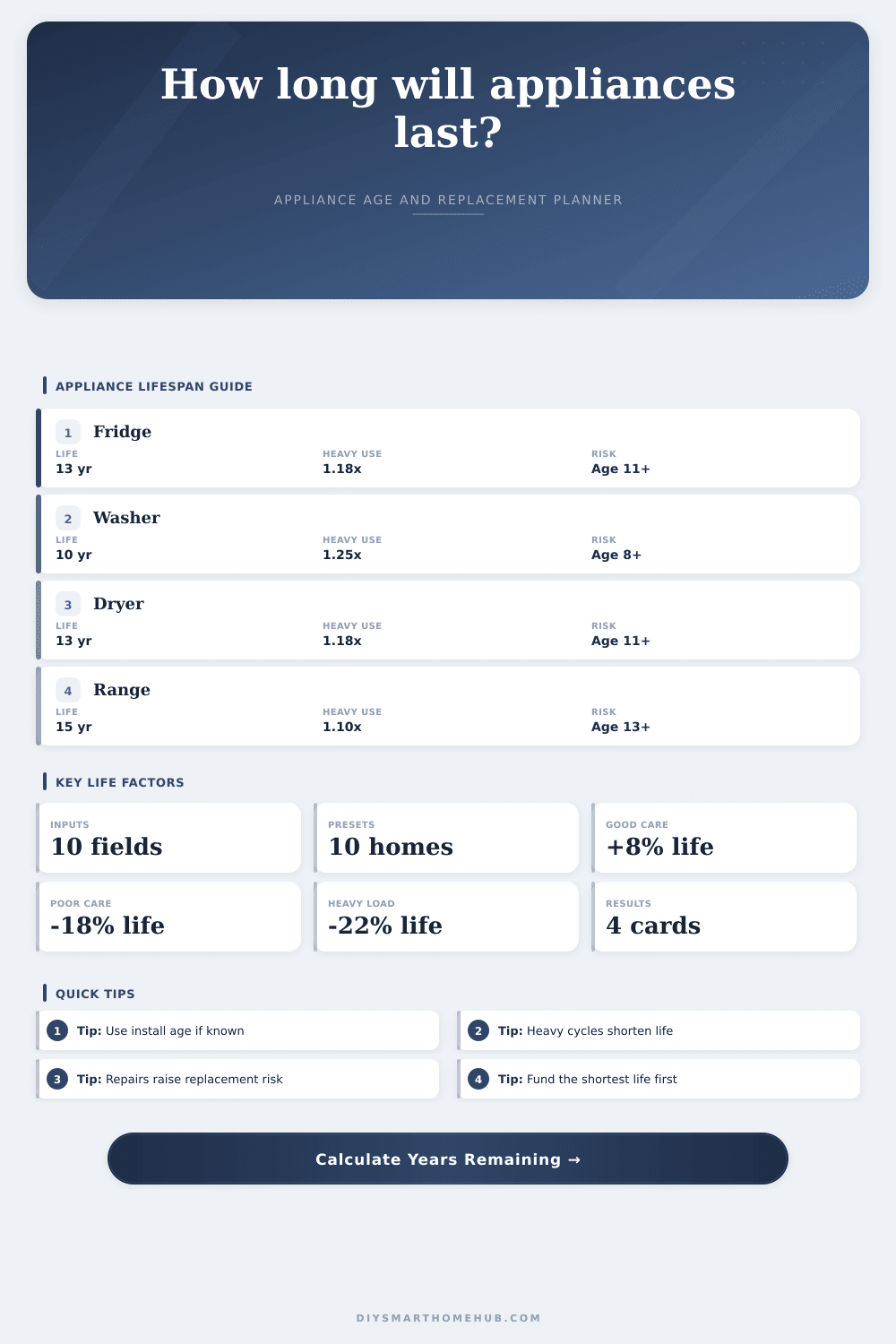
Appliance Lifespan Remaining Calculator
Estimate how many adjusted years an appliance may have left after age, household load, maintenance, and repair history are applied to the typical expected lifespan.
Base expected lifespan comes from common home planning ranges.
Used only for the annualized replacement fund.
Compressors, door seals, and condenser cleanliness make a large difference.
High cycle counts, oversized loads, and vibration shorten bearing and motor life.
Lint airflow, vent length, and heat cycling are the main lifespan pressures.
Pump wear, hard water, and rack condition often determine replacement timing.
Ranges often last longer than wet appliances, especially with lighter controls use.
Door switches, magnetron wear, and daily heat loads can shorten life quickly.
Tank life depends heavily on water quality, anode care, and flushing habits.
Runtime hours, filter care, coil condition, and climate load drive replacement risk.
| Appliance | Base life | Typical watch point | Major derate signals |
|---|---|---|---|
| Refrigerator | 13 years | Age 10 to 12 | Warm cabinet, seal leaks, noisy compressor |
| Washing machine | 10 years | Age 7 to 9 | Bearing noise, leaks, repeated unbalance |
| Clothes dryer | 13 years | Age 10 to 12 | Long dry times, heat faults, poor airflow |
| Dishwasher | 10 years | Age 7 to 9 | Pump noise, poor wash, control failures |
| Gas range | 15 years | Age 12 to 14 | Igniter faults, control board issues |
| Electric range | 13 years | Age 10 to 12 | Element faults, oven temp drift |
| Microwave | 8 years | Age 5 to 7 | Door switch faults, weak heating |
| Tank water heater | 10 years | Age 7 to 9 | Rust, leaks, slow recovery, sediment |
| Heat pump or AC | 14 years | Age 10 to 12 | Refrigerant leaks, compressor faults |
| Standalone freezer | 12 years | Age 9 to 11 | Frost, hot garage load, seal failure |
| Factor | Best case | Normal | High stress |
|---|---|---|---|
| Usage intensity | 0.90x wear | 1.00x wear | 1.30x to 1.45x wear |
| Load severity | 0.92x wear | 1.00x wear | 1.25x to 1.35x wear |
| Maintenance | 0.92x wear | 1.00x wear | 1.12x to 1.22x wear |
| Condition | 0.90x wear | 1.00x wear | 1.15x to 1.30x wear |
| Environment | 0.97x wear | 1.00x wear | 1.14x to 1.20x wear |
| Repair history | 0 repairs | 1 repair | 3 or more repairs |
| Scenario | Base life | Adjusted life | Planning note |
|---|---|---|---|
| Light-use guest suite refrigerator | 13 years | 14.5 years | Lower wear can extend the planning window. |
| Family washer with daily loads | 10 years | 7.4 years | High cycle load pulls replacement closer. |
| Garage freezer in hot weather | 12 years | 9.3 years | Environment derate matters for compressors. |
| Maintained water heater | 10 years | 10.8 years | Flushing and anode care improve the estimate. |
| Older dishwasher with two repairs | 10 years | 7.9 years | Repair history raises replacement risk. |
| Output | Formula | Purpose | Range |
|---|---|---|---|
| Adjusted expected life | Base life / wear factor | Converts care and load into usable life | Limited to 45% to 125% of base |
| Remaining years | Adjusted life - current age | Estimates practical years left | Minimum shown as 0 years |
| Replacement risk | Age ratio + repair pressure | Flags near-term replacement pressure | 0% to 99% |
| Annual fund | Net replacement / remaining years | Annualizes the replacement reserve | Uses 0.5 year floor |
You think of a refrigerator, washer, or other home appliance as an appliance because it works until it breaks. And then it’s super-expensive and it’s inconvenient. That’s not being pessimistic; it’s acknowledging that any motor have a limited lifespan.
The calculator does the math for you, it takes your lifestyle and translates it to months on the calendar. Appliance lifespan base numbers is meaningless if viewed alone. For example, on paper, a fridge last 13 years. But that’s assuming average usage! That is not your reality. You have a family of five, they open the door more frequent than average. You live in a hard water area; your washer gets hammered relative to soft water area. By using multipliers for maintenance and usage, the tool works out lifespan for you. It shames you into admitting that heavy use reduce lifespan. That is a small detail, but it matters.
How to Plan for Appliance Replacement
That leaves you, the one variable you can control. There’s also an option for “quality of maintenance” on the calculator. Why? Because how well you treat the thing change the rate at which it wears out. Dishwasher scale and clogged clothes-dryer vents don’t just get gross (they shorten the appliance’s lifespan). You can think of this as an investment: If you clean them, they last longer. If you don’t, they’ll die off faster. The table of references indicate what happens to life expectancy under varying care methods. Taking good care will add time; poor care will take time away.
Age doesn’t tell everything; repairs tell more. A seven-year-old washing machine repaired twice might be in worse shape than a ten-year-old machine never touched. The cost of those repairs and their recency is factored into the calculator. Having to spend money on repairs decreases it’s remaining useful life.
Here’s where replacement risk metric comes into play. It helps distinguish between “how old” and “how likely to break.” A high-risk machine are a good candidate to begin saving toward replacing. You can see some examples below:
What’s more practical? The answer: the annual fund output, which breaks down the number of years until replacement and the estimate for that replacement cost. That’s your savings goal in dollars per month (or per year). That transforms a huge someday expense into something that fits in your budget. You don’t have to save the entire amount all at one time. You only need to stash away some small percentage each year. Let the calculator do the math; let yourself focus on stashing it away.
Surprisingly, environment matters. An outdoor unit in a garage operate under more stressful conditions than one inside the house. Humidity and heat is hard on compressors and other electronics. The calculator includes this in its calculation by penalizing units in rough conditions. Remember: Where you put an appliance is as important as what brand you buy.
Don’t let it break down. When an appliance go down, you lack the luxury of selecting. Now you must purchase on short notice, and typically pay more. If you follow the estimate of remaining years, you can budget ahead. While the odds are in your favor, enjoy the appliance. Once the odds turn against you, begin saving. Following this routine takes panic out of upkeep. It trades shock for strategy. With eyes wide open, you’re managing the furnitures.