Aquarium Heater Warmup Time Calculator
Estimate aquarium heater warmup hours from gallons, temperature rise, heater watts, efficiency, room temperature loss, tank surface area, and watts-per-gallon sizing rules.
🐟Choose an Aquarium Preset
🌡Enter Heater Warmup Inputs
⏱Your Aquarium Heater Estimate
⚙Aquarium Heater Formula Constants
📊Heater Rule Comparison Grid
Large stable aquariums
- Often use about 2.5 to 3.5 watts per gallon in steady rooms.
- Water mass changes temperature slowly, so warmup takes longer.
- Two smaller heaters can distribute heat more evenly.
Normal tropical tanks
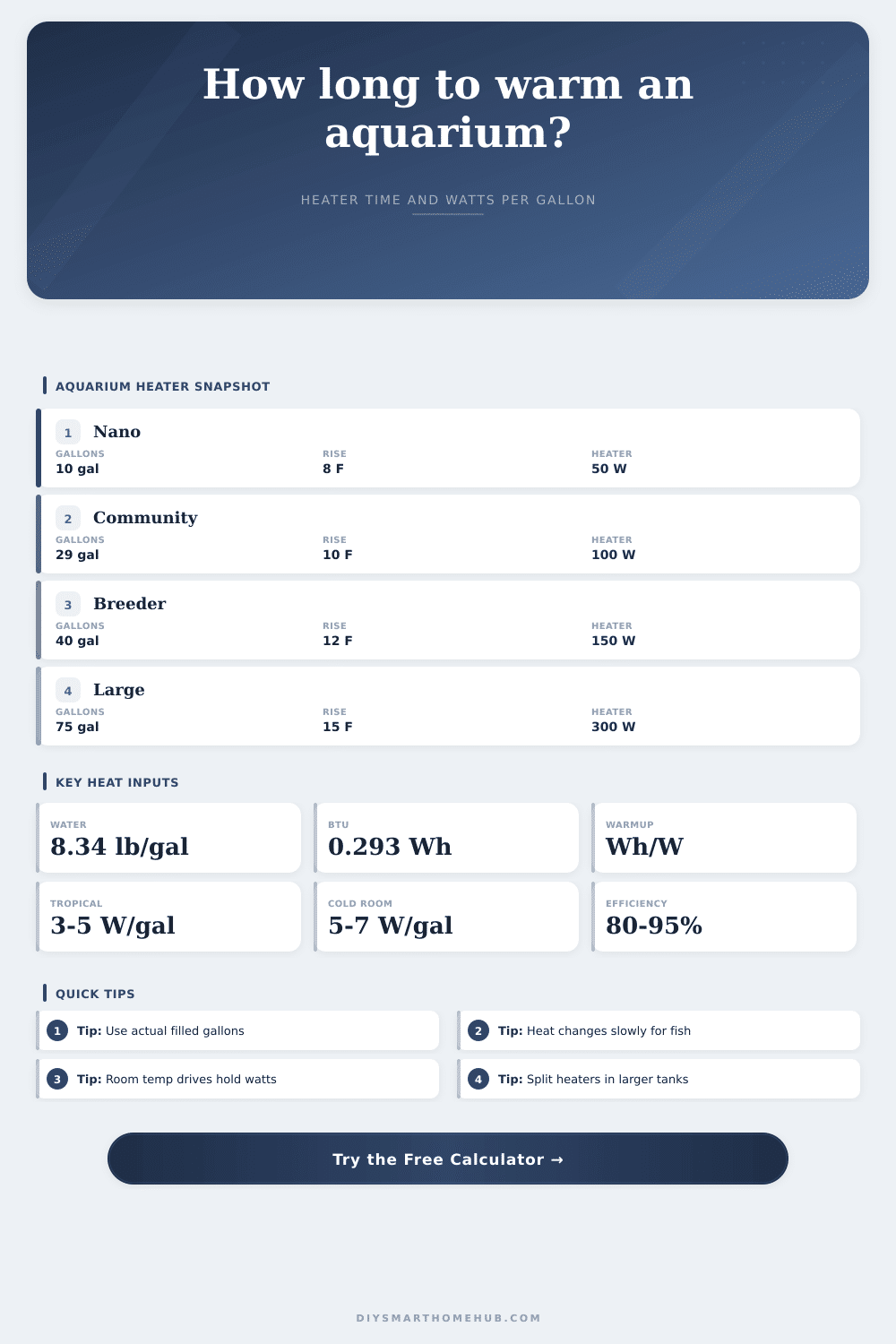
- A 3 to 5 watts per gallon rule is a practical first check.
- Maintenance watts depend on the room-to-water temperature gap.
- Glass lids reduce evaporation and heat loss.
Cool rooms or open tops
- Use 5 to 7 watts per gallon when room temperature is much lower.
- Open tops and fans raise the hold wattage requirement.
- Check recovery speed separately from steady-state holding.
📐Warmup Formula Reference
| Formula | Inputs used | Calculator expression | Result role |
|---|---|---|---|
| Temperature rise | Current and target water temperature | Target °F - current °F | Defines how many degrees the tank must gain. |
| Energy in Wh | Gallons and deltaF | Gallons x 8.34 x deltaF x 0.293 | Total heat energy added to the water. |
| Warmup hours | Energy, heater watts, efficiency | Wh / (heater W x efficiency) | Estimated time before room losses are added. |
| Maintenance watts | Top area, room temp gap, cover profile | Top ft² x water-room deltaF x 1.15 x cover factor | Watts needed to hold against room loss. |
🐟Typical Aquarium Heater Sizes
| Aquarium size | Common heater range | Normal room use | Cool room use |
|---|---|---|---|
| 5 to 10 gallons | 25 W to 50 W | 3 to 5 W/gal when covered. | Small tanks often need 5 to 7 W/gal. |
| 20 to 29 gallons | 75 W to 150 W | 100 W is common for a mild room. | 150 W adds recovery margin. |
| 40 to 55 gallons | 150 W to 250 W | Match heater output to room gap and lid type. | Two heaters can reduce cold spots. |
| 75 to 125 gallons | 250 W to 500 W | Large water mass slows warmup. | Split wattage across both ends if practical. |
🌡Room Loss And Cover Factors
| Top condition | Factor | Best match | Calculator effect |
|---|---|---|---|
| Tight lid with insulated gaps | 0.55x | Covered tanks with little evaporation. | Lowest room-temperature maintenance watts. |
| Glass lid or fitted hood | 0.75x | Most standard home aquariums. | Good default for steady holding load. |
| Partial lid | 1.00x | Open feeding gaps or rear equipment cuts. | Uses the base room-loss formula. |
| Open top with fan or dry room | 1.75x | Rimless tanks, cooling fans, dry winter air. | Maintenance watts can rise sharply. |
📋Preset Scenario Reference
| Preset | Volume | Heater | Why it matters |
|---|---|---|---|
| Ten gallon starter | 10 gal | 50 W | Small tanks respond quickly but lose heat quickly too. |
| Twenty nine tropical | 29 gal | 100 W | A common community-tank baseline for warmup estimates. |
| Seventy five cichlid | 75 gal | 300 W | Higher water mass makes the Wh formula dominate. |
| Reef quarantine tub | 30 gal | 150 W | Open-top loss can raise the hold wattage requirement. |
💡Calculator Tips
So you’ve got a new tank. You fill it up with some fresh water. You plop a heater inside. And then you sit back and stare at thermometer. Slowly, the water start to warm.
Is something wrong? Is your equipment busted? Nope, but physics is slow when it comes to water. Once you put in your desired temperature and volume for your calculation, calculator will do all the math for you (saving you from having to figure out conversions and coefficients). But knowing why it will take however long helps change the way you handle your livestock while transitioning them into your new tank.
Why Water Takes Time to Heat Up
Specific heat capacity mean water absorbs and retains heat very well. That’s the thing many folks overlook. What happens is they think adding a powerful heater will quickly increase the temperature. Nope. For example, it could take two or three hours for a 100-watt heater on a twenty-nine-gallon tank to close the gap from ten degrees. This warming up time depend on how much thermal mass there is, or how long it takes to get that water hot.
It also depends on how efficient your heaters are. Poor water circulation lowers efficiency, as does tucking the heater into a spot behind a rock where water doesn’t freely flow around it. Now consider the inputs. Remember that the label on your tank is not as important as how much water you put into it and how much of it is occupied by things like live rock, drift wood, and substrate. Fewer gallons mean a quicker warmup.
Sounds great but that’s fewer gallons to maintain thermal stability when you get to the desired temp. Big tanks don’t swing back and forth as fast. In fact, large tanks are safer because they don’t swing so much. Small tanks swings wildly when a door opens and a draft hits them.
The page shows some of these comparisons in watts-per-gallon based off comparison table. There’s a reason those size rules is there. For a comfortabley-warm-all-year round room, three to five watts per gallon is generally the rule. Got a basement with chilly walls? Do you have an uninsulated garage? More.
The calculator can be adjusted for the top cover condition and the room temperature. An open top loses heat through evaporation at a huge rate. Evaporation cools. Water leaving the tank carry away energy. So an open-top tank in a cool room may require seven watts per gallon simply to hold its temperature; never mind achieve it.
The tool’s efficiency settings hint at another smart move: split your heater wattage. Rather than running one big heater at one end of the tank, run two smaller heaters at opposite ends. Not only does this reduce hot/cold spots (the former cooks nearby fish; the latter stresses them), but it offers some level of redundancy, i.e., if one goes out, the other helps ensure the water doesn’t crash to room temp. A little thing, yes, but when you’re attempting to avoid emergency interventions at 2 AM, it matters.
Keep one thing in mind: this calculation is for the warmup phase, which is reaching the desired temp. It is not for the maintenance phase, which is maintaining the temperature. Getting there is the energy-intensive task; sustaining it is a constant burn. The calculator divide this into those two calculations. That’s why you’re seeing the big hit at first followed by the constant watts required to battle the house.
If your maintenance watts is greater than your heater capacity, you’ll never get close to the target. Instead, you’ll just barely hover under it. It might be okay if you have some hardy species, but it is dangerous for more sensitive types.
Place heaters near water flow wherever possible so they can evenly disperse the heat. If you have a heater in a dead zone, then not only is it going to stress the element but it’s cycling on and off inefficiently which wastes energy. You should of checked that first. This is accounted for with efficiency selector in the tool. If your heater reads high efficiency, then it’s doing its job. If it reads low efficiency, it means there is something obstructing your heater or the placement of your filters need some improvement.
In summary, you need patience. Patience is the least expensive upgrade you can make on an aquarium. Adding external heaters or turning up the thermostat in hopes of speeding up the warmup puts stress on them. Let the heater work as it does. How long? That’s what the math is for. Time to sit and wait.